Evolution of screw threads

I think you'll find that though he devised the 'Whitworth' thread spec in 1841, and it subsequently became fairly widely used, only later still did it become a formal national standard, 'BSW'.

And those threads will outlast all the new-fangled upstarts. By far the most significant feature is not the standard sizes, but the thread profile. Rounding off the tips and troughs to reduce corrosion and seizing.
Anecdote time....
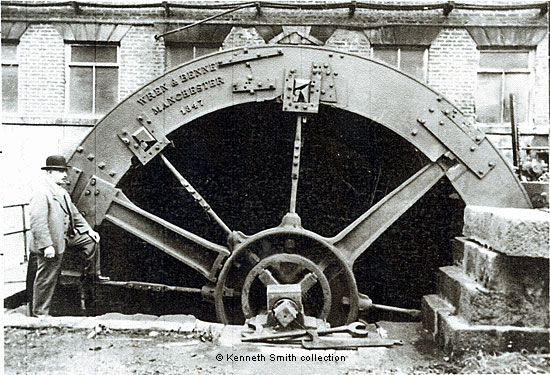
I once had the pleasure to work on refurbishing a 150 year old water wheel. Cast iron rim and steel buckets, all held together with Whitworth thread bolts slathered with red lead oxide putty. After all those years outside and submerged in water the bolts came apart with a pair of spanners. These modern upstarts of which you speak would have been less than dust on the breeze, never mind good enough to still work. :p
 
And those threads will outlast all the new-fangled upstarts. By far the most significant feature is not the standard sizes, but the thread profile. Rounding off the tips and troughs to reduce corrosion and seizing.
Anecdote time....
I once had the pleasure to work on refurbishing a 150 year old water wheel. Cast iron rim and steel buckets, all held together with Whitworth thread bolts slathered with red lead oxide putty. After all those years outside and submerged in water the bolts came apart with a pair of spanners. These modern upstarts of which you speak would have been less than dust on the breeze, never mind good enough to still work. :p


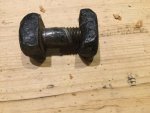
That’s mine......

We often used an impact driver windy gun to remove the bolts, as the nuts were so rusted as to be almost invisible. Here’s one of the bolts I kept. I also used BSW in the refurbishment, sadly square headed is no longer available. About 1500 bolts in total. Took a while....
 

Attachments

  • 9B607F0B-B5F3-45D7-A6DF-3F0F94531A4D.jpg
    9B607F0B-B5F3-45D7-A6DF-3F0F94531A4D.jpg
    494.3 KB · Views: 0
The most interesting place to go for some of this stuff is the Long Shop museum in Leiston in Suffolk. It was where Garrett built traction engines and boasts the first "production line" system, and they made all their parts in that way to suit that method, IIRC around the 1840's 1850's?
The earliest modern style production line was the block mill at Portsmouth, designed and implemented in 1802/3 by Marc Brunel, Isambard's father. As far as I know, that's the earliest genuine production line system, using standardized, interchangeable parts. Samuel Colt is widely credited with it for the production of guns, but he came much later (1840-ish), roughly parallel to the example you give, which I didn't know about. But both Garrett and Colt are Johnny-come-lately's compared with Brunel!

Standardized parts came along earlier; it was important to armies that firearms have interchangeable parts and ammunition, and iconic weapons like the "Brown Bess" were made to a standard pattern from about 1722 onwards. But the guns were still individually made using hand-crafted parts.
 

river_massonmillwheel1.jpg


Wow, that one had a hard life! Odds and sods of spokes and stitches all over.
 
How many people have lain awake at night wondering why there are so many screw threads? I thought so: maybe you would like to read an interesting article on the evolution of screw threads then?

https://www.philholdenfasteners.co.uk/evolution-screw-threads/

Sadly this was a topic of my Engineering Degree, Armed with a Zeus thread guide and a data book !

s-l300.jpg


there is also left handed to throw into the mix, but practical use.... Metric and some occasional imperial nonsense from the states

Another interesting but unknown piece of history is how we came to a standard electrical plug in the UK, at one point there was over 50 types up and down the county, and a gentleman invented a briefcase which could plug your appliance in from Cornwall to Scotland... the first travel adaptor, i remember reading a book about it but for the life of me cant remember his name or find anything on google about it, anyway it was ridiculous and was brought in line with the creation of "British standards" of course being British our plug had to be different from Europe and America had to do their own thing completely using a different voltage and Hertz altogether
 
How many people have lain awake at night wondering why there are so many screw threads? I thought so: maybe you would like to read an interesting article on the evolution of screw threads then?

https://www.philholdenfasteners.co.uk/evolution-screw-threads/
For my sins, I had a 5 year apprenticeship in a tool & gauge company and finished as a qualified precision thread grinder.
One of the delights of the job was to put a 'feather-edge' on the beginning of the thread, otherwise you could lacerate your hand.
Also had to produce tri-lock threads too.
 
Another interesting but unknown piece of history is how we came to a standard electrical plug in the UK, at one point there was over 50 types up and down the county, and a gentleman invented a briefcase which could plug your appliance in from Cornwall to Scotland... the first travel adaptor, i remember reading a book about it but for the life of me cant remember his name or find anything on google about it, anyway it was ridiculous and was brought in line with the creation of "British standards" of course being British our plug had to be different from Europe and America had to do their own thing completely using a different voltage and Hertz altogether

Our 13amp plug is a bit bulky but, from an electrical point of view, it's way better than most others as it allows the fuse to be matched to the appliance, so you don't have a table lamp with 0.5mm flex "protected" by the 20 amp fuse in the distribution box.
 
[/QUOTE]
i remember reading a book about it but for the life of me cant remember his name or find anything on google about it, anyway it was ridiculous and was brought in line with the creation of "British standards" of course being British our plug had to be different from Europe and America had to do their own thing completely using a different voltage and Hertz altogether[/QUOTE]

(That is interesting: I will certainly read the article)

Maybe his name is here?
https://en.wikipedia.org/wiki/AC_power_plugs_and_sockets:_British_and_related_types#Early_history
 
Last edited:
...All of which is fascinating, while adding hugely to the fog and confusion of this 'bear of little brain' when seeking to specify/order compression fittings, hose tails/connectors, 'ose and fuel filter bodies with which to build a simple fuel supply setup....

BSP? BSPP? BSPT? BSPM? NPT? Imperial? Metric.

I was introduced to the delights of competing conversions by the charming and ever-helpful Chloe, who patiently explained that a 3/8" BSP male fitting does not fit into a 3/8" ID hole without the energetic use of a Birmingham Screwdriver, and pointed me to the 'BSP/NPT IDENTIFICATION' chartlet in the rear pages of ASAP's catalogue.

Thank the heavens for Loctite!

It's at times like this when I fully appreciate the sage decisions of seasoned singlehanders such as Roger Taylor and Bill Churchhouse to do without engines and 'lecky, and just go sailing....
 
BSP is one of the most enduring of threads. An incredibly effective means of joining pipes together and relatively easy to machine.
 
I was repairing some mobile homes in France many years ago and was struggling to get a BSP fitting. Eventually found that the French taps with some fancy metric size thread quoted was actually 1/2" BSP. No more problems for a while ..............

I think BSP is an ISO standard. Obviously the French would never accept the "B" part of BSP, hence your odd metric dimensions.
 
BSP is also still a Whitworth thread form. NPT is similar with different thread angle, but same TPI below 3/8" just that it isn't 1/2" diameter, but refers to the nominal internal diameter of the pipe to which the thread is used, so this dictates also the pipe wall thickness.

Thus I can see why Metric that measures the obvious dimension is such a boon.

So if you are confused try my industry, Refrigeration. So I can buy a machine made in Germany with the main assemblies made with UNC, some electrical connections will have BSF, with very small threads BA. The tapered fittings for sealing connections will be NPT.

The terminal box cover threads will be metric, as will the sizes of any lifting eye holes.

Another German manufacturer makes everything on the machine metric, save the pipe connections (inch OD) and any tapered holes (again NPT).

Just to add further confusion, common fridge pipes refer to the OD of the pipe, in 1/8" intervals, and not the ID, and yes this is in 2018. So being ambidexterous with base dimensions becomes second place.
 
I think BSP will be around for many more years.

Quite correct as BSP has been adopted wholesale into the metric system!

https://en.wikipedia.org/wiki/British_Standard_Pipe

Extract from this page:
These standard pipe threads are formally referred to by the following sequence of blocks:

the words, Pipe thread,
the document number of the standard (e.g., ISO 7 or EN 10226)
the symbol for the pipe thread type:
G, external and internal parallel (ISO 228)
R, external taper (ISO 7)
Rp, internal parallel (ISO 7/1)
Rc, internal taper (ISO 7)
Rs, external parallel
the thread size
Threads are normally right-hand. For left-hand threads, the letters, LH, are appended.

Example: Pipe thread EN 10226 Rp 2½

The terminology for the use of G and R originated from Germany (G for gas, as it was originally designed for use on gas pipes; R for rohr, meaning pipe.)


I think the real reason for the letter codes, as alluded to in another post is so that the Europeans don't have to admit to themselves that they are using a British standard as they would if we continued to call them BSPP and BSPT.....
 
Quite correct as BSP has been adopted wholesale into the metric system!

https://en.wikipedia.org/wiki/British_Standard_Pipe

...I think the real reason for the letter codes, as alluded to in another post is so that the Europeans don't have to admit to themselves that they are using a British standard as they would if we continued to call them BSPP and BSPT.....

So it's an imperial standard within the ISO system, it doesn't have to be "metric".

Funny how our continental friends avoid the "B", but we're happy to talk about DIN plugs etc.!
 
Top