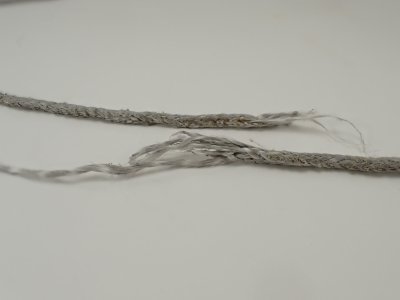
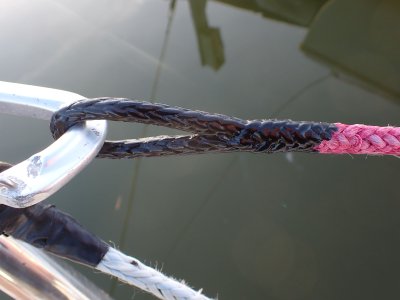
Dyneema guard 'wires'

Take to rigger, he's up a mast, wait for 30 minutes - you choose him because he's popular. You go back, to collect new wires, - that's 2 trips to the rigger (and you have learnt nothing)

Read post 14.

This is still PRACTICAL boat owner. Some of us still enjoy working on our yachts. Where are you going to draw the line - if its so cheap and easy - do it yourself. (Fortunately - its not rocket science).

Jonathan

My point is that I have never had to BOOK a rigger !! A guard wire or even a stay can be had over counter from most chandlers who have the swaging gear in the workshop .. walk in with old ... or measurements ... guy runs off the required wire from the reel ... cuts and swages ... you pay and walk out.

All the riggers I know would have a laugh if called out for a guard wire !!

Post #16 .....
 
Take to rigger, he's up a mast, wait for 30 minutes - you choose him because he's popular. You go back, to collect new wires, - that's 2 trips to the rigger (and you have learnt nothing)

Read post 14.

This is still PRACTICAL boat owner. Some of us still enjoy working on our yachts. Where are you going to draw the line - if its so cheap and easy - do it yourself. (Fortunately - its not rocket science).

Jonathan
Or use waveless fittings on stainless wire you’ve bough yourself…

3mm Stainless Steel Swageless Eye Terminal | GS Products UK
 
or your toe rail, which has nice little holes evenly spaced along its length.

Stainless wire is great until a strand breaks - and then its lethal.

You can instal dyneema without any special tools (except for a sharp knife) replacing stainless wire demands specialist equipment. You can instal Dyneema yourself - stainless wire needs a rigger, who has the right tools, you need to book his visit, maybe need to be on the boat when he does the new installation - much better making a few splices on a warm afternoon.

Jonathan
We have had the same s/s 5mm lifelines for 13 years. They are in perfect condition and no broken strands. We tie fenders to them because that is easier to do when you are moving them around as you come into a marina. The wire is 7x19 running rigging wire. They are our primary safety device when going forward at sea. We have tall stanchions bolted through the toerail that give us additional safety at sea. S/S wire is robust and reliable. The natural choice
 
Dyneema eye splice should be about 85% of the strength of the line
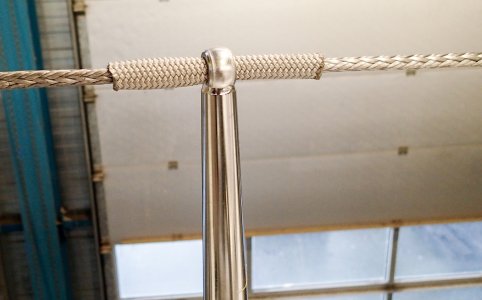
However, that is severely diminished if it’s around a tight radius like on the pulpit picture above, so a hard eye and lashing is the stronger option.
Probably both are strong enough to hang fenders on though.
 
I have a guard wire to replace on my 38 ... and considered replacing all with Dynema or Parafil .... but then checked the race rules ... the boat is 'measured' for racing and wire is stated in the 'book' .....
Just FYI, it depends on what sort of racing.

Dynema is approved for Cat 4, which is inshore day racing. It is not approved for Cat 3,2,1,0. Which are the various levels of offshore.

If you only ever want to do cat 4 stuff Dynema is fine, minimum diameters are specified for boat lengths.
 
I seem to recall people saying that the danger with dyneema guard wires is that if a sheet or line rubs (at speed) against dyneema then you have heat vs plastic which could end badly. I’m picturing a spinnaker sheet released accidentally in a breeze. Stainless better in this scenario surely?
 
Speaking as someone who has actually had dyneema guard wires (or ropes...) for over 4 years I've neither had chafe or problems hanging fenders at all during that time and they were still in perfect condition when I sold the boat earlier this year. The cost was minimal, I bought an offcut length of 6mm dyneema for £40 enough to replace all four lines, the whole replacement job was less than £100 including the pelican hooks and it still left me enough dyneema to replace some control lines on my Lark dinghy.
Each to his own I think but don't knock it unless you've tried it
 
offcut length of 6mm dyneema for £40 enough to replace all four lines
Are you certain that was dyneema and not the very similar looking but cheaper lazyjack line? Even as an offcut I can't see dyneema being even close to £1/metre. A ~40m "offcut" also seems suspicious, that's very nearly half a reel!
 
Dyneema lifelines are lighter and nicer to hang onto, particularly in very cold climates. The only real drawback we have noticed is that I think birds also prefer the feel of Dyneema to stainless steel.

Ours were professionally installed and are 8mm Dyneema with a protective sleeve as they pass through the stations. We have experienced no chafing issues.

The lines are attached at the bow with an eye splice. They are tensioned at the stern using thin Dyneema lashing.

IMG_2320~photo.jpegS
 
I've had 6mm dyneema life line on the boat for years now just cruising. Boat stored in a big shed over the winter, end September to 1st April.
Easy to make, I used SS hard eyes at pushpit and pulpit. Attached using a dyneema lashing. At the gate I use a cowhitch.
The breaking strain of SK78 is about 3,500kg.
The UTS of a 6mm SS stud is about 850kg
That's the weak point in a SS guard wire with a pelican hook.
The stanchions have sleeved hole with bell ends, so there are no sharp edges.
Easy to see if there any damage.
I happy with dyneema safety lines.
 
The patent on Dyneema has expired, which means there is now a wide variety of HMWPE lines available at reasonable prices.

Some of these "copies" are poor, but others are excellent, even arguably better than some types of genuine Dyneema, especially those manufactured mainly for commercial use.

We (my wife really) use a lot of Southern Ropes’ Stealth Super-12. Wilhelmsen’s Acera from Norway is another good brand.
 
However, that is severely diminished if it’s around a tight radius like on the pulpit picture above, so a hard eye and lashing is the stronger option.
Probably both are strong enough to hang fenders on though.
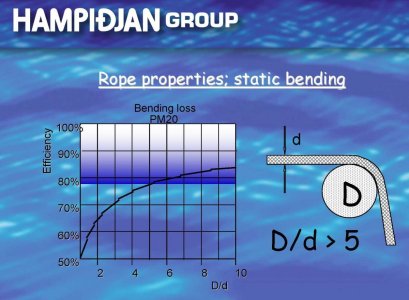
The manufacture says an eye is 100% strength (compared to infinite radius) at a D/d ratio of 1:1. I doubt the attachment points are smaller than the line.

Most common cable thimbles squash flat at full load with Dyneema, providing little improvement in D:d (tested). Only stronger, reinforced types maintain shape.

The motivation for the thimble is primarily chafe.

(50% reduction at 1:1, but an eye has two legs, so 1:1 does not weaken the eye. I also know this because I have tested many Dyneema eyes over 1:1 radius and a little less (shackles) and the splice fails at the end of the bury.)

1762956560089.jpeg

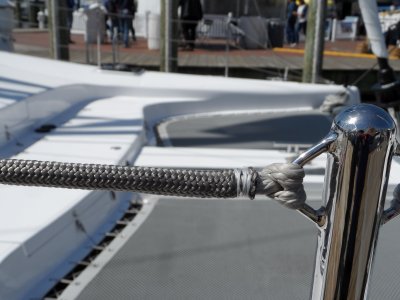
This was on a boat show Seawind. probably the most common way. The hitch weakens the line about 10% according to Hampidjan, but eliminates chafe and eases fitting. A lashing on the other end. Simple. If the radius seems concerting you can loop inside the fitting and hitch around the stanchion, which is also sometimes done.

In this case the Dyneema is also oversize to allow for sheet and stanchion wear. The end attachment still easily meets the requirements. I think we are worrying about failures that don't actually happen. Chafe at stanchions and sheet wear/burn are the issues.
1762956921450.jpeg
 
I doubt the attachment points are smaller than the line.
in both post 9 and your post the attachment point (the pushpit attachment point) is smaller than the line, that was the whole reason I brought it up. Better to splice a hard eye in the dyneema and lash to the pulpit.

As I said though, it'll still hold fenders, which is what guard wires are mostly for.
 
......
in both post 9 and your post the attachment point (the pushpit attachment point) is smaller than the line, that was the whole reason I brought it up. Better to splice a hard eye in the dyneema and lash to the pulpit.

As I said though, it'll still hold fenders, which is what guard wires are mostly for.
If you very rarely go into a marina, they mainly are for security when you go forward to set the spinnaker or pole out the genoa. We like them bar tight for this reason. I see no advantage of dyneema. I love dyneema for other applications and I love soft shackles but a big no to dyneema lifelines for me.
 
they mainly are for security
I don't consider guardwires a security thing. If that's all that's between me and the water I've already made way too many mistakes. I actually consider yachts without them to be safer as people take more care.
 
I don't consider guardwires a security thing. If that's all that's between me and the water I've already made way too many mistakes. I actually consider yachts without them to be safer as people take more care.

I tend to agree with you there ....

Years ago - I had an Alacrity 19 ... wife insisted on my fitting stanchions and guard lines ... it really made getting about the boat that little bit more awkward ...

As to the guard wires / lines ... I have never regarded them as a safety item to prevent vfalling overboard - especially after falling into a river bed off the deck of my later Snapdragon 23 triple keel boat .... boy did that hurt ...
The guard lines actually tripped me over and down I went when I was doing work on the side deck.
 
Are you certain that was dyneema and not the very similar looking but cheaper lazyjack line? Even as an offcut I can't see dyneema being even close to £1/metre. A ~40m "offcut" also seems suspicious, that's very nearly half a reel!
I can promise you it was 'proper' dyneema, bought from a supplier with whom I've done regular business over the years.
I also very recently bought 68 metres of 6mm for £70 for my new boat, it's out there if you're not in a desperate hurry to buy. (I confess I've never heard of 'lazyjack line')
 
in both post 9 and your post the attachment point (the pushpit attachment point) is smaller than the line, that was the whole reason I brought it up. Better to splice a hard eye in the dyneema and lash to the pulpit.

As I said though, it'll still hold fenders, which is what guard wires are mostly for.
And there is always the matter of whether the attachment loops are completely sound. Is there an incipient crack? A lashing the weaves through the attachment loop and around the stanchion will be strong and won't move. A smart way.

And yet we would not worry about the loop if fitting stainless wires. Ironic.

---

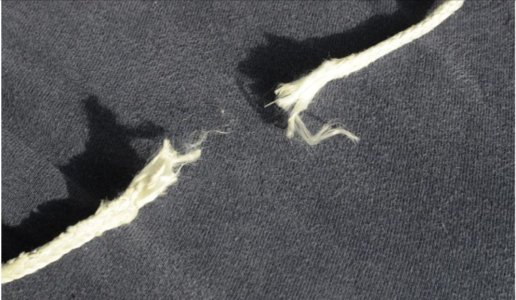
But the issue is still chafe in the stanchions, not the attachments. I have not heard of a documented case of the ends failing. I know numerous cases of chafe at stanchions or from sheets. I have some Dyneema lifelines, and it's not the ends that chafe. It is where things rub against them. Covers help. Coatings help.

Stanchion chafe.
1762962270983.jpeg

Sheet chafe.
1762962329743.jpeg

There are both thick dip coatings for the ends (black) and thinner coatings applied to the length (soaking, like dying, is the best application method). Both can easily triple the life expectancy of the line. They do stiffen it slightly. I've been experimenting with these for about 20 years. The red is Yale Maxijacket over Chineema. The black I'm not sure, a vinyl product I think.
1762962629591.jpeg
 
Top