Galvanic corrosion - cleaning up, a question for metallurgists or chemists

jlavery

Well-Known Member
Joined
25 Oct 2020
Messages
759
Visit site
I'm sorting out the galvanic corrosion problem where stainless fittings were fitted to the aluminium toerail of my Sweden 340 - I assume at time of manufacture.

Either the insulation between the two metals has finally broken down, or it was never there...

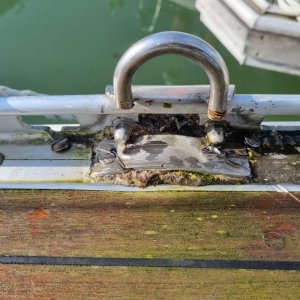
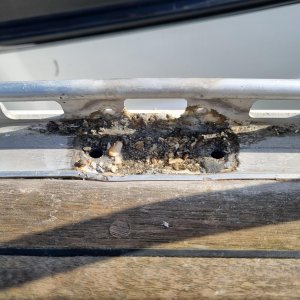
Anyhoo. The results are massive corrosion, resulting in the toerail being eaten away completely under the fittings. See photos.

I'm planning to clean up the hole, fill with epoxy, and then reinforce with aluminium plates over the top. I'll be using Duralac to insulate between the machine screws and the new plates.

My question is - apart from elbow grease and a wire brush, is there a solvent/chemical which will remove the corrosion to leave a clean surface ready for epoxy? Note that the grp deck is exposed where the corrosion has gone all the way through, so whatever I use mustn't damage the gelcoat below.
20260225_104802.jpg

20260225_112436.jpg
 
I am struggling to understand what these photographs show. It does not appear to me that this is galvanic corrosion. Why is the stainless steel so distorted? Is that a crack at left?

I would do nothing other than mechanical removal.of the deposit.
 
Well whatever it is, it's developed in the stainless/aluminium interface, and there's no aluminium left. The product has expanded and bowed the stainless. The photo is half way through angle-grinding the fitting off. The bulge had started to crack one fitting.
 
I'd instal new toe rails. You don't say how extensive is the damage - maybe you can salvage a lot of the original toe rails and only need to replace short sections (but finding a matching toe rail might be difficult - hence replace the lot.

The product of corrosion is inert, afaik. You need to take the toe rails off, cut out the corroded portions and see if you then have anything salvageable. I suspect the damage is too extensive and completely replacing the toe rails is the answer (even if its not a very attractive proposition).

Jonathan
 
I am struggling to understand what these photographs show. It does not appear to me that this is galvanic corrosion. Why is the stainless steel so distorted? Is that a crack at left?

I would do nothing other than mechanical removal.of the deposit.
Looks like the corrosion grew, applying a LOT of force to the stainless. Maybe. Not unheard of. Concrete rebar corrosion blows concrete apart.

Mechanical removal. Some final cleanup with lactic or citric acid would help. These are relatively mild towards aluminum.

I think the crack is a demo saw cut.

---

Impressive. It's hard to see how deep the corrosion went. I would not reinforce the aluminum. I would make the SS base considerably wider, spanning the weakened area by a margin.
 
So citric acid is one suggestion, thank you. I'm planning to put aluminium plates over the damage, and use these in place of the stainless pad eyes.

Replacing the toe rail isn't practical.

Toe-Rail-1019957437.png
 
So citric acid is one suggestion, thank you. I'm planning to put aluminium plates over the damage, and use these in place of the stainless pad eyes.

Replacing the toe rail isn't practical.
Absolutely, you'd have to take an unreasonable amount of interior joinery apart, plus a hell of a lot of other work.
 
Looks like the corrosion grew, applying a LOT of force to the stainless. Maybe. Not unheard of. Concrete rebar corrosion blows concrete apart.

Mechanical removal. Some final cleanup with lactic or citric acid would help. These are relatively mild towards aluminum.

I think the crack is a demo saw cut.

---

Impressive. It's hard to see how deep the corrosion went. I would not reinforce the aluminum. I would make the SS base considerably wider, spanning the weakened area by a margin.
Common with steel rebar, where the corrosion product (rust) has greater volume than the steel. Not the case with aluminium corrosion product: I have never seen an example like this. I think there is something else going on here, not just galvanic corrosion. There are millions of examples of stainless steel fittings on aluminium in marine environments but this appearance is rare.
 
Common with steel rebar, where the corrosion product (rust) has greater volume than the steel. Not the case with aluminium corrosion product: I have never seen an example like this. I think there is something else going on here, not just galvanic corrosion. There are millions of examples of stainless steel fittings on aluminium in marine environments but this appearance is rare.
I was wondering about that - many examples of stainless/aluminium which work. A friend with, I think, a Starlight has spotted the start of the same problem.

A bit academic now. More focussed on the remedial work.
 
You will find it very difficult and dangerous to dissolve the products of the corrosion. I would not try. Your best solution is to grind down to bare metal. To dissolve Al2O3 or AlOH - needs highly concentrated acids, hydrochloric, sulphuric or hydrofluoric acid or caustic soda, heated and time - preferably done in a fume cabinet with a full hazmat suit, goggles etc. I don't know where you are based but if in the UK you will find it difficult to source acids strong enough. Citric acid is good on rust and in soft drinks to polish threepenny bits - don't waste your time.

Jonathan
 
I would be inclined to cut out the lower section with a Dremel and TIG weld in a plate and rather than use a stainless fitting use a soft shackle to hold a low friction ring. Any strong acid or alkali with attack and remove the aluminium oxide / carbonate. but I would be wary of using it just use a brass wire brush and water.
 
I would be inclined to cut out the lower section with a Dremel and TIG weld in a plate and rather than use a stainless fitting use a soft shackle to hold a low friction ring. Any strong acid or alkali with attack and remove the aluminium oxide / carbonate. but I would be wary of using it just use a brass wire brush and water.
Toe rails are often part structural, contributing to holding deck to hull. I don't see how it would be possible to weld without taking the toe rail off and this is deemed not possible. Simply a toe rail with the level of damage in the images raise questions about structure integrity.
 
Toe rails are often part structural, contributing to holding deck to hull. I don't see how it would be possible to weld without taking the toe rail off and this is deemed not possible. Simply a toe rail with the level of damage in the images raise questions about structure integrity.
Any structural component will be minimal and longitudinal stiffening and deck to hull joint will remain very much unimpaired as it's a small section with deck to hull joints unaffected. A patch can be TIG welded and whilst the weld will not be perfect it will provide some longitudinal continuity to the rail. There will be an amount of heat transfer and some scorching to the deck below but nothing like as much as conventional welding and if done in sections should be OK particularly if the teak is wet / damp below the patch.Replacing the U bolt with either one or two soft shackles moved away from the repaired section will complete the process.
 
Any structural component will be minimal and longitudinal stiffening and deck to hull joint will remain very much unimpaired as it's a small section with deck to hull joints unaffected
Agreed.

What is this fitting loaded by ?

Never seen corrosion products causing such distortion, but I have seen ice do something similar, you aren't in an extremely cold place are you ?

It looks to me more like applied load caused distortion of the base. add a ruler to the photo, can't tell how thick the baseplate is.

Are you sure the toerail hole is caused by corrosion? not that you are seeing a slot cut in the toerail at time of build to allow the fitting to transfer load to the hull directly, not through the toerail.

Do you have internal access to the cut off fasteners, were they bolts or coach screw type fasteners
 
I was wondering about that - many examples of stainless/aluminium which work. A friend with, I think, a Starlight has spotted the start of the same problem.

A bit academic now. More focussed on the remedial work.

It isn't 'academic', you really need to find the cause and stop it happening again.
 
Summarising comments....

The applied load didn't distort the base. The first photo was taken after I'd cut the u-bolt legs off. The load is transferred from the u-bolt to the toe-rail via the horizontal bolts through the side, and the vertical bolts (already cut off in the photo). The toe-rail itself is not distorted by the loads.

The loads are not massive - from check-stays and spinnaker sheets/guys.

The toe-rail was continuous under the fitting, no intentional hole.

Yes, I agree it's structural - but only two bolts out of (lots) are affected along the length of the toe-rail. The bolts go through to the underside of the deck, accessible below with headlining off.

So I think filling the void and putting an aluminium plate over the top, through-bolted to the underside in the same manner as the original bolts, should be fine.

I'm going to just wire-brush, clean and dry the void before filling.

Thanks for all the input, various contributors.
 
Top