Dream Boat Has Osmosis, What to Do?

The osmosis just adds to the workload.

So basically if I can negotiate enough to pay for all or most of just a professional sand/grind down, I'll do that next winter and be done with it. Then I can get on with everything else it needs.
Of course that would require me to do all of the painting to build it back up. But I should be in better shape by then and of course I can't ask him to pay for the full job for the price I'm getting.

There really is no need to do that. 20 years ago that was the "done thing" and hundreds of boats went through the treatment, mainly because a boat became unsalable at any hint of the "O" word - and boats were worth comparatively more money. That is not the case now. 40 year old boats are almost worthless now - selling typically for less than 10% of their replacement cost. Almost nobody does strip and replace gel coat now - not least because it almost always fails in a few years.

Follow the good advice given by many experienced people here - just patch as you go along. Patching will have no effect on the value or potential life of the boat nor alter the enjoyment you get from it. Concentrate on the things that are important for the safety and usability of the boat.
 
What kind of mask is recommended? I sanded a day with my hand sander before applying antifouling and was pretty sick for several days after. I had a charcoal/cotton cheap mask (3 for 5 Euros) and apparently it did little. ....

I know a little of this, not least 'cos I did my research. The standard you require is 'FFP3D'. Nothing less. These are readily available at most chain builders' merchants, now that the Covid panic buying is largely over.

I also bought 'Force 8' masks from JSP ( JSP | Above The Neck PPE Safety Products ) when the first news broke of Covid spreading in Northern Italy. My wife had trained/worked as a microbiologist, and knew this pathogen would probably develop as an 'airborne vector', so we decided that 'better safe than sorry' while it was still possible for citizens to buy. I also bought several boxes of simpler - but still FFP3D - masks. We've used about half of them, and the others will be used when sanding down the boat hull and wood.
 
Where I agree mostly with Tranona ... I have to say :

The problem was that in the 'Heyday' of Osmosis paranoia ... too many numpties jumped on the moneywagon ... offering strip then Osmosis coating. Many of which had little real understanding and also relied on the often recc'd crap Meter ! It was little better than a Wall Detector meter - but well known names who even wrote books - recc'd it.

So we have a large number of poor knowledge people offering treatment ... supposedly drying out the hulls ... using that 'crap' meter ... you've all seen it ... square needle jobbie looks like an Ammeter .. I'll refrain from actually naming it !! Slapping on Epoxy and then charging a bumdle.

Few years down the line - just so happens warrantys probably just run out ... bingo - blisters again.

BUT there were people whop could actually do the job well .... you could have a blister free boat for reasonable number of years ... but you had to 'pay for it'

Example of 'numpty' job ....

I bought a Snapdragon 23 triple keel of a guy who's wife was moaning about it occupying drive at home. It had been Osmosis treated - based on a yard advisory ... guy paid a reasonable sum for the job.

This was about 3 years before I bought. Boat had only had 1 season in water during those 3 years. Bottom looked OK .. but I could tell she had a few small areas of micro-blisters - absolutely nothing to worry about ... but what I did not like was the Osmosis coat that had been applied.

Cash changed hands ... boat was trucked out to pal of mine who ran a decent Boat Workshop ... we both surveyed that underhull ... sighs and clucks as we went along. Once we started applying a scraper - the osmosis treatment started to literally onion peel in places .......... and was obviously Polyester based - not epoxy.
We found out what it was ... a 'Marine branded' version of Polyester Gel Coat sold for DIY blister work.
It was also obvious that they had only sanded the hull to get a 'clean' surface to coat.

The Yard is a famous one on South Coast ... which I shall not name - but just say - if you want such work done - don't trust anyone else to visit and check up on the job ... CHECK IT YOURSELF as job progresses.

We took blaster to it ... and then gave it two coats of OsmoGuard ................. years later sold her on completely free of any those blisters ..

Final : Not same boat - but I checked out many boats over years for people buying ... Insurance etc. My Meter was so sensitive - I told one guy where his 'water damaged' ply bulkheads were in his boat - from exterior hull readings. Been called in by owner who was having trouble with a yard and 'their pet surveyor' ... they reckoned hull was dry ... my meter went off scale !! Found out hour or so after - they needed the shed space for another job !

Like every 'money spinner' - too many fly-by-nights got in on the act and ruined the market. Please do not think I am trying to justify high prices ... no way ... just passing on some things about it
 
I know a little of this, not least 'cos I did my research. The standard you require is 'FFP3D'. Nothing less. These are readily available at most chain builders' merchants, now that the Covid panic buying is largely over.

I also bought 'Force 8' masks from JSP ( JSP | Above The Neck PPE Safety Products ) when the first news broke of Covid spreading in Northern Italy. My wife had trained/worked as a microbiologist, and knew this pathogen would probably develop as an 'airborne vector', so we decided that 'better safe than sorry' while it was still possible for citizens to buy. I also bought several boxes of simpler - but still FFP3D - masks. We've used about half of them, and the others will be used when sanding down the boat hull and wood.

OK Great. Thanks for the suggestion.
You just saved me a 'research project' ?

Just ordered a JSP Force 8, and a two pack of Press to Check P3 Dust Filters.
Hopefully when I do my 'quickie repair' to get me through summer, I won't be sick for a week this time!
After *that* experience I figure whatever work I do on the boat, these will be well worth the investment.


BUT there were people whop could actually do the job well .... you could have a blister free boat for reasonable number of years ... but you had to 'pay for it'

We took blaster to it ... and then gave it two coats of OsmoGuard ................. years later sold her on completely free of any those blisters ..

Right. So paying good money for the job is a risky affair. You may or may not get a real quality job.
Which also supports so many views here that it's not worth the payout. Especially when boats seem to need so much other often costly attention, where your money will make a real difference.

And if you do go the big money route, check progress yourself. Verify you're getting the quality work and materials you're paying for.
Got it. Thanks!


Depending on what you have to remove and where, here are another couple of suggestions for useful tools - countersink drill bit and Bahco scraper - the one with the ball on the end...

That Bahco looks like you could get a lot more leverage than a standard chisel style scraper.
A lot more 'horsepower' for the job ;-)
I assume that's for removing antifouling?
 
I can attest that the Bahco 665 scraper is a very effective tool and saves a lot of time and effort over other scrapers. However, do grind the very sharp corners of the blades into innocuous round shapes. That prevents the tool digging deep into the gelcoat and layup, creating 'oles which must be filled and re-sealed..... thereby negating the time and effort otherwise saved.
 
You do not mention how big the boat is. If it is large e.g. 40ft then removing lots of old antifouling is very tiring. Lots of yards no longer allow sand or soda blasting due to the mess. However you could try dry ice blasting. Dry ice is frozen CO2, so the only residue is the paint. Gransden Construction Ltd, who exhibited at the Southampton Boat Show last year, have a number of machines and will travel to your boat. Cost does depend on distance and size. I have seen the results on a 40 ft motor boat and know of several others in my marina who have booked them for this autumn as soon as they are lifted out. It is a lot cheaper and quicker with less gel coat damage than employing someone with a scrapper.

Gransden Construction Ltd
Contact Andrew Phillips
01795 478487
07749 384953
dib@gransdens.com
Marine Dry Ice – Gransden Construction Ltd

They are based in Sittingbourne, Kent. I have no connection to the company but have met Andrew on a couple of occassions and discussed the whole process. He is quite happy to group a number of boats together to split the travel costs. Also my local man who does boat maintenance now uses them as it is more cost effective than spending a week or more scrapping antifouling off.
 
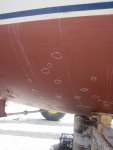
My boat broke out in spots ( first pic gives an idea of density and size - not so much boils as carbuncles ) when she was 25 years old. I considered that it was worth sailing back to NZ to get them sorted. Total strip , dried out with Heatvac system, and rebuilt with vinyl ester.
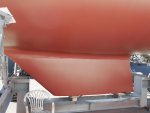
I considered it was money well spent ( 2nd pic).

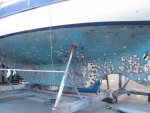
The owner of this HR thought it was too dear and then payed someone almost as much to do the job seen in the third pic .

What a lot of people call osmosis is really just polyester pimples.
 

Attachments

  • IMG_0220.jpeg
    IMG_0220.jpeg
    248 KB · Views: 39
  • P1190555.jpeg
    P1190555.jpeg
    266.7 KB · Views: 42
  • IMG_1994.jpeg
    IMG_1994.jpeg
    366.6 KB · Views: 40
If you don’t boat during the winter take the boat out of the water for 6 months every year , that will half the time it takes to get any worse, also keep the bilges bone dry when ashore and afloat as it’s been suggested that water vapour can actually pass through the hull , but this can’t happen if the bilges have water in them ,
 
Just a thought: to make a good key for filling a ground out blister, what if you use a router with a (tapered) dovetail jointing bit? You could go round the edge undercutting the edge, slightly, and not very deep, so your repair would be secure mechanically.
In re my buoy collision it should be noted that my hull was built to SFIA standards in 1976. They were a bit over the top, thankfully. Hull about 12mm topsides, with top hat frames @ 400mm centres, plus deck beam support horizontal stringer. Had there been a bulkhead nearby, it might have folded and broken the hull round it.

Things can be too strong. French FV used to have frame tops (stanchions) much smaller and less frequent, so if there was a bang it just broke the tops off, and not below deck.
 
Things can be too strong.
During the era of working sail gear was know, even expected, to fail when overloaded. Clew-sheets, halliards, spars, topmasts.....
It was part of a bosun's job to use what he had with sound judgement so that, when overwhelmed by a squall, breakages were 'progressive' such that the minimum damage resulted....and such that repairs were practicable when conditions allowed.

We see a remnant of that know-how in today's 'fuses' - strops of known breaking strain securing clews and tack fittings, protecting far more expensive gear from destruction.
 
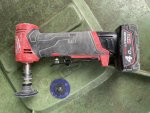
If you want to have go at the blisters yourself get one of these ,it’s a fantastic tool I bought it to do blisters ,you need to get a roloc holder and some 40 /60 grit discs available from eBay , wish I had bought it years ago I’ve used to on so many things it’s unreal , anyway back to the blisters if it was me I would wait till the end of the season assuming your using the boat this year, then strip all the an old anti foul use 1.5” chisel sharpened on upturned belt sander works great ,round the corners of the chisel off this stops gouging chunks out of the hull wear proper mask , then grind out all the blisters you can see , if you really want to find lots wait till the day when’s sun is low wet the hull with hose and you will see the ones you have missed , when done as many as you can see scrub the hull with water pref hot if can, and every time you go to the boat wash blisters out , then next year fill them ,if hull is thin and blisters are deep you might need to put fiberglass mat back into them but you will prob get away with just filling , you first need to re sand the blister again lightly, wipe with Acetone ,prime with some solvent free epoxy wait till it’s gone tacky and fill the depression with some international water tite filler then when dry paint some penguard or some other epoxy paint onto the repair , then prime the hull with primercon anti foul and wait till next year and find few more , or do absolutely nothing and go sailing, I wouldn’t think about getting it done properly, they only guarantee it for something like five years , that’s crazy for job that’s cost 15k , my uncle had done and it came back , and like I said before keep bilges dry , and have boat out water at the end of the season each year 4B4C5E9B-6820-405B-A0B0-59A323B98C22.jpeg
 
Well we came to another price a little lower. The spots that were poked open to verify the osmosis are being sealed off as a temporary repair to get me through the season until I can pull her out again in winter and fix them right. At least I'll get some season in. And I'll get my dream boat!

I hope this sailing season gets me in a little better physical condition because however you slice it come winter there will be a lot of work to do. Which is fine. Much of it I look forward to as a hobby.

By the way I've heard that newer boats that were 'laid up' correctly when built don't get osmosis. Is that true?
So if the resin is mixed right you don't get these problems ever?
 
Well we came to another price a little lower. The spots that were poked open to verify the osmosis are being sealed off as a temporary repair to get me through the season until I can pull her out again in winter and fix them right. At least I'll get some season in. And I'll get my dream boat!

I hope this sailing season gets me in a little better physical condition because however you slice it come winter there will be a lot of work to do. Which is fine. Much of it I look forward to as a hobby.

By the way I've heard that newer boats that were 'laid up' correctly when built don't get osmosis. Is that true?
So if the resin is mixed right you don't get these problems ever?
Many congrats and enjoy your sailing. Now you have to tell us what she is & post some pics...(y)
 
By the way I've heard that newer boats that were 'laid up' correctly when built don't get osmosis. Is that true?
So if the resin is mixed right you don't get these problems ever?

Combination of improvements in materials - particularly resins and manufacturing processes. If you had seen how hulls were laid up in the good old days you would not be surprised about seeing such failures. Poor resins (not a criticism they were what they were) that were not waterproof and poor laminations that led to uncured styrenes in the laminate plus voids and resin starved areas that allowed fluid to migrate through. The blister you see are the result of the styrenes getting to the surface - you will find a distinct vinegar smell when you pop big ones. The stripping off and replacement of the gel coat with a more waterproof one does not necessarily deal with the basic problem of the poor laminates, hence the common failure after a few years.

The improved materials and techniques came in during the 1990s and the issue has now largely gone, together with the repair industry as the number of boats where it is even vaguely economic has shrunk. In its heyday 20 years ago the industry was dealing with boats as young as 10 years old. I remember a friend's boat from one of the top builders requiring stripping at around 20 years old and the whole area between the 2 keels falling apart like cardboard to the extent that the repairer had to mould a whole new section, plus cutting out the floor from the internal moulding. The work cost as much as he paid for the boat.

However the reason most old boats survive is because the layups were over thick, so lots of material is still sound enough to keep the boat together. So the advice to just deal with the blisters as they come up is sound
 
Yes, chap worked at Cygnus marine...."Did we put catalyst in that pot...or not?"
Seafish hulls had to have clear gel bottom, and any visible voids were treated with a hyperdermic. Mine was such, but still riddled after ten years or so.
There was something about styrene gas sitting in the mould affecting the cure, for better or worse don't know, but then H&S insisted on blown ventilation. Some moulds were used upright, but some were done in two halves so the gas drained, until they were stuck together.
When they moulded the fast boats later they tried to skin down materials to keep the weight down, while still sticking to Sea Fish regs. No point in a FV, we always carry too much spare cra.....equipment. Result was lots of HP needed, which was fine til the fuel went up.
When I got a 26ft, 188hp boat, fuel was 9p.....
 
Top