Does a Bowthruster create too much drag

Or buy a retractable bow thruster in the first place
I saw a couple of new boats with retractable bow thrusters at the Toronto boat show a few years back. They looked very neat and could be a good solution. Only concern would be the complication of yet more things that could go wrong under water coupled with 'Sods Law' and its many variations.
Might be a major undertaking to retrofit.
 
No. I've had one for 13 years, with a proper eyebrow to streamline it. I often sail under genoa alone because of three canine crew and not infrequently outpace similar sized boats under full sail.
That is a very good point. My own thruster has no eyebrow and the tube was just cut to fit the hull. Best practice to minimise drag seems to be to cut the tunnel so that it projects outside the hull at the front by an inch or so, and is then faired to the hull.
Despite the above my own boat with a fairly small masthead rig relative to its size and displacement seems to go better than a lot of similar sized boats.
 
I made a drop down stern thruster for my boat using the side shift thruster set up on a home made swing down bracket.
Went that route as i didnt want the drag and didnt really have the depth in the bow for a decent thruster.
Pretty pleased with the set up, swings up out of site on the sugar scoop and obviously as its not in the water there is no drag and powerful when needed. Wouldnt work for everyone or be to everyones tastes but works well on my boat for me single handing a twin rudder set up.
 
I think there is a market for Drop-down/Lift-up and out of the water bow thruster. There is an American model that lifts out of the water, with an integrated battery, not sure how popular that model is.
 
Last edited:
I made a drop down stern thruster for my boat using the side shift thruster set up on a home made swing down bracket.
Went that route as i didnt want the drag and didnt really have the depth in the bow for a decent thruster.
Pretty pleased with the set up, swings up out of site on the sugar scoop and obviously as its not in the water there is no drag and powerful when needed. Wouldnt work for everyone or be to everyones tastes but works well on my boat for me single handing a twin rudder set up.
I did similar but with a fully demountable stern thruster, pretty much an electric outboard but home-made. Drop it in to use, pull it out on a tackle and stow it. I made both thrusters proportional and continuous which makes single-handed docking or leaving in any conditions a doddle. Spinning in your own length or going sideways off the fuel berth just for the fun of it always raises eybrows.
 
I was chatting to some friends over a beer in a taverna. The subject turned to bow thrusters. I mentioned that when I was looking for another boat I walked away from boats with bow thrusters because anyone who installed one had no soul and the boat was dying of shame (Nicholas Monsorate). One of the Guys slapped the table with his palm so hard that the beer bottles bounced on the table. "Exactly what I think" . This exchange was remarkable because none of the beer bottles fell off the table.
 
I did similar but with a fully demountable stern thruster, pretty much an electric outboard but home-made. Drop it in to use, pull it out on a tackle and stow it. I made both thrusters proportional and continuous which makes single-handed docking or leaving in any conditions a doddle. Spinning in your own length or going sideways off the fuel berth just for the fun of it always raises eybrows.
Interesting, I couldn't find an electric outboard powerful enough to convince me it would work, any details or pictures to compare against my set up. After spending so long researching options I find it quite a interesting subject.
 
Interesting, I couldn't find an electric outboard powerful enough to convince me it would work, any details or pictures to compare against my set up. After spending so long researching options I find it quite a interesting subject.
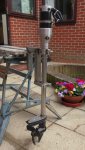
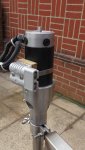
A couple of pics attached.

It's basically the gearbox and prop of a Mariner 2hp outboard (no neutral gearshift, fixed drive) plus driveshaft married to an Ampflow 2HP 24 volt DC motor, F30-400 with some machining plus fabricating/welding the mounting. There's a 50mm square socket on the bathing platform for it to drop into so it can't pivot, but the unit can be rotated to any selected angle- usually athwartships and it can be tilted up if necessary. The electrical connection is via an Anderson connector, the power lead being stored inside the small hatch by the stern for the cockpit shower.

Three-Inch High Performance Motor

2.5hp, could have gone higher but didn't want to overstress the gearbox I had. Fully reversible. It's proved ample. Having built it in 2016 I then uprated the Sidepower bow thruster I'd installed in 2007 to use an Ampflow 24v 4hp reversible motor so I could add a 4QD speed controller to make it continuous and proportional - its Mosfets don't work reliably down to 12 volts or less so the old motor couldn't be made proportional. I wanted it to be able to run constantly at no more power than needed while I handled lines etc, rather than brief full blats then falling off the wind again . When that succeeded the final step was to add another (smaller) speed control to the stern thruster and some switching and pots at the helm.

One advantage of using 24 volt motors is reduced current. Another is that they can also run on 12v at reduced power without a speed controller. I have all three options, controller, 24v or 12v so there's a redundancy in the event of system failure.

Between them they give total control. I'd found that even with a bow thruster the boat had so much propwalk astern before the rudder can take over that a stern thruster was an obvious solution for tight spots.
 

Attachments

  • S1650001 revised.jpg
    S1650001 revised.jpg
    826.3 KB · Views: 76
  • S1650002 revised.jpg
    S1650002 revised.jpg
    643.3 KB · Views: 75
Last edited:
A couple of pics attached.

It's basically the gearbox and prop of a Mariner 2hp outboard (no neutral gearshift, fixed drive) plus driveshaft married to an Ampflow 2HP 24 volt DC motor, F30-400 with some machining plus fabricating/welding the mounting. There's a 50mm square socket on the bathing platform for it to drop into so it can't pivot, but the unit can be rotated to any selected angle- usually athwartships and it can be tilted up if necessary. The electrical connection is via an Anderson connector, the power lead being stored inside the small hatch by the stern for the cockpit shower.

Three-Inch High Performance Motor

2.5hp, could have gone higher but didn't want to overstress the gearbox I had. Fully reversible. It's proved ample. Having built it in 2016 I then uprated the Sidepower bow thruster I'd installed in 2007 to use an Ampflow 24v 4hp reversible motor so I could add a 4QD speed controller to make it continuous and proportional - its Mosfets don't work reliably down to 12 volts or less so the old motor couldn't be made proportional. I wanted it to be able to run constantly at no more power than needed while I handled lines etc, rather than brief full blats then falling off the wind again . When that succeeded the final step was to add another (smaller) speed control to the stern thruster and some switching and pots at the helm.

One advantage of using 24 volt motors is reduced current. Another is that they can also run on 12v at reduced power without a speed controller. I have all three options, controller, 24v or 12v so there's a redundancy in the event of system failure.

Between them they give total control. I'd found that even with a bow thruster the boat had so much propwalk astern before the rudder can take over that a stern thruster was an obvious solution for tight spots.

Fantastic job.

And no drag when sailing.
 
A couple of pics attached.

It's basically the gearbox and prop of a Mariner 2hp outboard (no neutral gearshift, fixed drive) plus driveshaft married to an Ampflow 2HP 24 volt DC motor, F30-400 with some machining plus fabricating/welding the mounting. There's a 50mm square socket on the bathing platform for it to drop into so it can't pivot, but the unit can be rotated to any selected angle- usually athwartships and it can be tilted up if necessary. The electrical connection is via an Anderson connector, the power lead being stored inside the small hatch by the stern for the cockpit shower.

Three-Inch High Performance Motor

2.5hp, could have gone higher but didn't want to overstress the gearbox I had. Fully reversible. It's proved ample. Having built it in 2016 I then uprated the Sidepower bow thruster I'd installed in 2007 to use an Ampflow 24v 4hp reversible motor so I could add a 4QD speed controller to make it continuous and proportional - its Mosfets don't work reliably down to 12 volts or less so the old motor couldn't be made proportional. I wanted it to be able to run constantly at no more power than needed while I handled lines etc, rather than brief full blats then falling off the wind again . When that succeeded the final step was to add another (smaller) speed control to the stern thruster and some switching and pots at the helm.

One advantage of using 24 volt motors is reduced current. Another is that they can also run on 12v at reduced power without a speed controller. I have all three options, controller, 24v or 12v so there's a redundancy in the event of system failure.

Between them they give total control. I'd found that even with a bow thruster the boat had so much propwalk astern before the rudder can take over that a stern thruster was an obvious solution for tight spots.

This is why these forum are still so great, I absolutely love what you have built there.
I did so much research and spent so much time researching options as I really did not want to fit a bow thruster but I really needed something as single handing a twin rudder with a lot of prop walk in some very tight harbours could get a little too exciting.

I think you have a great solution, I don't think its something I could have done as my electrical knowledge is lacking.
There are a couple of ideas I may rob off you though, I looked for an easy to take apart connector but struggled at the 450amp rating of my unit but the Anderson connector looks great.

Also like your attachment method (50mm socket) I was thinking similar but as I could not find a connector that suits I made mine a semi permanent bracket albeit a prototype. I think I will this year get a Anderson connector fitted and mod my bracket to make it easier to pop the thruster on and off.

As to my thruster I have also been pleased with it, its 5hp so enough to make you have to steady yourself when I give it a kick, only slight downside is its limited to 30 sc bursts with 10secs cool down but it pushes that hard that that suffices..
I can deploy it in about 5 secs and lift it back up in 5 secs, no drag and looks quite tidy tucked away.

So this winter I will fit a connector and fabricate a lovely shiny stainless bracket.
Hope this helps others as I spent so long researching and basically found nothing so it was all a bit of a gamble but im pleased with it.
 
This is why these forum are still so great, I absolutely love what you have built there.
I did so much research and spent so much time researching options as I really did not want to fit a bow thruster but I really needed something as single handing a twin rudder with a lot of prop walk in some very tight harbours could get a little too exciting.

I think you have a great solution, I don't think its something I could have done as my electrical knowledge is lacking.
There are a couple of ideas I may rob off you though, I looked for an easy to take apart connector but struggled at the 450amp rating of my unit but the Anderson connector looks great.

Also like your attachment method (50mm socket) I was thinking similar but as I could not find a connector that suits I made mine a semi permanent bracket albeit a prototype. I think I will this year get a Anderson connector fitted and mod my bracket to make it easier to pop the thruster on and off.

As to my thruster I have also been pleased with it, its 5hp so enough to make you have to steady yourself when I give it a kick, only slight downside is its limited to 30 sc bursts with 10secs cool down but it pushes that hard that that suffices..
I can deploy it in about 5 secs and lift it back up in 5 secs, no drag and looks quite tidy tucked away.

So this winter I will fit a connector and fabricate a lovely shiny stainless bracket.
Hope this helps others as I spent so long researching and basically found nothing so it was all a bit of a gamble but im pleased with it.
Many thanks, most kind. I'm sure yours does equally well at the job you built it for and I suspect that like me you get as much pleasure out of researching and developing ideas and making them work as actually sailing the boat! Mine was an evolution which started with an idea of using a car starter motor from a breaker's yard, which fell at the first hurdle when I discovered that because of the way they're wired they don't reverse even when the polarity is reversed.

Google failed to find a suitable 12 volt motor but eventually led me to 4QD where the very helpful Steve Smith suggested the merits of 24 volt motors and put me on to Ampflow. They're excellent quality motors with a lot of power for the size and weight - the 4hp in the bow thruster is identical to the 2hp in the photos and weighs a fraction of the original Sidepower motor but puts out more power.

It helped that at the time I had access to both a fabricator/welder, now retired, and a machine shop, fortunately still operating. The cost of that work exceeded the motor though, plus of course batteries, cabling, solenoids and speed controllers.

Running 24 volts involved two extra batteries, bow and stern, linked in series to existing batteries for power delivery but in parallel for charging and care is needed to set that up properly to eliminate any possibility of a dead short. It's useful having extra battery capacity, all on the engine start/windlass/thruster side of things but able to be cross-linked to domestic if needed.

I fitted various safety features such as delay timers to prevent an inadvertent and instant reversal of direction which might damage the motors, and a runback timer which turns everything off after 7 minutes in case I forget to do so. The motors run cool for that time but the solenoids can get a bit warm if left energised for too long and it's easy to forget to close everything down after you've left the berth and motored off to sea.

Anderson connectors are used for such as charging electric forklift trucks so come in various sizes - mine are 175 amp which is adequate but they come much larger. Furneaux Riddall put me on to them just in time to prevent me asking the machine shop to turn up a mighty great bespoke plug and socket!

If you opt for a drop-in deck socket, put a line on the thruster and attach it via a block and snapshackle to the boat - it makes it easier to pluck the thing out of the deck (mine is pretty heavy and I hook it on the stern arch and pull down with one hand while lifting with the other) and it also saves the angst of dropping it over the side.
 
I made a drop down stern thruster for my boat using the side shift thruster set up on a home made swing down bracket.
Went that route as i didnt want the drag and didnt really have the depth in the bow for a decent thruster.
Pretty pleased with the set up, swings up out of site on the sugar scoop and obviously as its not in the water there is no drag and powerful when needed. Wouldnt work for everyone or be to everyones tastes but works well on my boat for me single handing a twin rudder set up.
Hey your solution sounds neat could send a picture and details…I just bought a boat that has a sideshift on the stern and would love to get it the heck out of the water when I am sailing. Thanks
 
Naturally, a bowthruster is a nice thing to have to get in and out tight spots. However, do they create too much drag?
An old friend with a Swan 47 had a bow thruster, two big holes, but still won class 2 in the Swan Europeans. He got no rating allowance for the holes so no difference there then.
 
An old friend with a Swan 47 had a bow thruster, two big holes, but still won class 2 in the Swan Europeans. He got no rating allowance for the holes so no difference there then.
I would have thought most Swans would have retractable bow thrusters - like most performance cruisers such as Arcona, X-Yacht, some Maxis. A well as some Hanse etc
 
I would have thought most Swans would have retractable bow thrusters - like most performance cruisers such as Arcona, X-Yacht, some Maxis. A well as some Hanse etc
Modern ones probably but a 47 is old school. A tunnel with eyebrows for the thruster.
 
Top