Do PLBs ...save lives....regularly...? Or...?

My father sailed for half a century and never wore a lifejacket, except once in the Pentland Firth. He did use a harness and lifeline. He never fell in (that I know of) and his first boat had no guard rails.

Decades later my understanding is that safety begins with behaviour and extends into various forms of protection. Like the OP, I have some misgivings about using a PLB in anger but I judge its better to be surrounded by lifesaving bits of kit just in case. If you actually get a PLB and/or other location items then you're thinking seriously about adding to you and your crew's safety. You never know what incident or situation is going to befall you.

Better to have a good active safety culture afloat than to follow the old "if not duffers won't drown" approach.
 
That is classic catastrophic thinking.
If you die, perhaps the chances of your body being recovered are higher, if you used a PLB, and your survivors won't have to wait 10 years to declare you dead so that your estate can be wound up.
Yes! but if you are not declared "dead", is your estate is entitled to your pension, if you were of pension age when you went down? My other half could do with that, or if not her/my offspring can have a beer or two on me.
So instead of a PLB would not 5 lbs of lead ballast be better. Saves prolonging the agony & stops the body being found too soon- if at all- Batteries not required:unsure: 🫣😇
 
My father sailed for half a century and never wore a lifejacket, except once in the Pentland Firth. He did use a harness and lifeline. He never fell in (that I know of) and his first boat had no guard rails.

….
But by definition we hear less from others who also didn’t wear life jackets and lifelines and then did fall in.

Expertise and experience don’t count for much with the sea - as evidenced by the fate of Eric Taberly who fell OB en route to the Clyde. RIP
 
There have been three conflicting versions of what happens when they pick up the alarm. 1) They do a phone round of contacts and when they are happy it's a real MOB they launch. 2) They do a five minute phone around then launch. 3) They launch then do a phone around to see if it's a false alarm.
A definitive answer to which would help a lot. (MAIB reports suggest 1, but by definition they're the ones where someone died so perhaps not typical.)
you describe those three scenarios like they are black and white mutually exclusive protocols. They clearly don’t have some sort of direct PLB-Launch system with no thought or oversight, but then neither does a DSC distress alert or even a voice mayday / 999 call.

There is not (for a distress alert at sea) a presumption of false alarm like your option 1 might imply. There is also not some fixed time limit like you describe in 2. They don’t stop trying to contact the vessel or its shore contacts once the lifeboat or helo is requested, so 3 is true… but there’s a bit of 1 and 2 involved first.

Even the process of launching a lifeboat is not as binary as this might suggest. There’s various options: immediate launch, first X people with the minimum roles/experience required launch and go; or muster and prepare to launch, everyone goes to station but the most appropriate people for the job in hand are picked - eg if there is a medical incident they may want crew who are better placed to deal with that. They may even muster and wait for another emergency service / expertise before launching. Obviously with a PLB and no other information they are working blind - they don’t know if they are looking for a person or a boat.

The CG ops room staff and rescue service launch authorities have to make those decisions every day. I think you can be assured that if you set off a PLB at sea and they are unable to reach the vessel or shore contacts

EPIRB .... haven't read a report for years about false alarm ...

Used to be quite often you would read about an EPIRB set off at a house ...
There's still plenty of false alarms. I think they've become so common that they aren't really newsworthy, but I follow my local RNLI station on social media and they get called out a couple of times a year for one. Presumably better GPS locations, easily contactable owners via mobile phone etc help eliminate a lot of call outs.
 
So instead of a PLB would not 5 lbs of lead ballast be better
IIRC, there was a well-known racing sailor of the late 19th or early 20th century whose crew were expected to wear ballast so he didn't have to turn back and look for them. :eek:

OTOH, arguably, a quick death from drowning is better than a slow one from hypothermia while waiting for a rescue that never comes
 
When I registered my PLB with Falmouth it took them six months to reply. If I activate it I'm worried they'll work on the same timescale.
When I registered mine a poor chap rang me up to tell me it would take a while to upload my info on to their database. He had been told to ring all outstanding applicants to put their minds at rest. However, they had the info & it would happen in time. We chatted for a while about staff shortages & I asked what was actually involved. He said basically copying one form (mine) to their database.
Just before he rang off, I pointed out that had he not phoned me, he could have transferred not only my form's details he could have done a couple of others as well. He agreed,-- but orders being orders. :cry:
 
Last edited:
IIRC, there was a well-known racing sailor of the late 19th or early 20th century whose crew were expected to wear ballast so he didn't have to turn back and look for them. :eek:

OTOH, arguably, a quick death from drowning is better than a slow one from hypothermia while waiting for a rescue that never comes

As a person who suffered Hypothermia and obviously survived ... plus as a young lad - made mistake of diving of the High board and was choking on water - lungs bursting scrabbling to surface .... Hypothermia wins hands down.

With Hypo - you drift off and have no idea whats happening .. your brain and body just slowly shuts down .....

Drowning hurts !!
 
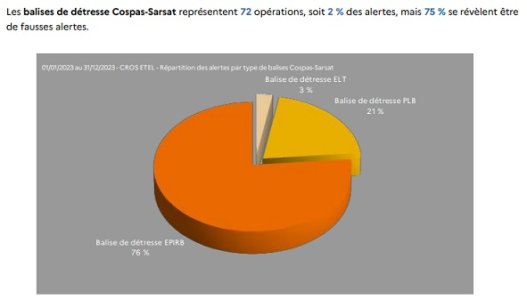
They do not describe in detail what they do when an alarm is received, but the French Atlantic MRCC 2023 report says they received 72 distress calls from satellite beacons (about 2% of total distress calls), of which 75% were false alerts.

https://www.premar-atlantique.gouv.fr/uploads/atlantique/pages/b445ea7c1382c94e2e6ba3eeb43f0531.pdf

View attachment 189531

It needs two way comms. That way your position is communicated and you can back it up with "This is a real situation, I need urgent help." and there's no need for a phone round. That needs to be transmittable in a way that cannot be accidental but also doable from the water. A simple key sequence, text or voice message. It shouldn't be rocket science.

That requires a Satelite subscription, obvs, but it would be a game changer. This stuff already exists (ACR Bivvy Stick) but I think Sailors are conservative and prefer to use marine branded stuff so it really needs a marine Standard, or at least someone like
McMurdo to do it.
 
Last edited:
OTOH, arguably, a quick death from drowning is better than a slow one from hypothermia while waiting for a rescue that never comes
Have you been reading the report on the Ouzo disaster? When they examined the bodies of the crew, they suggested that those with lifejackets had survived for 24 hours before drowning and those without had only survived for an hour or so.

I know which one I prefer
 
Have you been reading the report on the Ouzo disaster? When they examined the bodies of the crew, they suggested that those with lifejackets had survived for 24 hours before drowning and those without had only survived for an hour or so.

I know which one I prefer

As I posted before you ..... Hypo - you have no idea of what's happening - you are in a state of basically feeling 'nothing' ....

The persons who were in water possibly 24 hrs - if found before drowning - there would be chance of revival. Slim - but still a chance.
 
but I think Sailors are conservative
I think -strictly my guess- a number of alerts are being considered "false" as the beacons were voluntarily activated for reasons like running out of fuel or similar; one definitely hears Mayday calls on VHF for such silly reasons (flat seas, no immediate danger, etc etc). With a digital two-way confirmation system those people would confirm the need for assistance... There should be a two-way voice device, in the meantime the most efficient way imho is to have people learn/understand the basics of distress, urgency, etc.
 
Have you been reading the report on the Ouzo disaster? When they examined the bodies of the crew, they suggested that those with lifejackets had survived for 24 hours before drowning and those without had only survived for an hour or so.

I know which one I prefer
Being rescued?
 
EPIRB .... haven't read a report for years about false alarm ...

Used to be quite often you would read about an EPIRB set off at a house ...
During two yacht races and their return journeys (Sydney to Hobart and the less well known Melbourne to Hobart) in 2021 fourteen false alarms were generated by electronic items. These included PLBs and DSC. Two DSC alarms were initiated from the same boat by a crewman resting his foot on the radio and inadvertently pressing the hinged cover onto the DSC button. Two of the PLB alarms were investigated by the manufacturer, ACR, who subsequently altered the construction of their PLB to prevent pressure on the face of the unit causing activation. It is not clear how the other ten alarms were initiated.

It appears that the rescue authorities first tried raising the relevant vessels by radio to ascertain whether the alarms were false. Presumably the authorities also phoned the registered contacts of the PLB owners but that would not have helped them establish whether the alarm was false or real. Only one of the fourteen false alarms resulted in an aircraft overflying the yacht, which along with diverting other yachts to the scene, would be the main means of rescue given the absence of an equivalent to the RNLI. This would seem to indicate that the authorities do not immediately dispatch rescue assets on receiving an alarm.

The above information is based on a report which includes some interesting information. To find the report, search for "ORCV SIG Report Inadvertent Distress Beacon Activations"
 
Two DSC alarms were initiated from the same boat by a crewman resting his foot on the radio and inadvertently pressing the hinged cover onto the DSC button
Once would be embarrassing. Twice is surely stupidity! You have to lift or slide a flap and then apply pressure for a period of time, during which I think most/all VHFs make an audible noise and the display lights up.

If my foot is in contact with the VHF then I am in distress - either because the boat is on its side or I’ve taken up gymnastics. Whoever installed a radio in a position that someone can rest their foot is almost as stupid as the crewman who rests their foot on a piece of electronics that might be needed to save a life!
 
Presumably the authorities also phoned the registered contacts of the PLB owners but that would not have helped them establish whether the alarm was false or real.
Actually a lot of serious race boats have trackers or data coming back to base. So if it showed the PLB was still on the boat and the boat was being sailed consistently (course, speed etc) before and after the PLB alert it would probably provide some reassurance it was not a MOB, and the boat itself was not in difficulty. But for a PLB which is personal rather than vessel based it would tell them which boat, how many people were on board, where it was going to/from, sat phone numbers etc if out of VHF range etc. Not only does that allow them to rule in/out certain scenarios but it helps them work out what resource to send.

would be the main means of rescue given the absence of an equivalent to the RNLI.
Do you mean because of the distance offshore? Or do AUS and NZ not have libeboat orgs?
 
Top