DIY LiFePo4 installation - Don't do what I did (maybe) . . .

The insurers seem quite happy with the blanket term Lithium-ion. They don't seem particularly keen to see the positives of LiFePo4 chemistry which isn't helped when a so-called electrical guru (NC) keeps banging on about thermal runaway in all lithium based batteries - despite evidence in the real world seemingly pointing to the contrary.

I look forward to Dockhead's install receiving approval and wish him well.
 
Lithium iron phosphate batteries are a type of Lithium ion battery, as is lithium manganese oxide, lithium manganese cobalt oxide and lithium polymer. They all use lithium ion cathodes.

As for MGN 550 it's not irrelevant to all, it's been quoted for use by coded yachts, and is as far as I'm aware, the only UK published specification for an installation.
 
But as far as I am aware, LiFePO4 is technically a Lithium-ion - just one that is much safer for boats than some other chemical formulae of Lithium-ion. Some use the term Lithium-ion to mean not LiFePO4, but I think that may be a marketing distinction rather than a technical one.
But happy to be corrected by a proper chemist.
That's incorrect. Lithium-ion and LifePO4 are both Lithium based but have different chemical compositions, most notably the cathode material.
 
That's incorrect. Lithium-ion and LifePO4 are both Lithium based but have different chemical compositions, most notably the cathode material.
dunedin is correct, LiFePO4 is a class of lithium ion battery


"Li-ion battery" can be considered a generic term involving at least 12 different chemistries; see List of battery types. Lithium-ion cells can be manufactured to optimize energy density or power density.[16] Handheld electronics mostly use lithium polymer batteries (with a polymer gel as an electrolyte), a lithium cobalt oxide (LiCoO2) cathode material, and a graphite anode, which together offer high energy density.[17][18] Lithium iron phosphate (LiFePO4), lithium manganese oxide (LiMn2O4 spinel, or Li2MnO3-based lithium-rich layered materials, LMR-NMC), and lithium nickel manganese cobalt oxide (LiNiMnCoO2 or NMC) may offer longer life and a higher discharge rate. NMC and its derivatives are widely used in the electrification of transport, one of the main technologies (combined with renewable energy) for reducing greenhouse gas emissions from vehicles.[19]

Lithium-ion battery - Wikipedia
 
Last edited:
dunedin is correct, LiFePO4 is a class of lithium ion battery


Lithium-ion battery - Wikipedia
Problem with relying on the likes of Wikipedia is that it's all written by who knows who, often incorrectly. Then along comes someone who's read something there and they think they are an expert on the subject.

Lithium-ion and LifePO4 are not the same.
 
Lithium iron phosphate batteries are a type of Lithium ion battery, as is lithium manganese oxide, lithium manganese cobalt oxide and lithium polymer. They all use lithium ion cathodes.

As for MGN 550 it's not irrelevant to all,
I didn't say it was irrelevant to all.
it's been quoted for use by coded yachts, and is as far as I'm aware, the only UK published specification for an installation.

MGN 550 is NOT a specification, it's nothing more than guidance, as it says at the top of the document.
 
Problem with relying on the likes of Wikipedia is that it's all written by who knows who, often incorrectly. Then along comes someone who's read something there and they think they are an expert on the subject.

Lithium-ion and LifePO4 are not the same.
No, they not the same, LiFeP04 is a subclass of Li Ion technology - there are a number of Li Ion battery chemistries - and I'm not relying on Wikipedia - I know what is classed as Li-ion I transport them for work all the time.

There are Lithium metal batteries - but I've never heard of a secondary battery (i.e. one that is rechargeable) that is Lithium Metal.

All other Lithium technology batteries contain lithium in its ionic form and are Lithium Ion Secondary Batteries under UN, EU and UK law. This includes the original Lithium Cobalt Oxide ones developed in the 90s by Sony and the newer Lithium Iron Phosphate batteries.

All batteries that move charge using Lithium cations are classed as Li-Ion in the relevant rules. No one is saying that all Li-Ion battery chemistries are the same, but they are Li-Ion. LiFEPO4 is safer than earlier chemistries, but it's still classed as Li-Ion

Some other references:

International Air Transport Association:
Lithium-ion batteries contain lithium which is only present in an ionic form in the electrolyte and are rechargeable.
... For example, within lithium-ion batteries there are lithium polymer, lithium iron phosphate (LiFePO 4), lithium ion to name a few.
https://www.iata.org/contentassets/...c9d42b9/lithium-battery-guidance-document.pdf

Exide Batteries UN Data Sheet:
3.2 Li-ion cell chemistry
The following Li-Ion cell chemistries are available from Exide:
LFP: LiFePO4 , Lithium Iron Phosphate
NMC: NiMnCo, Lithium Nickel Manganese Cobalt
https://www.exidegroup.com/nz/sites/default/files/2022-08/SDS Lithium Download.pdf

Yausa Batteries:
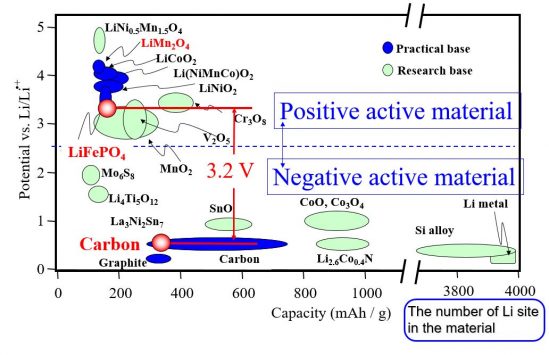
Many different types of chemical can be used to make the electrode materials which carry the lithium-ions. This is a very active area of research and development, which is promoting the use of lithium-ion batteries in an increasing number of applications. Some examples of the chemicals that can be paired together to make cells are shown below:
Technical Map of Lithium-ion Cells


As each pair of materials will make a cell with different electrical properties, it is important to select the right cell for a particular application and not to mix or replace cells with different chemistries. For example, Lithium Iron Phosphate (LFP) cells combine a carbon negative electrode with an iron phosphate positive electrode to make a cell with an operating voltage of 3.2V.
Introduction to Lithium-ion Batteries - Yuasa UK
 
But as far as I am aware, LiFePO4 is technically a Lithium-ion - just one that is much safer for boats than some other chemical formulae of Lithium-ion. Some use the term Lithium-ion to mean not LiFePO4, but I think that may be a marketing distinction rather than a technical one.
But happy to be corrected by a proper chemist.
You are correct. LiFePo4 is a subspecies of the broader category of lithium-ion batteries. The "FePo4" refers to the cathode material. Other subspecies include NMC (nickel manganese cobalt), LCO (lithium cobalt oxide), and others.

These types differ according to cathode material. All use similar lithium salt electrolytes; most have graphite anodes. In all cases, it's lithium ions which move between cathode and anode to store and release energy, and that's why they're called "lithium ion" batteries.

Good reading on the subject, by an eminent Japanese professor:
Part 1: What are lithium-ion batteries? An expert describes their mechanism and characteristics. | Murata Manufacturing Articles
 
Problem with relying on the likes of Wikipedia is that it's all written by who knows who, often incorrectly. Then along comes someone who's read something there and they think they are an expert on the subject.

Lithium-ion and LifePO4 are not the same.
Nobody is saying that all types of Lithium batteries are “the same thing” - quite the opposite. That is the whole issue with some insurers.
BUT LiFePO4 are a type of Lithium-ion battery. But a much safer type of Lithium ion for yachts to use than some other types of Lithium ion.
The point being made on this thread is that some insurers bundle all these types in together without differentiating on the specific chemistry, and that is a big concern as that bundles LiFePO4 in with other more risky types.
 
It depends on what you're using it for.
If building a new system from scratch there can be almost no upfront penalty for choosing LFP, and given the far longer service life, a substantial long term saving.

But just because something is a no brainer for a full time liveaboard doesn't mean it's the right answer for somebody who uses their boat a few weekends of the year.
 
Nobody is saying that all types of Lithium batteries are “the same thing” - quite the opposite. That is the whole issue with some insurers.
BUT LiFePO4 are a type of Lithium-ion battery. But a much safer type of Lithium ion for yachts to use than some other types of Lithium ion.
The point being made on this thread is that some insurers bundle all these types in together without differentiating on the specific chemistry, and that is a big concern as that bundles LiFePO4 in with other more risky types.
You are confirming what Paul says, “they are not the same”
 
I think the only way to answer this is to ask whether the MCA consider LiFePO4 batteries to be included in their use of the term 'lithium ion'.
From a strictly technical perspective it ought to, but it's clear that the terms can cause confusion without further clarification.
 
I think the only way to answer this is to ask whether the MCA consider LiFePO4 batteries to be included in their use of the term 'lithium ion'.
From a strictly technical perspective it ought to, but it's clear that the terms can cause confusion without further clarification.
Surely it's individual clarification of one's insurance.
Obviously this is another area where people do things in innocence, but one goes tits up and leads to someone's injury or death.
I can see this ending in tears for someone.
 
Surely it's individual clarification of one's insurance.
Obviously this is another area where people do things in innocence, but one goes tits up and leads to someone's injury or death.
I can see this ending in tears for someone.
Well for insurers, yes. I was specifically talking about MGN 550.
 
Legally ?

You mean for shipping ?
Not just for shipping - the safety labeling, the classifications for use, testing requirements etc - but as LiFePo4 is a Li-ion technology, until they start classifying the different chemistries, rather than the umbrella term, we're stuck with what we have.
 
Well for insurers, yes. I was specifically talking about MGN 550.
But MGN 550 is only guidance, it's not a specification that anyone has to follow. There has been talk in this thread about coded boats, but MGM280, which covers coding for vessels up to 24M has no mention whatsoever of Lithium batteries.
 
Not just for shipping - the safety labeling, the classifications for use, testing requirements etc - but as LiFePo4 is a Li-ion technology, until they start classifying the different chemistries, rather than the umbrella term, we're stuck with what we have.
Can you point us to the legislation that requires end users, fitting LifePO4 to boats, have to comply with please ?
 
Top