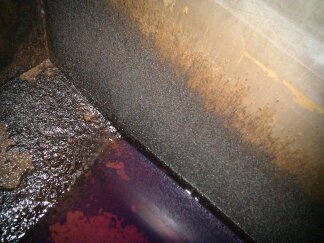
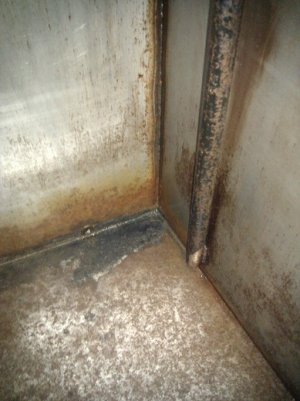
Diesel bug.....

Billyo

Well-Known Member
Joined
6 Nov 2016
Messages
219
Location
Swanage
Visit site
So I have the bug.....

I have 2 tanks one is contaminated the other fine. I shock dosed tge contaminated tank 2 days ago, just wondering about the next steps.

As background I'm in no position to be able to empty the dirty tank and clean it properly so:

If I run the shocked fuel through a 10 micron filter for a couple of hours, back into the contaminated tank then change down to a 2 micron filter and repeat but return this fuel to the clean tank will I have clean fuel?

I have accepted that I probably lose half my tank capacity as I can't clean the dirty tank.
 
Have you drained the water out of the tank? That's the first step. And bulk remove the thick sludge which will clog even the coarsest filter. Then see how much fuel is left and consider whether it's worth the effort of polishing it.
 
Obviously, you need to treat the good tank also. You are going to infect it (the treatment is not 100% effective and you are sharing lines). IMO, it is probably safer to ditch (recycle as used oil) the contaminated fuel. Not worth the risk for a few quid, since you state you cannot clean tanks. Infect the good tank and you have no engine.

Yes, you can eventually clean the dirty tank, Some are just more difficult than others.
 
The problem you will encounter is that the majority of the contaminants (sludge) will be below the fuel pick up tube in the tank and therefore not be getting picked up for filtration and simply remixing with the filtered fuel. This only really becomes an issue when in any heavy sea whereby the contaminants get sloshed around and can block the primary filter.

There is no other solution in dealing with this other than cleaning the tank internally. I had issues with this for the past couple of years and eventually cut access hatches bolted onto the top of my tank enabling me to get an arm in and physically remove the contaminated matter. I now no longer have any issues.
 
You should be able to clean the tank through the sending unit opening with a power washer and vacuum. Remove all of the fuel first, and rinse with water. You will need 45 and 90 fittings for the washer.
In a small tank with no internal baffles this is doable
 
What quantity of fuel are you talking about? There is a you tube video posted by a couple on a boat under the heading Cadoah. They have installed a fuel cleaner. At the time it seemed expensive- Forget how much. But taking in the price of fuel & how much you use such a cleaning device may be the answer. Fit & not completely forget. But it sems to have sorted their fuel issues. That was just on a yacht. On a MOBO you will be shoving lots of fuel through it, so it would be more conomical- At least I assume that is the case & we all know the definition of assumption :cry: 🤣
 
Well used mobos don't have old fuel in the tanks, so it's not a problem.

I worked for several years on various workboats which were used daily. Never once had bug, not even a dirty filter.

My yachts on the other hand...
 
So I have the bug.....

I have 2 tanks one is contaminated the other fine. I shock dosed tge contaminated tank 2 days ago, just wondering about the next steps.

As background I'm in no position to be able to empty the dirty tank and clean it properly so:

If I run the shocked fuel through a 10 micron filter for a couple of hours, back into the contaminated tank then change down to a 2 micron filter and repeat but return this fuel to the clean tank will I have clean fuel?

I have accepted that I probably lose half my tank capacity as I can't clean the dirty tank.
Depends what you've 'shock dosed' it with perhaps?

Various 'treatments do different things to the bug, water and fuel.

Personally I would have tried to remove as much fuel from the dirty tanks as possible, before treatment.

How big are the tanks?
How much fuel in each?
Is it possible to pump fuel into cans?
Is it red or white diesel?

My boat has about a 70 litre tank. I removed a lot of the fuel in November and as it was white, used it in the car.


If you're going to attempt to clean the fuel, I think you will need to suck fuel right from the bottom of the tank, to remove water etc. If you can do that then either circulating fuel through filters, or letting it settle can work.

But not all 'bug' or crud is the same, sometimes it's like soup which can be sucked into a filter, sometimes it's more sticky. Sometimes it a mix of 'soup' and 'tarry black shit' which isn't amenable to being sucked out through a tube, it needs scraping.
 
Depends what you've 'shock dosed' it with perhaps?

Various 'treatments do different things to the bug, water and fuel.

Personally I would have tried to remove as much fuel from the dirty tanks as possible, before treatment.

How big are the tanks?
How much fuel in each?
Is it possible to pump fuel into cans?
Is it red or white diesel?

My boat has about a 70 litre tank. I removed a lot of the fuel in November and as it was white, used it in the car.


If you're going to attempt to clean the fuel, I think you will need to suck fuel right from the bottom of the tank, to remove water etc. If you can do that then either circulating fuel through filters, or letting it settle can work.

But not all 'bug' or crud is the same, sometimes it's like soup which can be sucked into a filter, sometimes it's more sticky. Sometimes it a mix of 'soup' and 'tarry black shit' which isn't amenable to being sucked out through a tube, it needs scraping.
Never saw the tarry black shit till we had modern E cr*p vegie added diesel
 
If the additive OP used is M16 or similar - then that will only kill bugs - will not assist in solving the sludge / dead bug issue.

A decent enzyme additive that actually breaks down the sludge is called for. Add that to BOTH tanks ... leave to do its work for a few days ... then >

OP needs to get hold of a Pela or similar - get that fuel out .... and suck out as much crap from the tank bottom as possible.

But as another says - what boat is it - twin tanks makes me think it could be a motor boat ??

Once sucked out ... treat the containers with strong dose of enzyme additive ... get it well mixed .. then let it stand ... couple days later syphon off the clean fuel and ditch the crap at bottom.
You can do this a couple of times ... doesn't hurt to have well overdosed ...

You can then use this heavily treated fuel as a base to get the tank on its way to sorted. Pour it in .. and let do its work .. couple days later suck it all out again ... and the crap on the bottom .. you'll likely find that you get a lot less crap this time ...

The enzyme additive is designed to reduce crap to miniscule size to allow it to burn in the engine along with the fuel ....

Filtering is only removing particles .. does nothing to sort the bug problem. Yes you can filter to help clean the fuel - but that's all its ever going to do.

The addition of enzyme additive will be advised every time you top up for a reasonable number of times ... and then at intervals through the season .. that way you will help clean and maintain system.

DO NOT FORGET to treat the other tank with regular dose as well .... as another says - its likely other tank has it - but you haven;t seen effect yet. Dose it before it does !!

Can you close of each tank from engine ? or are they common line ? If you can close off - then I would be inclined to use the good tank for most of the time and at intervals open 'bad' tank as well for short run to get that used ... doing a combo like that will help engine to keep going while getting rid of that bad tanks fuel ....

Because you say you cannot get into tank to clean it .... it will take time to sort .... take it sensibly and carefully ...
 
Oh - nearly forgot ... get a few fuel filters for the engine and keep handy ......

Don't wait for filter to be clogged before changing it ... changing it at intervals will ensure fuel flow and nothing bad getting to injection pump etc.
 
Thanks for all the responses!

Cleaning tank is going to be very hard, I can put in a new access plate on the other side of the baffle but can't reach the bottom or back by hand and as I'm in the depths of indonesia will struggle to find a pressure washer! Also due to location getting hold of treatments is problematic too.....
I shocked with Bardahl marine biocide treatment, french product, picked it up in New cal a couple of years ago so will look into what it actually does to the algae. Hopefully it kills and breaks down!

Edit, as background, sailboat with 2 yanks port 100 gallon starboard 60 gallon ish, starboard tank is full and has the visible problem....
 
Last edited:
If the additive OP used is M16 or similar - then that will only kill bugs - will not assist in solving the sludge / dead bug issue.

A decent enzyme additive that actually breaks down the sludge is called for. Add that to BOTH tanks ... leave to do its work for a few days ... then >

OP needs to get hold of a Pela or similar - get that fuel out .... and suck out as much crap from the tank bottom as possible.

But as another says - what boat is it - twin tanks makes me think it could be a motor boat ??

Once sucked out ... treat the containers with strong dose of enzyme additive ... get it well mixed .. then let it stand ... couple days later syphon off the clean fuel and ditch the crap at bottom.
You can do this a couple of times ... doesn't hurt to have well overdosed ...

You can then use this heavily treated fuel as a base to get the tank on its way to sorted. Pour it in .. and let do its work .. couple days later suck it all out again ... and the crap on the bottom .. you'll likely find that you get a lot less crap this time ...

The enzyme additive is designed to reduce crap to miniscule size to allow it to burn in the engine along with the fuel ....

Filtering is only removing particles .. does nothing to sort the bug problem. Yes you can filter to help clean the fuel - but that's all its ever going to do.

The addition of enzyme additive will be advised every time you top up for a reasonable number of times ... and then at intervals through the season .. that way you will help clean and maintain system.

DO NOT FORGET to treat the other tank with regular dose as well .... as another says - its likely other tank has it - but you haven;t seen effect yet. Dose it before it does !!

Can you close of each tank from engine ? or are they common line ? If you can close off - then I would be inclined to use the good tank for most of the time and at intervals open 'bad' tank as well for short run to get that used ... doing a combo like that will help engine to keep going while getting rid of that bad tanks fuel ....

Because you say you cannot get into tank to clean it .... it will take time to sort .... take it sensibly and carefully ...
Please suggest brands of decent enzyme additives
 
Please suggest brands of decent enzyme additives

I have to be careful as I am in the OIl / Fuel business and I will not grade products ....

What I can say is that there are a couple of easily found brands that will do the job ... Startron is one.

The only reason I give that name is that it is found not only on shelves - but on eBay and other online outlets.
 
Marine 16 gets good PBO reviews & I use it. But during the season I do get a good turnover of fuel. (white from garages) so, apart from a full tank over winter, it does not sit in the tank long.
An internet search should find the PBO review, or at least some mag review. That would tell you the best for initial clean & then maintenance.
What I do not understand is what happens to anything that has been "cleaned" from the fuel. It cannot disappear - even as a re constituted chemical-so must either go through the injectors or stop at the filters.
When I had the bug, 15 years ago, I just drained the lot & started again. But that does not seem the OPs option.
 
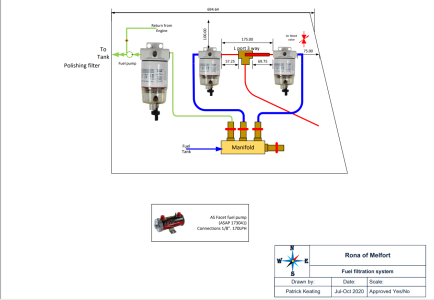
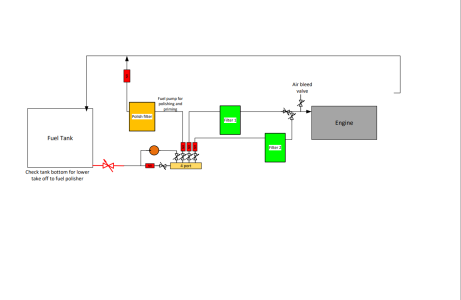
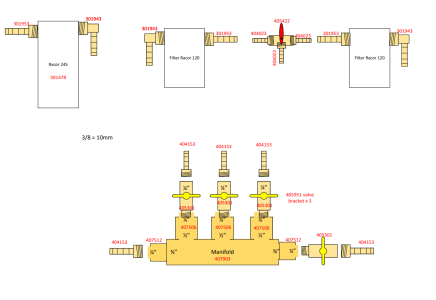
Having a twin fuel filter with a fuel polishing system might be worth fitting. At the boat show I was chatting on the ASAP stand and staff member Patrick Keating had recently designed and fitted a twin filter system to his own boat. He sent me his working drawings and feel sure he would not object to me posting them on here. He includes all the ASAP part numbers if anyone wants to fit a similar system, I certainly am considering it.


Screenshot (77).png

Screenshot (78).png

Screenshot (79).png

Hope this might be helpful to more than the OP.
 
Marine 16 gets good PBO reviews & I use it. But during the season I do get a good turnover of fuel. (white from garages) so, apart from a full tank over winter, it does not sit in the tank long.
An internet search should find the PBO review, or at least some mag review. That would tell you the best for initial clean & then maintenance.
What I do not understand is what happens to anything that has been "cleaned" from the fuel. It cannot disappear - even as a re constituted chemical-so must either go through the injectors or stop at the filters.
When I had the bug, 15 years ago, I just drained the lot & started again. But that does not seem the OPs option.

The PBO article is yonks old and gets regurgitated every so often. Its about time a newer study was made ...

M16 is good as a maintenance treatment to keep tanks good - or when you can fully drain / suck out all ... to treat out of tank. But as far as I know - its not enzyme based ... its not an industry product so I can only go by what I read about it.

I'm always concerned that some additives kill bugs - that then drops to botttom of tank and collects - without breaking them down to allow burning off in the engine. Its why I always prefer and advise enzyme based.

Fuel filtering systems of course come into their own with non enzyme additives - where need to filter out the dead bugs - but such filtering does not kill or eradicate bugs. You can 'polish' fuel for as long as you like - but stop filtering and you can still end up with bug problem ... This is why I do not support it as much as some do.

The use of a maintenance dose each time you fill up is good .. and that should look after you ... but only after sorting initial bug infestation.
 
Thanks for all the responses!

Cleaning tank is going to be very hard, I can put in a new access plate on the other side of the baffle but can't reach the bottom or back by hand and as I'm in the depths of indonesia will struggle to find a pressure washer!

Edit, as background, sailboat with 2 yanks port 100 gallon starboard 60 gallon ish, starboard tank is full and has the visible problem....
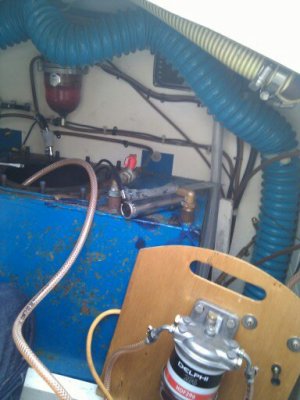
I used a home made fuel cleaner for some years and since the filter was always clean thought nothing more about it. Until one day there was a tiny wisp black strand in the water seperator. Thankfully the tank has a 9 x 12" inspection hatch. You can see what I found when peering inside. I think this is a mix of brown fuel bug and black asphaltenes on the side of the tank. However, I am not a chemist.

The diesel fuel was reasonably clean above the contamination, so I pumped this out through a CAV filter into clean containers, dosed it and later put it back in. Then with the marigolds on used a 2" wall paper scraper to clean the rest of the sludge and tar like asphaltenes off the sides of the tank. Finally used some filtered diesel to wash the insides of the tank. A pressure wand through a filler wouldn't have worked.

Given you have a good 100 gallon tank and a contaminated 160 gallon tank, I take it she is quite a big yacht. The loss of the large tank is going to be a problem. Are you travelling anywhere that could fit a couple of hatches in a tank. After all its only cutting and bolting the steel with a new plate and gasket. Could even be a DIY job on a beach. The plate doesn't even have to be stainless, my tank is mild steel and a few spots of rust after 35 years but still going strong with the occasional dab of paint. A decent sized plate of steel, lots of bolts to go around the edges. Set of taps and dies if you don't have them on board, always useful. A decent electric drill and an angle grinder. Empty any fuel and fill / wash with water then empty before using a gas torch or angle grinder on a fuel tank.

Finally, the source of the diesel bug problem turned out to be the fuel filler cap seal, which I now replace every couple of years so water can no longer get in the tank. I checked the tank last year after a decade of cleaning it out and its still spotless.

Pete
 

Attachments

  • Moody 033.jpg
    Moody 033.jpg
    50.3 KB · Views: 26
  • Before.jpg
    Before.jpg
    29.6 KB · Views: 25
  • After.jpg
    After.jpg
    92.4 KB · Views: 31
Top