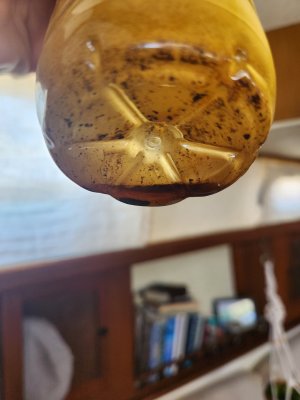
Diesel bug.....

So I have the bug.....

I have 2 tanks one is contaminated the other fine. I shock dosed tge contaminated tank 2 days ago, just wondering about the next steps.

As background I'm in no position to be able to empty the dirty tank and clean it properly so:

If I run the shocked fuel through a 10 micron filter for a couple of hours, back into the contaminated tank then change down to a 2 micron filter and repeat but return this fuel to the clean tank will I have clean fuel?

I have accepted that I probably lose half my tank capacity as I can't clean the dirty tank.
Who was your supplier? If local do others have a dose of the bug?
 
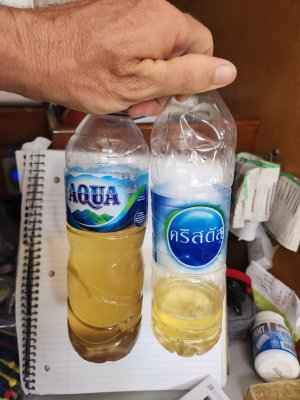
So I have managed to pump out a sample of fuel from the bottom of one corner of the infected tank, can't get to the other corner at the moment as I cant get the fitting off the pick up hose. Attached 2 photos, the bottle on the left is from the bottom of the tank, some crud and a little water but the fuel is really cloudy compared to the sample on the right from the top of the tank which looks as good as what I normally.purchase.

Any ideas on why it's cloudy? It's not water and doesn't look like normal bug sludge.....
 

Attachments

  • 20240125_134741.jpg
    20240125_134741.jpg
    1.3 MB · Views: 23
  • 20240125_134756.jpg
    20240125_134756.jpg
    1.1 MB · Views: 23
Cloudy usually is due to temperature drop ... summer grade diesel can cloud at about -5C .. with CFPP at about -7C ...

Its the Parafins dropping out ... depending on the additives / blend - they can remain after product has warmed up above that Cloud Point etc.

Sediments - that's common.

OK - another reason for cloudy is emulsification .. basically over time water and the fuel emulsify and cause milky appearance. Looking at your bottles - the milkyness is far more than I would expect with Cloud Pt ... it looks to me like emulsified fuel.

What happens after leaving the bottle standing in a warm place (above normal house room temp) ?? Needs leaving for maybe couple or more days undisturbed .. just look at intervals see if any change.

There are additives to combat it - but I have no idea if available on the shop shelf.
 
Cloudy usually is due to temperature drop ... summer grade diesel can cloud at about -5C .. with CFPP at about -7C ...

Its the Parafins dropping out ... depending on the additives / blend - they can remain after product has warmed up above that Cloud Point etc.

Sediments - that's common.

OK - another reason for cloudy is emulsification .. basically over time water and the fuel emulsify and cause milky appearance. Looking at your bottles - the milkyness is far more than I would expect with Cloud Pt ... it looks to me like emulsified fuel.

What happens after leaving the bottle standing in a warm place (above normal house room temp) ?? Needs leaving for maybe couple or more days undisturbed .. just look at intervals see if any change.

There are additives to combat it - but I have no idea if available on the shop shelf.
Thanks, I've left it 3 hours and there is slowly more water appearing at the bottom..... so hopefully it's emulsification. it's 34 degrees here so keeping it above normal room temperature is not a problem!

So if i leave it long enough all the water should separate out? I can then suck all that out and possible start filtering?
 
Thanks, I've left it 3 hours and there is slowly more water appearing at the bottom..... so hopefully it's emulsification. it's 34 degrees here so keeping it above normal room temperature is not a problem!

So if i leave it long enough all the water should separate out? I can then suck all that out and possible start filtering?

If the fuel returns to clear and bright (that's the actual technical term !!) .. then you could syphon off and dose with an additive that actions water and bug ..

Is it possible to 'lean boat' so you can suck out all fuel from that tank ??
 
The cloudy nature of the sample may be because the Op 'dosed' the tank with something?
It could be that the water which was lying in the bottom of the tank waiting to be removed is now emulsified into the fuel?
Back last century, I saw yacht tanks with several litres of water in the bottom.
Magick additives might deal with a few spoonfuls, but when there's 'excess' water additives can be an own goal, making the fuel and water harder to separate.

If it looks too suspect to actually run the engine on, best best may be to syphon it in to several cans to see what separates out?
Or would a few trips through an agglomerator filter remove some water?

You could remove the 'good, bright' fuel from the top of the tank into cans.
Then agitate the tank and polish the remainder?
 
If you can dry out somewhere, then lead a small syphon tube out through a seacock you could empty a tank. Gives you a good long drop, assuming you can get the tube down into the tank corners. If you can 'see' the corners attach the tube to a wand.
Jiggle syphons are effective, you might have to fit a longer tube. I made my own from 1 inch hose with a foot valve one end, gate valve the other, emptied 800 litres in a fairly short time. Remember it doesn't matter how high the tube goes (within reason) as long as the exit is lower than the pickup.
 
I did add an additive, but the boat has not moved since then so can't see how it could have got.mixed up?

But will leave it a couple of days and maybe siphon off the top of the tank into a jerry can, run that through a filter and put it into the other clean tank. If the remaining fuel in the contaminated tank doesn't clear then I will empty the tank and dump the fuel somewhere that can deal with it or use it.

Thanks all.
 
I did add an additive, but the boat has not moved since then so can't see how it could have got.mixed up?

But will leave it a couple of days and maybe siphon off the top of the tank into a jerry can, run that through a filter and put it into the other clean tank. If the remaining fuel in the contaminated tank doesn't clear then I will empty the tank and dump the fuel somewhere that can deal with it or use it.

Thanks all.

Depends what additive you used ... many common ones are not capable of sorting the water ...

You will never get all the fuel back ... there will be an emulsion volume whatever.... all you can hope for is that more fuel separates out.

You can in fact mix fresh fuel with the old - but at a large % fresh to overcome the emulsified poor fuel .. but not if its to stand - it would be prudent to use it asap .. to avoid causing new fuel to spoil.

To be honest ... if it was me - I would syphon off ... and eek it out over a long period in small amounts ... yes I'm that much of a scrooge !! I would be dosing my tanks with such as Startron or whatever I can get hold of ... to keep the water broken up and able to burn off ..

This may sound strange - but in all the years I have been in the Oil Business .. blending etc. - I have never seen or used a Water / Oil separator funnel. I know some people talk about them ... and I cannot say whether it works or not. Maybe if you can find one - give it a try for any fuel you want to put back ?

I would suggest NOT contaminating the good tank...
 
Top