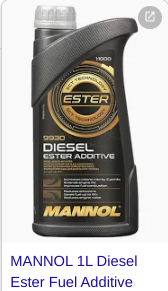
Diesel additives to clean injectors. Snake oil?

fredrussell

Well-Known Member
Joined
24 Mar 2015
Messages
4,356
Visit site
Obviously there’s masses on the web re fuel additives, but unsurprisingly they all are anecdotal. Anyone know of a ‘before and after’ type additive test on, say, injector spray patterns. Diesel bug has been much discussed on here, I’m more interested in additives that claim to clean injection system.
 
The only experience I had came from a recomendation from an MOT tester. His Garage dealt with a local airfield that had lots of Rover Diesels on the books. He tested most of them. Many failed through excess smoke due to pootling around on the base, never getting a good clear out.

I bought a Rover Diesel for my dad that smoked badly. I asked the MOT tester the best way forward. He suggested a bottle of Wynnes - IIRC - injector cleaner, tipped into an almost empty tank. I did this and then followed his further instructions "Find the steepest, longest 'ill in your area and go 'an give a right good bollocking, full throttle in the 'ighest gear it can take, at the best speed it can make!"

I did, by East Ilsey on the A34. The following traffic was lost in a huge cloud of black smoke. By the time I got to the Chievely junction and turned around, it was far better. By the time I got it back to Didcot it was mended, passed the MOT emmisions easily.

No hills on the sea to load it though-I suppose you could tow some buckets.................................. ;)
 
The only experience I had came from a recomendation from an MOT tester. His Garage dealt with a local airfield that had lots of Rover Diesels on the books. He tested most of them. Many failed through excess smoke due to pootling around on the base, never getting a good clear out.

I bought a Rover Diesel for my dad that smoked badly. I asked the MOT tester the best way forward. He suggested a bottle of Wynnes - IIRC - injector cleaner, tipped into an almost empty tank. I did this and then followed his further instructions "Find the steepest, longest 'ill in your area and go 'an give a right good bollocking, full throttle in the 'ighest gear it can take, at the best speed it can make!"

I did, by East Ilsey on the A34. The following traffic was lost in a huge cloud of black smoke. By the time I got to the Chievely junction and turned around, it was far better. By the time I got it back to Didcot it was mended, passed the MOT emmisions easily.

No hills on the sea to load it though-I suppose you could tow some buckets.................................. ;)
Similar experience with our 4.2td Landcruiser - it gets a bottle of wynns and a hoofing for the mot
 
Most over counter are 'diluted' rubbish ... they never sell the full strength additives available to such as when I ws full working additives.

Over counter bottles are OK for light 'clean-up' .. maybe you have a engine that is just borderline for test ... a bottle of stuff ... a good thrash down the motorway ... then top up tank with good amount of fresh fuel ... make sure you drive enough to get it out of system before test !!

But if you have significant - it will take a bit more than just a bottle of goop !
 
Similar experience with our 4.2td Landcruiser - it gets a bottle of wynns and a hoofing for the mot

Latvia is getting strict and its easy for both Petrol and Diesels to fail emmissions here ... its zero tolerance.

My Volvo XC70 2.4 petrol has had 3 Cats over the last 10yrs to get through .. so much so - I will not buy Volvo's own now ...

My Range Rover flew through its import testing .. but I know next year - it will need a good thrash before test ... the DPF has already had 3 set drives to clean out (2000rpm for 20mins) .... 4.4 ltr TDV8 ...
 
It's hard to tell, because you can't isolate the effect of an additive from the effect of driving some miles with fresh fuel.
I used the Millers additive in my car a while ago, I'm fairly sure it ran a bit better and gave a couple more mpg. It passed the MOT with no problems on the emissions., so I see it as £8 well spent.
 
One aspect that no-one I've asked in my business can answer - whether clean-up additives go OK with DPF .. I asked because last thing I want is to clog up a DPF - and then have to pay exorbitant fee to get it changed .... JLR in Riga are not cheap !
Its bad enough doing cats on my Volvo !!
 
One aspect that no-one I've asked in my business can answer - whether clean-up additives go OK with DPF .. I asked because last thing I want is to clog up a DPF - and then have to pay exorbitant fee to get it changed .... JLR in Riga are not cheap !
Its bad enough doing cats on my Volvo !!
I think you'd have to shift a lot of gunk to foul the DPF?
AIUI, the aim of the additives is mainly to clean out a few fractions of a gramme of varnish or whatever from the injectors and maybe the pipework. Most of which should be burned?
I think the DPF is maybe more at risk from the lube oil than the fuel?
I take the view that putting any additive in should best be done before a decent run, not a trip to the shops. Let it do its stuff with a hot engine and exhaust.

It's maybe possible that additives, which AIUI may contain a lot of detergent, could free up a a lot of crud from the fuel tank and dump it in the engine or filter? Maybe it's worth looking at the filter first to gauge the state of the system?
My tame garage owner says very few people ever ask for a diesel fuel filter to be changed, of those he does change about one in four is disgusting.

The best cars thrive on neglect.
 
Err..... wasn't the question about marine diesels?

I can see the same might apply but how do you know its made a difference on a boat engine?

Do people running diesel generators for 1000's of hours use them?
 
I have used various fuel additives on the boat over a few years.
Overall I would say there is a small advantage in smoother cleaner running but really that's just the impression I get rather than anything scientific.It could be just the engines have improved with age and are now run in nicely .
I haven't had any fuel issues in 850 engine hours over 9 years with my present boat which proves nothing of course.

The additive I am using at the moment cost about £12 for a litre which treats 1000 litres of fuel .

Screenshot 2023-12-30 22.34.14.png
 
The question in my head is - in the cases where a bottle of Wynns followed by a damned good thrashing solved a smoking problem, would just the damned good thrashing on its own have done the job? A roundabout way of wondering whether the additive actually did anything.

It's a good example of the "Placebo Effect".
 
There seems to be a lot written about Dipetane Engine Treatment? https://dipetane.com/
Buy on Ebay, usually the cheapest and a 1 ltr bottle lasts ages. Been used in my 2008 Honda CRV (non DPF) and NEVER had issues passing MOT emission testing (engines covered 163K so far!)
 
Its like the Rope Stripper fitted to shaft ... you never know if it works ... you cannot replicate same without it ...

The only way to tell is to stop using it and see what happens ... with a boat engine - how to tell ?? With a car - easier as eventually it may fail MOT ... but is that due to non use of additive - or just build up over time ?

All I can think - is it does no harm to use periodically, but I would make sure its well before any emissions test so the additive does not affect the tests.
 
I don't think there are any bad fuel additives so its a matter of personal choice.
From a cost perspective its important to consider the dose rate and not just look at the cost per litre for the additive . But really the cost is small within the overall costs of running a boat.

Oddly enough I have never used a fuel additive in a car but I have a petrol car at present.
 
Thanks for all the replies folks, they seem to be generally in agreement that whilst these additives are probably beneficial, perhaps not hugely so.
 
I don't think there are any bad fuel additives so its a matter of personal choice.
From a cost perspective its important to consider the dose rate and not just look at the cost per litre for the additive . But really the cost is small within the overall costs of running a boat.

Oddly enough I have never used a fuel additive in a car but I have a petrol car at present.
If you buy the posh brands of fuel for your car, there are additives included.
Some motorcyclists will tell you that the extra-££ BP fuel helps clean the injectors or whatever of a bike that's been idle for a few months.
 
Err..... wasn't the question about marine diesels?

I can see the same might apply but how do you know its made a difference on a boat engine?

Do people running diesel generators for 1000's of hours use them?
A diesel generator is run at optimum power, so it'll stay clean. The cars that are mentioned are the ones that pootle around town, clogging up both injectors and DPF, and it's the same with yachts, the engines often aren't worked hard enough to blow out the cobwebs.

How much of Wynns and other products' effect is placebo and how much genuine, I don't know, but the first thing I'd do with an unhappy marine diesel, providing it's got good oil pressure and cooling, would be to give it a good blast at close to full throttle for a several minutes.

My old Snapdragon 24 had a 28 HP engine - way too big for her, so it almost never worked hard enough and would get smoky over a period of months, so I'd get it nicely warmed up and give it a blast up the harbour. I'd lay a smokescreen worthy of a destroyer on the Murmansk run at first, but that would soon diminish and things were back to normal.
 
Top