Dead Saildrive; electrolysis? but why isn't the anode more damaged?

It is more likely that aliens have invaded it and turned it into an allotment for the chemical that drives their interplanetary craft :D

A couple of months ago in another thread, VicS found that the zinc anodes supplied by MGDuff contain some indium that makes a surprising difference to the potential in seawater, i.e. considerably more anodic. In the case of a saildrive leg the material is quite anodic anyway, and some grades of zinc anode may actually be more cathodic than the thing they are trying to protect. I believe that is what happened here. The leg is more anodic than the anode and has done its best to protect it.

Aha, so it was as I suspected then, I always said you couldn't trust those darned Martians. This is my starting gambit with my insurers however, so I hope they don't follow this forum!

Latest update:
just spoken to my neighbouring boat owner at Veere, to whom I gave an old anode to when I was explaining what we did when we all had very racy boats when we were young, and anodes attached to anywhere were not done; we just slung them over the side on a wire after racing (as has been previously mentioned here). He wanted to try this to increase his existing protection, and so I gave him the sister of the anode I used this year (I had used it for a year and replaced it as usual, eaten away or not - and NOT was the operative word as it was hardly touched, just like the current one). He told me it was completely untouched, unlike his shaft anode which was almost gone.
He may not have connected it properly, but as it was the same make and model (generic volvo, cheaper than the real thing) bought at the same shop I'm sure, maybe I have at last some solid ground (no pun intended) to investigate.
 
My 2 blade flexofold doesn't have the button anodes and no screw holes to fit them.
Darglow say (that flexofold say) that thery aren't necessary and were only introduced to shut up customers who thought they should have anodes!
My prop has lasted 5 years so far without them and looks fine but that was in fresh water.
I'm waiting anxiously to see the effect of a year in the sea.

Mine does, and they are almost exhausted after a year in the water, so they are doing something (unless the local mullet like zinc).
 
Mine does, and they are almost exhausted after a year in the water, so they are doing something (unless the local mullet like zinc).

Anodes fitted to a copper alloy (eg bronze) prop will be dissolved away by the electrochemical reactions which result from immersing two electrically interconnected dissimilar metals in an electrolyte such as salt water.

It does not follow that anything useful is happening.
 
Last edited:
Anodes fitted to a copper alloy (eg bronze) prop will be dissolved away by the electrochemical reactions which result from immersing two electrically interconnected dissimilar metals in an electrolyte such as salt water.

It does not follow that anything useful is happening.

Vic
Does that mean you think it should be OK without anodes?
The hub and blades are specified as nickel aluminium bronze and the pivot pins as ANC4 austenitic stainless.
Looking at Flexofold's website, the current pictures and installation instructions show anodes on the SD version but not on the shaft version. I don't know when the anodes were introduced; mine is a 2008 SD prop without anodes.
I'm going to raise the question with them but would be interested in independent opinions.

Edit - the website shows a 2 blade racing prop on a SD hub without anodes. Very confusing. I don't know whether mine is cruising or racing. In any case it says the hubs are the same only the blades are different. Confusing!
 
Last edited:
Vic
Does that mean you think it should be OK without anodes?
The hub and blades are specified as nickel aluminium bronze and the pivot pins as ANC4 austenitic stainless.
Looking at Flexofold's website, the current pictures and installation instructions show anodes on the SD version but not on the shaft version. I don't know when the anodes were introduced; mine is a 2008 SD prop without anodes.
I'm going to raise the question with them but would be interested in independent opinions.

Edit - the website shows a 2 blade racing prop on a SD hub without anodes. Very confusing. I don't know whether mine is cruising or racing. In any case it says the hubs are the same only the blades are different. Confusing!
Not necessarily. I was just pointing out that anodes on props will be consumed whether or not they are really necessary and actually doing anything useful.

I would say that if the manufacturer fitted anodes then they should be maintained ....... but then you find statements like this one quoted earlier,
My 2 blade flexofold doesn't have the button anodes and no screw holes to fit them.
Darglow say (that flexofold say) that thery aren't necessary and were only introduced to shut up customers who thought they should have anodes!

.
 
Not necessarily. I was just pointing out that anodes on props will be consumed whether or not they are really necessary and actually doing anything useful.

I would say that if the manufacturer fitted anodes then they should be maintained ....... but then you find statements like this one quoted earlier,

"Darglow say (that flexofold say) that thery aren't necessary and were only introduced to shut up customers who thought they should have anodes!"
.

Another interpretation would be "Darglow say (that flexofold say) that they aren't necessary and were only introduced to generate ongoing revenues from customers requiring replacement anodes!"
 
Very quick reply from Flexofold!

Quote:

Yes it may be true that your 2 blade flexofold hub doesn’t have any zinc anodes – as our old 2 blade hubs didn’t have these at all.

To answer your question whether it’s advisable or not – no it’s not necessary, but if you would like to fit anodes to your old hub you can send the hub to us and we will drill the holes and add anodes for you.

What it would cost you would be the freight charges (UK-DK you pay in advance) DK-UK and the 2 zinc anodes that’s it

1 set of Anodes 23 EUR
Freight charges from DK to UK 35 EUR
Total 58 EUR
 
Has anybody considered the fact that the corrosion could be caused by another boat? They could be using mains without a galvanic isolator with the unforunat effect of the earthing through their drive and using your drive as an anode....seen this before with sterndrives....the anode may not active if it has been covered usually with antifoul or grease or something to isolate it? or its not OEM? We must also consider under water effects such as steel piles power cables etc..
 
Has anybody considered the fact that the corrosion could be caused by another boat? They could be using mains without a galvanic isolator with the unforunat effect of the earthing through their drive and using your drive as an anode....seen this before with sterndrives....the anode may not active if it has been covered usually with antifoul or grease or something to isolate it? or its not OEM? We must also consider under water effects such as steel piles power cables etc..

So what is the circuit you are suggesting.

Shorepower to another boat without a galvanic isolator. Other boat's underwater fittings bonded to the incoming shorepower earth, through the water to the Ops sail drive .... but then where?
He says only occasionally connected to shorepower and has a GI fitted anyway!

The degree of local attack around the drain plug is difficult to understand. The local attack adjacent to the anode even more difficult to understand.
 
My opinion as an electrical engineer is that the anode must be defective or isolated in some manner from the leg. If the problem was pure electrolysis the anode would have protected the leg. If the problem were stray currents or earth currents then the anode would have gone first or preferentially but it's only slightly gone. Has it been fitted with nylon screws and rubber gasket?

Edit just looked more closely at the photos. Can I see some rubber type material between the anode and the leg?
 
Last edited:
Galvanic.jpg

i have attached info concerning galvanic corrosion,

Another cause of galvanic corrosion is from the shore power hookup. When you plug in, you tie your aluminum drive unit to other boats using shore power through the grounding lead.Your aluminum drive unit is now part of a large galvanic cell (a battery salt water is the electrolite) interconnected with onshore metal that is in the water—as well as other boats—and corrosion possibility may be greatly accelerated, if other owners are not using a galvanic isolator this problem escalates!

Its always woth checking that your galvanic isolator is working..and looking for local information regarding corrosion problems in the marina.
Sorry I forgot to say...Generic anodes can be bad news, unless they are from a reputable company....Aluminium Anodes are pure aluminium and will work very well in replacement for Zinc anodes in seawater or sea/fresh water...it can happen that manufacturers have the understanding that by making anodes from scrap aluminium casings which are an alloy and will not work properly...if you are using your vessel in just fresh water you should use Magnisium or Zinc anodes.
 
Last edited:
View attachment 43706

i have attached info concerning galvanic corrosion,

Another cause of galvanic corrosion is from the shore power hookup. When you plug in, you tie your aluminum drive unit to other boats using shore power through the grounding lead.Your aluminum drive unit is now part of a large galvanic cell (a battery salt water is the electrolite) interconnected with onshore metal that is in the water—as well as other boats—and corrosion possibility may be greatly accelerated, if other owners are not using a galvanic isolator this problem escalates!

Its always woth checking that your galvanic isolator is working..and looking for local information regarding corrosion problems in the marina.

Sorry, not true. The saildrive is completely isolated from the engine and electrical system, so cannot corrode preferentially in protecting anything else. I thought it was established some time ago that the cause was sub-standard anodes?
 
Hi
You have probably resolved your problem by now but it appears from the thread that you didn't get to the bottom of it. I found your discussions by googling "saildrive corrosion/anode....." as I have taken my yacht out of the water for the winter to discover the very same situation as yours, up til now no problems at all . My boat has used the same mooring at Whitby for the past 20 seasons and the only difference this year is that the saildrive has spent a lot of low waters submerged in the mud due to a lack of dredging. The whole of the antifoul and the drive leg were stained brown even after pressure washing. The anode was coated in a brown film as well and when tested there was little continuity apart from the distinct areas that were heavily pitted. Volvo have been v.helpful and they consider that it is the mud that has caused the corrosion.
I note your drive leg was stained, so perhaps you have been sitting in mud resulting in the same problem !
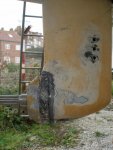
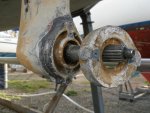
I attach some shots of my drive leg before repairs.
RegardsPB110331.jpgPB120333.jpg
 
Interesting. Did Volvo say anything about the mechanism? I assume that the leg is anodised, which usually provides good protection from sulphides, which I assume is the main constituent of the mud. Whatever the active reagent is it seems odd that it should attack the alloyed aluminium before it attacks the anode that is designed to corrode preferentially.
 
My boat with a Volvo saildrive sits in a mud berth with a lot of other boats, and has done so for 10 years with no sign of corrosion.
The brown film is normal from using a mud berth, at least round here it is (Thames Estuary). It appears to be some form of calcium deposit.
 
I am interested in this thread as I have the same sail drive and a Volvo folding prop. Looking at the pictures the greatest corrosion has occurred at the interface of the sail drive and the anode. This suggests to me that the voltaic cell made up
by the two components is acting in the wrong direction. I agree with Vyv Cox that there must be something wrong with the composition of the anode. Is there any way you could get the metal checked? Perhaps it has been made from melted down scrap which contains impurities (copper?) Could it have been made in Ch**a? I have come across a lot of plumbing fittings recently which come from there and the metal is definitely of inferior quality.
 
I am interested in this thread as I have the same sail drive and a Volvo folding prop. Looking at the pictures the greatest corrosion has occurred at the interface of the sail drive and the anode. This suggests to me that the voltaic cell made up
by the two components is acting in the wrong direction. I agree with Vyv Cox that there must be something wrong with the composition of the anode. Is there any way you could get the metal checked? Perhaps it has been made from melted down scrap which contains impurities (copper?) Could it have been made in Ch**a? I have come across a lot of plumbing fittings recently which come from there and the metal is definitely of inferior quality.

I am sure their are plenty of labs who could check the composition of the anode but it would probably cost you more than the anode is worth.

The advice that I am sure Vyv will give is to buy your anodes from a reputable source that guarantees that they conform to MIL-A- 18001K:

Cadmium . . . . 0.025% - 0.07%
Copper . . . . . . .0.005% Max.
Iron . . . . . . . . . 0.005% Max.
Lead . . . . . . . . .0.006% Max.
Aluminium . . . . 0.1% - 0.5%
Zinc . . . . . . Remainder (special high grade 99.995%)

The low iron content is crucial ... even the figure above is only made possible by the addition of cadmium
 
Top
