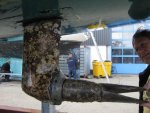
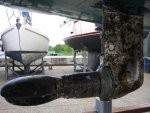
Dead Saildrive; electrolysis? but why isn't the anode more damaged?

Quote Originally Posted by ashanta
If you have painted it with you normal antifoul you will have accelerated the corrosion process.

This is a very good point.
Any copper based anti-foul will eat your drive like mad.

You must use paints that are specifically designed for Alloy or at least ones that won't react.
Ally is a bugger to get stuff to stick so many say you need an etch primer however I use International Primacon and then Trilux 33 on my leg with good results.
 
Your prop is protected by the anode not the saildrive. You should have protected the saildrive by painting it with a special paint for aluminium. If you have painted it with you normal antifoul you will have accelerated the corrosion process.

That is not the case. The anode protects the saildrive housing. It is not connected to the prop which is isolated by a rubber bush in the hub. You are confusing the issue with the need to use a non copper based antifouling, which could indeed lead to galvanic corrosion on the housing.
 
I answered a question in YM for someone with a HR berthed in Scheveningen. His saildrive had also corroded preferentially to the anode. Most of the points I made in the response have been made in this thread, however, a couple of additional ones:
Check that there is infinite resistance between the engine and saildrive. Possible leaks are electrical connections to the saildrive from elswhere in the boat, degradation or bridging of the insulator by salt, engine oil, general muck. Wire wound hoses from the saildrive to the engine can be a source of electrical connection.
Also check for good electrical continuity between the anode and the saildrive.

Scheveningen is seawater of course but I think your berth is fresh water, which may affect the anode.

I think that epoxy putty would be OK to patch up the saildrive for your voyage back to France. I use Milliput for many jobs like this and have confidence in it. The main thing would be to check that the casing is not perforated. Drain the oil and check for significant water content.
 
I answered a question in YM for someone with a HR berthed in Scheveningen. His saildrive had also corroded preferentially to the anode. Most of the points I made in the response have been made in this thread, however, a couple of additional ones:
Check that there is infinite resistance between the engine and saildrive. Possible leaks are electrical connections to the saildrive from elswhere in the boat, degradation or bridging of the insulator by salt, engine oil, general muck. Wire wound hoses from the saildrive to the engine can be a source of electrical connection.
Also check for good electrical continuity between the anode and the saildrive.

Scheveningen is seawater of course but I think your berth is fresh water, which may affect the anode.

I think that epoxy putty would be OK to patch up the saildrive for your voyage back to France. I use Milliput for many jobs like this and have confidence in it. The main thing would be to check that the casing is not perforated. Drain the oil and check for significant water content.

Thats very cheering news, I'll give it a go. As for the rest of the rest of your and everybody else's advice I'll check it all out, but if it ain't the tank I haven't done anything else except add the solar panel. When I do find the problem I'll post it. I've already checked the oil from the filler and it is ok, so I don't think the saildrive is perforated, it remains to be seen.

Milliput, never heard of it before!

Thanks to everybody who replied.
 
Milliput, never heard of it before...

Me neither: http://amzn.to/1nM3hNN

Just to add to Vyv's post. As already discussed, some saildrives are not isolated from the engine. Instead the whole engine and saildrive are isolated from the negative, and are switched via relays to connect to negative for starting and stopping.
 
Last edited:
Could it be anything to do with the antifouling type, too copper rich for instance or applied directly to the casing.

John lilley

The OP has already said, "The saildrive has never been antifouled except with the specialist spray on stuff, and the original volvo paint has never been removed. It's only been in the water for five years!"
 
Nonsense. However you are correct about the antifoul, unless it has a layer of paint underneath.

Not nonsense! That's why, As I have done for the past 20 years, is to ensure the leg is protected by appropriate paint. If there was no protective coating, regardless of an anode, the aluminum leg would corrode in sea water. Having a copper bronze prop attached also requires protection. If you have a penta 3 blade folding, you attach the 3 segment anodes but most 2 bladed folding props and the fixed bladed props have no facility to attach anodes. They rely on anodes that are not in 'contact' but are in close proximity, such as the one on the sail drive.
In principle if the Copper Bronze Prop OK you would expect to see some erosion of the anode regardless of saildrive issue. I cannot see clearly in pics if the prop is OK. It looks like the prop is pitted too on what can be seen. This would indicate that the anode could be Ali/Mag for freshwater rather than Zinc? My suggestion has been that the saildrive has not been protected properly (I appreciate the owner says it has) My concern would lie around the stainless steel drain plug and the corrosion at that point. It seems that there has not been a successful barrier between the two and galvanic corrosion has resulted. This was changed last year. My drain plug is the original plug fitted in 1995. I haven't used spray on paint so I cannot comment on what was used. All I do know is that as long as the aluminum leg is adequately coated with an appropriate coating (and a barrier for the drain plug) it would stop the sail drive becoming what is an anode for the big CB prop on the end. The fitted anode doesn't need to do anything because the sail drive is doing it instead.
 
I mentioned fresh water anodes but it was just a question something to check. My understanding, as mentioned, is the saildrive is exposed and is acting as an anode for the big copper bronze prop (which from what I can see is slightly pitted.
 
Not nonsense! That's why, As I have done for the past 20 years, is to ensure the leg is protected by appropriate paint. If there was no protective coating, regardless of an anode, the aluminum leg would corrode in sea water. Having a copper bronze prop attached also requires protection. If you have a penta 3 blade folding, you attach the 3 segment anodes but most 2 bladed folding props and the fixed bladed props have no facility to attach anodes. They rely on anodes that are not in 'contact' but are in close proximity, such as the one on the sail drive.
In principle if the Copper Bronze Prop OK you would expect to see some erosion of the anode regardless of saildrive issue. I cannot see clearly in pics if the prop is OK. It looks like the prop is pitted too on what can be seen. This would indicate that the anode could be Ali/Mag for freshwater rather than Zinc? My suggestion has been that the saildrive has not been protected properly (I appreciate the owner says it has) My concern would lie around the stainless steel drain plug and the corrosion at that point. It seems that there has not been a successful barrier between the two and galvanic corrosion has resulted. This was changed last year. My drain plug is the original plug fitted in 1995. I haven't used spray on paint so I cannot comment on what was used. All I do know is that as long as the aluminum leg is adequately coated with an appropriate coating (and a barrier for the drain plug) it would stop the sail drive becoming what is an anode for the big CB prop on the end. The fitted anode doesn't need to do anything because the sail drive is doing it instead.

You are right about the paint being an important protective coating and that its should be maintained

You are also right about folding props being protected by attached anodes

But you are wrong in suggesting that the sail drive leg anode can offer any protection to a prop without its own anodes simply by being in close proximity.

Sacrificial cathodic protection is dependent upon there being a good electrical connection between the anode and what it is protecting. This does not exist because the copper alloy prop will be electrically insulated from the shaft.
If the prop were not insulated from the shaft the sail drive leg would suffer from galvanic corrosion due to its proximity to the prop and an electrical connection between the two.

The electrical insulation of prop from the shaft prevents galvanic corrosion of the SD by the prop and also of the SD anode.
 
Another problem that I had, was that I craned the boat out for the yard to antifoul. Usually I'd do this myself but as the boat was so far from home and I'd stopped in Holland between visiting Kent and going back home in SW France, I did not have the time; so I only hung around whilst the boat was lifted just to check on the anode. The car was packed and I had to get home to go to work so I spent as much time as I had to try to get to the bottom of the problem, but really leaving it to the yard to take it further.

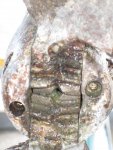
So until I go back I'm not in a position to give better info than my memory allows; but the the yard owner struck the prop and said "It doesn't ring, that means the prop is also knackered". Maybe he is right, this is really not my area of expertise, as I was thinking of fitting a fixed prop I wasn't so concerned about it; but although the prop was not it's shiny normal colour, it is not pitted. Anything that looks like pitting is because I have always sprayed Prop o Drev on it, but last year I'd run out, and although I took it back to my workshop to clean it, due to work pressures I didn't make the usual nice job of it and so refitted it with just a cursory rub over with emery. This left a lot of craters which are really more "prop o drev/not prop o drev"! HOWEVER the gear teeth where it folds do look a little chewed.
The original volvo paint is still (or was) there, however in hindsight, my old berth was a mudberth and perhaps a few scratches can be found.IMG_1657.jpgIMG_1656.jpgIMG_1661.jpg
I appreciate that I may have scratched the alloy when I removed the drain plug every year, so that may have contributed. But having craned out every year, never having seen any corrosion ( and I do look) I'm just gobsmacked that there is so much damage in the one year I didn't.
 
Its a puzzle why the SD is so bad but there appears to have been no action on the anode.

Either the anode is not making good electrical contact with the SD or it is of very very dubious composition.

Also wondering if the electrical insulation between the prop and the shaft has broken down .. leading to galvanic action between the SD and the prop.
 
Top