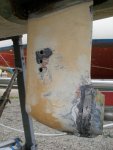
Dead Saildrive; electrolysis? but why isn't the anode more damaged?

Is that so? In view of the many reported problems with saildrives I would have expected them to be anodised at the very least.

The face behind the anode is bare aluminium. Looks to me as if there has been poor contact between the anode and the housing. The anode is barely eroded, but the bearing housing to which it is attached has corroded. If that were mine I think i would replace the bearing housing and clean/etch prime and paint the damaged lower part of the main leg. The standard finish stands up well even to drying out in mud. Usual to further coat it with Trilux to reduce fouling.
 
The anode in question was a genuine Volvo spare.
The point Volvo made was that a film of mud residue built up on the anode during the season causing most of the surface to become inactive i.e. the remaining clear area was too small to protect the drive leg sufficiently. Even after cleaning there was little continuity when checked with a meter !
 
I had a similar saildrive corrosion problem last year. Again the anode was not eroded at all but much of the paint had come off the saildrive leg and there was erosion of the metal around the drain plug. Fortunately not as severe as your photos appear to be. I put the problem down to no electrical contact between the anode and the saildrive, which relies on bare metal-to-metal contact at the small bushes around the mounting bolts. This was found using a multi-meter - I also checked isolation from the engine and prop, which were both OK.

The saildrive needed extensive surface treatment and re-painting. I also added a dangling anode connected ONLY to the saildrive by routing a wire from the top of it's gearbox, out through a deck locker to an eye-bolt where the anode cable gets clipped (the cable is covered in a piece of garden hose to stop it earthing onto the stanchions where it goes overboard). We've just lifted out after a season afloat and I am pleased to say that it still looks good. Much more anode erosion this time.

Corrosion treatment went like this:
1. Abrade away all of the affected areas where white oxide powder has formed until you have solid metal everywhere.
2. Neutralise the aluminium surface with Deoxidine 624 phosphoric acid etch (I bought it from Light Aero Spares in Devon)
3. Etch prime with PR30B (or similar DTD 900/6064) also from LAS.
4. Epoxy build filler to fair the surface if necessary.
5. Marine 2-part epoxy prime, 2 coats.
6. Antifoul Trilux 33 or similar.

As previously posted, unless the leg is severely structurally weakened or seeping oil then it should be repairable.
 
I had a similar saildrive corrosion problem last year. Again the anode was not eroded at all but much of the paint had come off the saildrive leg and there was erosion of the metal around the drain plug. Fortunately not as severe as your photos appear to be. I put the problem down to no electrical contact between the anode and the saildrive, which relies on bare metal-to-metal contact at the small bushes around the mounting bolts. This was found using a multi-meter - I also checked isolation from the engine and prop, which were both OK.

The saildrive needed extensive surface treatment and re-painting. I also added a dangling anode connected ONLY to the saildrive by routing a wire from the top of it's gearbox, out through a deck locker to an eye-bolt where the anode cable gets clipped (the cable is covered in a piece of garden hose to stop it earthing onto the stanchions where it goes overboard). We've just lifted out after a season afloat and I am pleased to say that it still looks good. Much more anode erosion this time.

Corrosion treatment went like this:
1. Abrade away all of the affected areas where white oxide powder has formed until you have solid metal everywhere.
2. Neutralise the aluminium surface with Deoxidine 624 phosphoric acid etch (I bought it from Light Aero Spares in Devon)
3. Etch prime with PR30B (or similar DTD 900/6064) also from LAS.
4. Epoxy build filler to fair the surface if necessary.
5. Marine 2-part epoxy prime, 2 coats.
6. Antifoul Trilux 33 or similar.

As previously posted, unless the leg is severely structurally weakened or seeping oil then it should be repairable.

I would second the suggestion of lack of contact between the saildrive and the anode. I had this problem to a much lesser degree a few seasons ago. When I investigated with a multimeter there was no connectivity between the two. Since then I always scrape the lugs on the saildrive that the anode attaches to and the inside of the hole the bolts pass through and check for continuity before launching. No problems at all since I started doing that.
 
Thanks for all the advice on rebuilding.

There was continuity between the anode and the drive. The attached picture shows the anode had worked but in a limited area !

Apart from these "craters" the remaining surfaces ( both inside and out ) , showed only about 5% continuity with the either the craters or the two small areas behind the fixing bolts, which had been in contact with the drive.

The light brown coating and deposits from the mud had the same effect as painting most of the anode !

PB110329.jpg
 
Is cost the only reason saildrives aren't made out of some sensible material like bronze, composite, steel, etc, instead of melt before your eyes die cast aluminum?
 
Is cost the only reason saildrives aren't made out of some sensible material like bronze, composite, steel, etc, instead of melt before your eyes die cast aluminum?

Really is no need. Tens of thousands in service over the last 35 years and very few have problems. When there are it is failure to change the anode or unusual circumstances such as this which cause the anode to become inactive.
 
Top