clipping on

Chae_73

Well-Known Member
Joined
18 Aug 2020
Messages
373
Location
London / Suffolk
Visit site
When I started sailing, I was told that falling off the boat is one of the most high risk events that can happen at sea, and even in relatively benign conditions, it can be hard to recover a MOB.

As a result, I've always been quite diligent about "clipping on", when on passage, Recently, I was told that if you find yourself overboard but attached to the boat which carries on sailing, you may quickly drown due to water being forced down your throat. Sounds grim.

I also note that the Vendee Globe sailors (and many others) seem rarely to bother attaching themselves to their boat, even when its blasting along at 20 knots in the Southern Ocean, which would seem like exactly the sort of situation when you would want to be clipped on.

So, what are people's views? Do the risks and inconvenience of being clipped on actually outweigh the benefits, unless you are doing something specific such as working at the mast in rough conditions? In that situation, you can use a line that would prevent you from leaving the deck, but when attached to jackstays, it's impractical to have a short enough line that you couldn't end up over the side if something unexpected happens.
 
You may drown indeed this is down to lifejacket design, they're getting better at it. Still safer to clip on imo.

Clip on to the 'other' side of the boat not the closest side.
 
Our usual routine is to clip on when sailing is boisterous, roughly, with a reef, and always at night. We very seldom need to go on deck except for dealing with ropes and fenders, but I clip on when setting up a pole and normally when going forward except in drifting conditions, or possibly sheltered water.

I can’t imagine sailing without a clip in ocean conditions, but then, I can’t imagine sailing an ocean. I always regard the autopilot as potentially the most dangerous item on board.
 
When I started sailing, I was told that falling off the boat is one of the most high risk events that can happen at sea, and even in relatively benign conditions, it can be hard to recover a MOB.

As a result, I've always been quite diligent about "clipping on", when on passage, Recently, I was told that if you find yourself overboard but attached to the boat which carries on sailing, you may quickly drown due to water being forced down your throat. Sounds grim.

I also note that the Vendee Globe sailors (and many others) seem rarely to bother attaching themselves to their boat, even when its blasting along at 20 knots in the Southern Ocean, which would seem like exactly the sort of situation when you would want to be clipped on.

So, what are people's views? Do the risks and inconvenience of being clipped on actually outweigh the benefits, unless you are doing something specific such as working at the mast in rough conditions? In that situation, you can use a line that would prevent you from leaving the deck, but when attached to jackstays, it's impractical to have a short enough line that you couldn't end up over the side if something unexpected happens.
I find the obvious risks apply. Weak crew. Mounting sea conditions. Own fatigue, Going forward under most conditions. Cooking at the galley on passage. Using the tender ( how many get separated from their rubber ducks and drown!) Sea sickness / another other impairment.

If strop length is tailored to layout so that going over the side is almost impossible, then being dragged under when at sea is highly unlikely. Staying upwind when going forward is a useful precaution, using decklines for mobility; having to unclip and reclip when moving about on deck is strictly to be avoided..

Racing types do use harnesses but not when taking that promoter shots I guess; besides they do have to rather jump about all the time to get the most out of their screaming rigs!

PWG
 
If you fall overboard single handed or alone on watch you will drown or die of hypothermia.

If you are clipped on you might get back on board if boat luffs or off watch crew member realises something is amiss. It might not - but it sure improves the odds from 99% certain early death

I know of only once instance when unclipping after falling in saved a life, but that was a freak instance in summer a mere 500m from shore
 
I am usually solo, usually clipped on as I am less risk averse than the professional skippers on the VG.

To date I have only gone in the oggin unintentionally while in the dingy.
 
I sail singlehanded and have a lifejacket with a combined harness to clip on a safety line. In ordinary sailing conditions I do not use a safety line, but in rough weather I will use the safety line within the cockpit. Everything is set up for operation from the cockpit except the mainsail tack during reefing, but this is about to be changed. So there is no need to leave the cockpit except whilst reefing.

Also fitted to my lifejacket is a PLB. Being singlehanded there would be no way of getting back onboard if tethered if unable to get back to the transom. Sailing at 6 knots makes it difficult to do anything at this speed. The PLB might be the best option as instead of a 100% chance of drowning has probably reduced to 50%. So the couple of hundred pounds is worth spending to increase my safety.

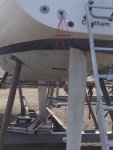
Have you ever tried getting someone out of the water? I have. I was almost prepared to enter the Chatham marina lock and I heard a shout of "Help". It took a while to realise there was a man hanging on to a mooring buoy. I managed to get him alongside and to the transom. It was only then I found my transom ladder did not go into the water enough for him to get his foot on it. Leaving my boat drifting, I tried pulling him out with a rope, but he was too heavy. Another yacht came alongside and with 3 of us we still could not pull him out. As it was the end of April I knew he needed to get out of the water quickly. So I strapped him to the transom and motored to the Medway Yacht Club pontoon as it was very close and had steps on the end. The other yacht moored up first and helped me alongside. Then we moved the man to the steps and he managed to get out of the water. It was only then did we realise the man must have weighed about 18 stone plus wet clothing. To my surprise he started removing his wet clothing, so I found some towels to help dryhim off. He then wrung out his clothes and put them back on. His dinghy flipped as he was board his yacht due to some unexpected wash catching him at that critical moment, luckily he was wearing an automtic lifejacket. He did not want any further assistance and then walked back to Upnor Sailing club to have a warm shower and to phone his wife for some dry clothes. His car key and phone were ruined by the water. Since this event, I have now fitted an emergency rope ladder that can be reached whilst in the water which I hope I will never have to use.

IMG_1560 1000pix.jpg

IMG_1563 cropped 1000pix.jpg
 
We sail at least half the time time without clipping on even when days out sea because sailing is fun, the weather is warm and a harness spoils things compared to a T shirt or less.

However at night, even in the cockpit, and when I’m leaving the cockpit in even moderately rough weather I clip onto the upside Jack stay at the cockpit end and don’t touch the clip until I return. We also have a rule that nobody leaves the cockpit when the other is down below off watch.

When I crewed on a boat going across the Atlantic nobody clipped on going forward or at night but that was too relaxed even for me.
 
I'm not sure what isn't fun about being clipped in. I mean... you're still sailing. It's like wearing a car seat belt, the seat belt doesn't disturb the fun of driving.
 
I’m afraid that as a singlehanded sailor mostly , I tend to put harness on before leaving harbour and it stays on . Tether length may vary but essentially , even down below in galley or chart work ( remember that ??) I am tethered to the boat . Even asleep in a bunk the tether is just long enough from a cockpit attachment point..blue water the thing stays on-period-except for washing haha

And my thinking is : when you are dozing down below or pootling around and something goes bang! against the hull or ping, bang! up aloft, I am not going to say to myself “ hmm , well let’s see, better put my harness on, lean outside and clip it on , then hmmm what’s going on ...” . One is out on deck in a shot in damage control and assess mode ..
Has kept me safe and aboard thus far ...bit of a pita on hot still humid days etc
 
I once organised a sailing holiday of five yachts around Corfu. On the last evening one of the yachts trailed some lines over the stern and I, amongst others, swam over to catch the lines. Unfortunately, the skipper had not told the helm to slow down. The force of the water at five knots makes it very difficult to do anything but hold on. I adopted the white water kayakers' approach and turned onto my back and watched the wave form over my head but still leave me able to breathe. With a life jacket on I would have been forced on to my front and had the wave forced down my throat. That's why the manufacturers are changing the designs.

TBH I was scared
 
On getting back aboard from the water:

In my late teens, I took some friends out on my dad's boat and we sailed from Orford down the river to Aldeburgh. On arrival at Aldeburgh, we got ourselves into a bit of a pickle and ended up going aground more or less adjacent to the yacht club. Hard astern didn't get us off, and knowing that the boat's draft was less than 4', I jumped in and pushed us off. Then I realised that noone aboard could control the boat, and I was clinging onto the rail in soaked clothing.

With a rush of adrenaline, I did manage to haul myself aboard. She had low freeboard and I was fairly light and fit in those days, we were in benign conditions in a sheltered river. It was still touch and go. So, mainly the folly of youth, but it made me think very differently about the difficulty of at sea recovery.

I would have no chance of getting back into our Westerly without something like the ladder which Concerto pictures above. I will this to add this to the list of improvements.
 
We sail at least half the time time without clipping on even when days out sea because sailing is fun, the weather is warm and a harness spoils things compared to a T shirt or less.

However at night, even in the cockpit, and when I’m leaving the cockpit in even moderately rough weather I clip onto the upside Jack stay at the cockpit end and don’t touch the clip until I return. We also have a rule that nobody leaves the cockpit when the other is down below off watch.

When I crewed on a boat going across the Atlantic nobody clipped on going forward or at night but that was too relaxed even for me.
When I met my wife and persuaded her to come sailing we had a few rows about it, but I insisted. If I am skipper you clip on in cockpit in bad weather at night or if leaving cockpit once away from moorings. Or we all go back to moorings and go home.

A friend describing how he could not find his wife on a storm battered boat was traumatic - as it happened she had only got stuck in the heads due to jammed door but he didnt know till the squall was over and he could hear her cries from below not the ocean. His description of his moments of grief and despair still echo - and that from a situation that all turned out well and may even seem comedy when related
 
I think clipping on decision depends on conditions and number of people on board to recover you. Many people are alive because they were clipped on. OTOH some have drowned while clipped on, by going overboard on long tether while working on deck, they may have been recovered if they'd floated free. When a boat overturned a couple of years ago the three guys who were clipped on drowned whereas the fourth who wasn't, swam ashore.
 
I think clipping on decision depends on conditions and number of people on board to recover you. Many people are alive because they were clipped on. OTOH some have drowned while clipped on, by going overboard on long tether while working on deck, they may have been recovered if they'd floated free. When a boat overturned a couple of years ago the three guys who were clipped on drowned whereas the fourth who wasn't, swam ashore.
Its a bit like seat belts. They might occasionally hurt you, mostly they just save your stupid hide. No one swims ashore offshore in UK waters. 40 minutes to hypothermia in the Bristol Channel, 2 hours to death , and thats summer. Your PLB is to help the RNLI find your corpse
 
If you fall off, even a crewed yacht, you might die (whether you have tether or not) your skull can be cracked by your hitting the hull. If you have no tether and the crew inexperienced - they may never find you. In big seas even if the crew are experienced - they might find your body. If you don't believe any of this - just search for the background on the RTW Clipper experiences - count the deaths, think of the training, think of the wealth of experience, the yachts fully kitted out etc.

Work on the simple basis - if you go over the side - you will die.

There are simply too many examples of the worst case scenario - forget the idea you will survive (how often have you won the lottery?)

Focus on ensuring you stay on board, not on what happens if you go over the side. Most tethers are too long. Short tethers (at least 2), good jackstays, good hard points round the yacht, good tether clips. It might be the way of wimps, crawl on the windward side of the yacht (I know real men would stand upright - but they are the ones likely to die) - stay clipped on.

In sunny Oz and if I'm alone I wear a harness all the time. tethers, many of them are clipped so that you can attach one whilst in the saloon etc etc. I'm more worried of being killed by a shark - than hypothermia :(. Not long ago we were able to use our dinghies without a LJ. Too many people drowned, usually older men. Now if you are alone in a dinghy you must wear a LJ. We all said how inconvenient etc etc (after all its sunny Oz) - now its. second nature and not inconvenient at all. Contradictorily you can use a SUP without a LJ (but maybe older, unfit, inebriated men don't use SUPs :) ). If wearing a LJ in a dinghy become second nature - then so should wearing a harness (even on a cat :) ).

Once you have a foolproof jackstay/tether system, that does not allow you to go over the side - as a second phase look at the, much more remote, possibility of retrieval.

When we raced we put a man over the side when sailing at 5 knots with harness and tether. He was completely helpless (as mentioned by a number of members, above).

Don't go over the side - it should be an impossibility.

Jonathan
 
If you fall off, even a crewed yacht, you might die (whether you have tether or not) your skull can be cracked by your hitting the hull. If you have no tether and the crew inexperienced - they may never find you. In big seas even if the crew are experienced - they might find your body. If you don't believe any of this - just search for the background on the RTW Clipper experiences - count the deaths, think of the training, think of the wealth of experience, the yachts fully kitted out etc.

Work on the simple basis - if you go over the side - you will die.

There are simply too many examples of the worst case scenario - forget the idea you will survive (how often have you won the lottery?)

Focus on ensuring you stay on board, not on what happens if you go over the side. Most tethers are too long. Short tethers (at least 2), good jackstays, good hard points round the yacht, good tether clips. It might be the way of wimps, crawl on the windward side of the yacht (I know real men would stand upright - but they are the ones likely to die) - stay clipped on.

In sunny Oz and if I'm alone I wear a harness all the time. tethers, many of them are clipped so that you can attach one whilst in the saloon etc etc. I'm more worried of being killed by a shark - than hypothermia :(. Not long ago we were able to use our dinghies without a LJ. Too many people drowned, usually older men. Now if you are alone in a dinghy you must wear a LJ. We all said how inconvenient etc etc (after all its sunny Oz) - now its. second nature and not inconvenient at all. Contradictorily you can use a SUP without a LJ (but maybe older, unfit, inebriated men don't use SUPs :) ). If wearing a LJ in a dinghy become second nature - then so should wearing a harness (even on a cat :) ).

Once you have a foolproof jackstay/tether system, that does not allow you to go over the side - as a second phase look at the, much more remote, possibility of retrieval.

When we raced we put a man over the side when sailing at 5 knots with harness and tether. He was completely helpless (as mentioned by a number of members, above).

Don't go over the side - it should be an impossibility.

Jonathan
Moderation in all things, I sail for pleasure and very often without a great deal of wind so my attitude is perhaps a little more tolerant than some.
 
A friend describing how he could not find his wife on a storm battered boat was traumatic - as it happened she had only got stuck in the heads due to jammed door but he didn't know till the squall was over and he could hear her cries from below not the ocean.

I experience claustrophobia in lifts etc (due to childhood experience being sent to play with a psychopathic boy who, variously, locked me in a cupboard and/or sat on my head with a cushion to cut off my breathing!) but have learnt to largely anticipate and control my rising anxiety... or take the stairs! If a public or pub loo doesn't have a simple exposed sliding-bolt or I don't 'trust' the tumbler-style lock, then I leave the door unlocked and sing very badly while I'm busy!

On boats I never lock the door to the heads... and even if the door is just closed I always first check I can kick the bloody thing off its hinges!
 
Top