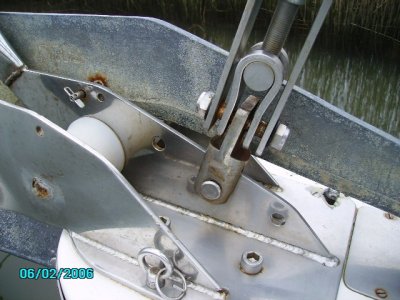
Clevis pin vs nut and bolt to secure forestay to stemhead.

Well I had a brief look on eBay today for a 7/16” A4 bolt and there weren’t any that were a suitable length and part threaded - only set screws. I’ll have a proper look on the web at some point.

Edit: Found some on the web. I think I’ll go with a nut and bolt. The way I see it it’s the same strength as a clevis pin, but a nyloc nut (with ‘red’ threadlock) seems more secure to me than a split pin.
 
Last edited:
Well I had a brief look on eBay today for a 7/16” A4 bolt and there weren’t any that were a suitable length and part threaded - only set screws. I’ll have a proper look on the web at some point.

Edit: Found some on the web. I think I’ll go with a nut and bolt. The way I see it it’s the same strength as a clevis pin, but a nyloc nut (with ‘red’ threadlock) seems more secure to me than a split pin.
Most, many, some clevis pins are 316 stainless. If you are really worried you can source Duplex bolts (though you may not have the range - the issue you describe in your recent post of the length of the threaded vs unthreaded portions).

If you use a Nyloc nut and are generous with the red thread locker you may find it very difficult to release the bolt. Normally you would use heat to release the thread locker but heat will destroy the Nyloc nut.


I don't recall mention ever being made that a clevis pin distorted and or failed. I actually don't recall failure of a cotter pin either other than when re-used - they should be treated as single use, then replace.


You could assemble so to get the spacing, dismantle, drill a hole through the nut (at the correct spacing) and, bolt and use a cotter pin - belt, brace and a piece of string. :). The cotter pin need not be the conventional splint pin but could be the sort like a 'Kirby' grip or one like a key ring.

If you are worried about the cotter pin corroding then overlay with a dob of clear silicone and if there is any corrosion it will show as a browning of the silicone which will be visible through the silicone. Make sure your cotter pin are actually 316.


The thread seemed to migrate to an interesting debate on threads and ignored the reason for the thread - how to secure reliably.

Loctite sets in the presence of water usually from the atmosphere) - it will set under water.

Jonathan
 
Without being able to argue the point I use clevis pins through out with ss split pin. Not sure I like Nigel's threaded rod though of course it depends on size but thread will cut the fittings loaded sideways. But inevitably I use what I have.
Having said that I did have, just like OP, a clevis pin fall out/disappear while sailing. I could not remember the split pin arrangement before it fell out. Fortunately the jib luff/halyard held the mast up and with a high field lever in forestay I was able to substitute a screw driver held in with gaffer tape.
I actually use an ordinary 6mm shackle in forestay for disconnecting fore stay. With a locking wire on pin handle. (small boat 3/16 rigging wire) ol'will
 
Well I had a brief look on eBay today for a 7/16” A4 bolt and there weren’t any that were a suitable length and part threaded - only set screws. I’ll have a proper look on the web at some point.

Edit: Found some on the web. I think I’ll go with a nut and bolt. The way I see it it’s the same strength as a clevis pin, but a nyloc nut (with ‘red’ threadlock) seems more secure to me than a split pin.
Find a bolt with the correct unthreaded length, screw on a nut, cut it to length, smooth the cut end with a grinder or file, Add a hole for locking wire if needed, and finally screw the nut off, which will straighten the threads. A custom bolt.

I'm constantly doing this when building stuff. You never have just the right length in the bin unless you live in a hardware store. Takes less than a minute with practice.
 
Without being able to argue the point I use clevis pins through out with ss split pin. Not sure I like Nigel's threaded rod though of course it depends on size but thread will cut the fittings loaded sideways. But inevitably I use what I have.
Having said that I did have, just like OP, a clevis pin fall out/disappear while sailing. I could not remember the split pin arrangement before it fell out. Fortunately the jib luff/halyard held the mast up and with a high field lever in forestay I was able to substitute a screw driver held in with gaffer tape.
I actually use an ordinary 6mm shackle in forestay for disconnecting fore stay. With a locking wire on pin handle. (small boat 3/16 rigging wire) ol'will

The stud bar is because I have a dual attachment at that point ... stay to stemhead and furling gear side plates.

If I was to use a standard smooth pin and split pin - to just service furling gear would mean fully removing the smooth pin - releasing both furling gear and stay. If I use a bolt - same problem - the solution is a smooth pin with split pin BOTH ends or a short piece of stud bar with nuts each end.
 
If you must use Thread Lock - at least only use Blue ... then at least you have chance to undo the nut later ... Red is deemed 'permanent' ...
Fair point, but as Neeves suggests, a bit of heat will release red threadlock. My stemhead fitting is chunky enough to not transfer the heat to fibreglass.
 
Fair point, but as Neeves suggests, a bit of heat will release red threadlock. My stemhead fitting is chunky enough to not transfer the heat to fibreglass.

I stopped using RED because of its difficulty to release even with heat ....

Just a thought - ever tried soldering or applying heat to an object on deck ?? Slightest breeze and its awfully hard to do !!
 
To me a rigging that is subject to vibration needs a Positive locking device

types of positive locking are as follows'


Nyloc are not considered a a positive locking device

I use a clevis pin and split pin which is closest to a castellated nut and split pin

I alos use a wahter between the split pin and the fork
 
Is that the head of a clevis pin on the lower fork? Is the hole for the retaining cotter pin on the hidden side near where the anchor or chain can catch or rub?
Yes, but it's tight in and doesn't catch, well not for the last 25 years it hasn't 🤞
Afterthought - when I bought a bigger anchor about 12 years ago I moved the anchor over onto the Port side roller..
 
Top