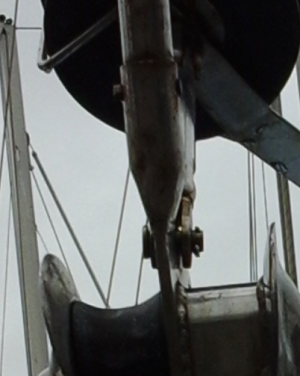
Clevis pin vs nut and bolt to secure forestay to stemhead.

fredrussell

Well-Known Member
Joined
24 Mar 2015
Messages
4,153
Visit site
I recently had a clevis pin disappear from the bottom of my forestay. I don’t know how as I was sailing at the time and the clevis pin and split pin fell in the sea. The toggle fork at forestay end was splayed so I’m guessing the split pin broke or came out. Conditions were quite breezy with short sharp chop and boat was hobby-horsing along at the time. Luckily I have a keel stepped mast so mast stayed up and I was able to spin boat away from wind and get a halyard down to the stemhead quick sharp. Clevis pin (and split pin) was a new one, replaced when I did the standing rigging a year ago.

So my faith in clevis pins is diminished somewhat and I’m wondering why they’re are used in this application rather than a good old fashioned nut and bolt?
 
Last edited:
Probably the split pin failed, allowing the clevis pin to work free.

The question then is: why did the split pin fail?

  • Old pin re-used too many times.
  • Not stainless steel and corroded away.
When did you last do a rig inspection?

Clevis pins and split pins are very reliable components used in innumerable applications ashore and afloat, so they have been proven to be satisfactory
 
I don't see a problem with using a nut and bolt - provided the parallel shank of the bolt completely bridges the eyes of your stem head fitting. You will, of course, need a split pin (or some other) to stop the nut from undoing itself. You should not do the nut up with tension - this is an unfair load on the stem head fitting. In fact - the clevis pin is the correct item for the job.
 
Probably the split pin failed, allowing the clevis pin to work free.

The question then is: why did the split pin fail?

  • Old pin re-used too many times.
  • Not stainless steel and corroded away.
When did you last do a rig inspection?

Clevis pins and split pins are very reliable components used in innumerable applications ashore and afloat, so they have been proven to be satisfactory
He said in the original post "Clevis pin (and split pin) was a new one, replaced when I did the standing rigging a year ago."
 
Another thought - on my boat, the anchor chain runs very close to the forestay clevis pin. Maybe the chain has been rubbing and bending the legs of your split pin and they finally broke. Also - a one year old fitting is not new anymore!
 
Another thought - on my boat, the anchor chain runs very close to the forestay clevis pin. Maybe the chain has been rubbing and bending the legs of your split pin and they finally broke…
Hmm, that’s a possibility. I’ll have a look next time I’m down the boat.
 
Another thought - on my boat, the anchor chain runs very close to the forestay clevis pin. Maybe the chain has been rubbing and bending the legs of your split pin and they finally broke. Also - a one year old fitting is not new anymore!

That is a very good point.

Below is a picture of my forestay attachment. As can be seen, the chain runs close to the head of the clevis pin. That's why the split pin is on the other side, where it can't get knocked by the chain.


1748812922833.png
 
A threaded bolt is never going to be as strong as a clevis pin. I had a clevis pin drop out because the keyring type retainer came out. A properly sized pin with a strong fixing would be my choice.
Please explain. Threaded pins are common practice in the lifting industry. I understand that the cotter pin is not load bearing, but I don't understand why a threaded fixture makes it weaker. I would honestly love to know. So would others.

I should add that threads don't always make things more secure; they certainly can twist off and must be additionally secured in critical applications. In some ways, a cotter is more secure and well proven.

But I don't think I would argue that threads make it weaker (assuming the threads are outside the shackle or fork).

shopping

shopping
 
I've seen it stated that cracks at the point of the V in cut threads are quite common, and in SS, an initiation point for crevice corrosion. Rolled, rather than cut threads, are supposed to be superior in this respect, but not often specified, and might be hard to find.
 
On my 25 - I use Clevis + split pin for the stay to turnbuckle ...... but a threaded short length of stud bar for attachment to stemhead fitting. The stud bar has standard nut either side before the furling gear plates are placed over the stud bar - with another nut to secure them.

Sounds 'Heath Robinson' - but it replaces a plain pin arrangement which was always a pain to disconnect / connect when mast raising / lowering ..

On the 38 - its Clevis pins and split pins all the way ..
 
One of the problems with split pins is that they are usually covered in tape to stop them damaging other stuff. Thus proper inspection is a faf.

A properly fitted bolt with a proper locking system for the nut would allow for easier and more regular inspection.
 
Threads cut into the metal, reducing the effective diameter. The threaded part is therefore inevitably weaker than a pin of the same diameter. However, a partially threaded bolt, like the pin in Thinwater's shackle, should be just as strong. I've used such bolts, with nylock nuts, in similar situations with no problems.
 
I've seen it stated that cracks at the point of the V in cut threads are quite common, and in SS, an initiation point for crevice corrosion. Rolled, rather than cut threads, are supposed to be superior in this respect, but not often specified, and might be hard to find.
Rolled threads are principally used to reduce the likelihood of fatigue, not corrosion. The surface layer is in compression after rolling, making fatigue less likely, plus the stress concentration is considerably lower. Rolled threads are usually used in larger sizes for specific fastenings in machinery.
 
Rolled threads are principally used to reduce the likelihood of fatigue, not corrosion. The surface layer is in compression after rolling, making fatigue less likely, plus the stress concentration is considerably lower. Rolled threads are usually used in larger sizes for specific fastenings in machinery.
On the alternative Vyv, bicycle and motorcycle spoke threads are rolled. The old imperial 6g are the largest I have ever seen, used on some Vintage/Classic car wheels. Motorcycle spokes were normally 10 or 12g with the HD variety being 8g.

Pretty sure the speed of manufacture was why they were rolled, plus the advantage of fewer stress raisers than a cut thread.
 
The process of rolling a thread starts with a bar of a smaller diameter than the finished thread diameter so the bar will be less than a cut thread that weaker then the full diameter then a cut thread bolt
 
I've seen it stated that cracks at the point of the V in cut threads are quite common, and in SS, an initiation point for crevice corrosion. Rolled, rather than cut threads, are supposed to be superior in this respect, but not often specified, and might be hard to find.

Yes ... and at the same time not at all.
  • Standard practice for heavy lifting.
  • The threads, in the sense that the OP was suggesting, won't start until well outside the high stress region. If a cotter pin will hold, there is virtually no bending or shear stress in this area.
Moody?

I'm not suggesting whole sale replacement of clevis pins. I'm not suggesting any replacements. But I've used many threaded pin in heavy rigging and I've used a few bolts in place of pins on boats (specific applications), and I'm not seeing how they are weaker (assuming a good grade bolt, no threads in the stress region, and a locked nut). I want to learn.
 
Top