
Chain locker drain, through hull.

Crazy-Diamond

Well-Known Member
Joined
27 Mar 2019
Messages
175
Location
Essex. UK
Visit site
Hello all,

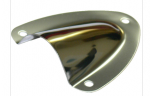
I'm going to fit a drain to my chain locker, rather than it draining to the bilge. I could use one of these:


1588064268889.png

But I don't like the idea of drilling the holes to secure it.

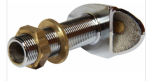
Any reason not to use one of these:


1588064226777.png
 
Using the first pictured fitting would allow for a larger drain hole ,less likely to get blocked and would be easier to unblock ?
I've never seen pic B used for that application.
 
I would have thought around 1/2" but have seen a few as small as 6mm.
I would say drill the hole, coat the edges in epoxy to protect the grp and screw the cover on using very short screws.
I'm sure others on here may be able to give better information in due course ?
 
I have simple holes, about 10mm, port and starboard. It has never been a problem, though you will see witness marks where the water drains.

I would not be keen on drilling 4 holes each side. Provided the GRP is undamaged the holes hardly show. Drill pilots from the inside and open them up carefully from the outside.

A bit of gelcoat would seal it - or epoxy has Rappey has suggested.
 
My anchor storage locker has a drain outlet that is just flush with the hull. I understand that is simply a flared ended pipe bonded into the hull. The anchor storage locker drain does block from time to time, it’s 10-15mm pipe, can’t remember. Poking from above usually packs off whatever has settled, hence the need for external access to poke the pipe through.
My chain locker drains into the bilge and is much lower down anyway than the deck well for anchor storage.
 
Design and use may play a part. Some have deck hatch openings allowing some water in.
Others may anchor a lot introducing weed, mud, sand. Others may never anchor.
A cover over the drain hole could act like a self bailer sucking water out when bow goes through a wave ?
 
My boat, a Leisure 23sl, has a drain similar to second pic. It is indeed small diameter less than 10mm. I anchor most of the time and in
mud, so with a Bruce anchor (no comments please) I can haul up a few clods of dark sticky mud. The drain comes in handy for the occasional clean out. The drain is positioned about an inch above the bottom of the fully enclosed anchor box which has puzzled me until I figured that being a little higher it stops mud and small stones getting into hole. I've never known the drain to block but I did buy a flexible wire drain cleaner from Screwfix for little money.
If I put my gardening gloves on and scoop out most of the built up dried mud this little drain is very effective in quickly emptying a few buckets of water used to sluice out locker and anchor.
The exit is high up on the bow.
 
We have anchor locker drain holes with the covers shown in the first picture. Work fine - the purpose being to avoid forward motion and waves ramming masses of water in under pressure.
Can’t see the issue with drilling three small pilot holes for the three fixing screws. The bow GRP should be very thick there, so short self tappers won’t come through and will be sealed with epoxy or sealant. And clearly there needs to be a much bigger hole for the actual drain water (with edges suitably sealed).

Clearly need to make sure the anchor locker base is well above waterline, and fully watertight floor and rear bulkhead to avoid a Darwin Award nomination.
 
I see yachts with simple drain holes, neatly gel coated, and I see others with clam shell covers - and I think the cover does as Dunedin suggests. You are bound to introduce mud and weed to the locker - it will block the drain hole if the hole is 'too' small and/or you don't clean the locker out as often as possible.

Leaving mud and water in the base of the locker is a sure fire way to reduce chain life - so you need to keep it clean and design the drain hole to remove all, or as much of the water as possible. I'd recommend you line the bottom of the locker with some form of perforated base, a rubber door mat works well, as you will (actually) never completely dry the locker - if you use your anchor.

Here is some leisure reading for you:

Know how: Ground Tackle

Jonathan

It was only when I was collating data for a series of articles on chain lockers I found I did not know what the device was called in the OPs first image - this forum put me on the straight and narrow :)
 
Neeves I can see your concern regarding wet mud in a chain locker. I personally don't haul much water with the anchor but of coarse mud is totally unavoidable if you don't have time to lean over bow and scrub it off. I am singlehanded personally but if conditions are right I have hung anchor on a cleat and given it a quick bath while motoring. Nothing I can do to dry chain except as I tend to sail in the warmer months it seems to dry enclosed in its little plastic box fairly quickly. Also the locker has an inclined floor so have never left achor in a pool of water, I can see that would lead to trouble. Have been trying to get the right rubber door mat for a while, mainly as a 'shock absorber' when hauling chain, but never seem to see them in the shops.
Your article looks very interesting, will save for later thanks.
 
Its not the mud on the anchor that is, usually, the problem but mud on the chain 'in' the links. You can get rid of all or most mud on the anchor by letting it dangle from the bow roller and motoring slowly, making sure the anchor does not bash the stem. Mud on the chain cannot be removed this way as you would need to dangle an awful lot of chain :(. The answer is a deck wash with some reasonable pressure - and take time to clean the chain on retrieval. A still brush and a bucket of water works - but its hard (work).

Some muds are anaerobic and they can exude sulphur containing materials that are acidic, that bad egg smell of mud. If left these compounds will slowly dissolve the gal. Some chain lockers are clean but the chain covered in a white deposit - this is white rust (look it, white rust, up on Google). White rust is more of your gal slowly dissolving.

I recommend that every time you come across free access to fresh water, fuel wharf?, rain?, you wash the chain locker and you should try to air the locker to get it , or the chain, as dry as possible. Lift the hatch slightly allow the contents to air.

Sitting the chain on a perforated base allows the chain to drain, as much as possible, and will ensure it is not sitting in a puddle. The other no no is don't let the chain sit on wet rope - hang the rope on the locker wall/bulkhead.

We bought cheap rubber mats from the hardware shelves of our supermarket and hardware stores have something similar. Lots of industrials premises (abattoirs come to mind, fishmongers.....) use perforated rubber mats. Here Lockers (Lockers were in the UK) sell fibreglass gratings (used for walkways), google 'fibreglass gratings' or the walkways in marinas use perforated walkways.

If you simply leave the chain in a manly location - don't be surprised if it corrodes quickly. I do see some awful examples :(

Now - if you always anchor in nice clean sand - much of this is simply not an issue.

Jonathan

Here we go:

FRP Grating - industrial flooring - lockergroup

It comes in rather large sheets - unless Lockers and the other suppliers will sell smaller pieces - but if you don't ask - you will never know.

Our 'door mat' on the base of our locker is a much less sophisticated version of this

Doormat

I think this sort 'rolls up' ours is all rubber and one piece, holes right through and dimples on the underside - cut it with a stanley knife.
 
Last edited:
Here are some pics of my homemade chain scrubber/cleaner in action (more pics below). Before starting to raise the chain (I have an electric windlass) the device is attached and run down to just below the water level. As the chain is raised I run it up and down, and can see the mud running off in the water. Because I like to keep everything as clean and dry as possible, I tend to pause when raising to allow water to run back down the chain before it comes over the roller. I also position a rag under the chain before the windlass to collect the odd drip.

1583757358801.png


1583757383143.png


This is the scrubbing end (next to a boat hook). There are two domestic gutter downpipe fittings screwed through the pole, each one with a small amount of the circumference cut out, and astro turf matting sikaflexed in place.

1583757392087.png


As you can see, the holes in these are opposing, which stops the chain popping out. Clipping the device on and off is not difficult. There is also a mini brush, designed to help getting mud off the anchor, this has proved less successful, and I may remove it as I am worried it will damage something!

1583757399759.png


The Essex mud is deep and thick. Previous experiences were of significant amounts of mud on deck, and in the chain locker, making for a dirty boat. Since using this I have almost completely eliminated the mud - there just isn't any. I actually thought I must have been anchoring in gravel when first using this, but the Crouch and Roach are mud, and the anchor had plenty of mud too. It just works, and is super simple, much more simple than my original plan of fitting a pump.
 
My main desire with the intended modification to the chain locker is to avoid water from the rain, and when taking a big wave over the bow, ending up in the bilges. Some water from raising the anchor does get in there too of course, but it is not often ending up in the bilge, unless I anchor every day for a few days. Rain and wave water does get in there, and I don't want to fit something in, or over, the windlass to prevent this. I prefer the chain locker drain idea as much better.
 
I have anchor locker drain holes with the stainless covers as shown in the first picture, they have been on the boat for thirty years and never been a problem.
As the type in the second picture are cast I would think that they are more prone to corrosion and will probably show signs of pitting after a few years. Stainless won't.
 
I share the OP's dislike of drilling holes in my boat. I would use the first variety and just stick them on with sikaflex/ct1/etc. They would stay on there I reckon.
 
Top