Catalac 9M confusion

and bought a 20hp 4 stroke Tohatsu that with a hi thrust 4 blade prop is pretty good. Quiet, good fuel consumption and with power tilt I tend to sail more as no bother to just drop or lift the leg. I think the 9M needs a 25/30 hp sized engine.

Good info. That is actually my main concern with these 2, 2-stroke engines that comes with the boat. Noise and consumption. But I guess that's more of a "luxury" problem than an actual "Have to be fixed" problem so I can live with that.
 
@stu9000 . Thanks for joining in with your experience here. I'm sorry to hear the "Maybe best viewed as a motorsailer". That's exactly what some people seem to think about this boat and that concerns me a little, cause I'm not buying a sailboat to motor around. Are you referring to the windward sailing or was that your experience of the boat in general? Can I ask how heavy you were on this trip? I'm asking because I have noticed in other threads around the internet, that some of the people that say they ended up mostly motoring also oftentimes gave an impression of being heavy when they set sail, and I was kinda hoping that might be a big part of the reason they ended up not liking the boat.

It was a long long time ago. Probably heavy'ish as we were a family of 5. But not overloaded.
Fairly beamy bluff hulls (e.g. compared to a wharram) mean she will find it harder to push through the water.
But you do get the accommodation.

No doubt you are here because you want to make a choice that will still be valid in a couple of years time.
Online research is valid but there is no substitute for getting a feel for things on the water.
I recommend joining a club (cheap if you are not paying mooring fees) and crew for a few people.

Moody 36 sounds good to me.
I have a Westerly 35 cc and she is a great family boat that is big enough for the hoards but I can still single hand.

What's your budget? I thought the M36cc would be pricier than a Catalac.

S
 
Thanks, this is really good to know and lead me to ask the seller about this. His answer was:

"The pevious owner modify the rudderblades to long full metal ones. Bit heavyer than the original setup but much more stronger than the plywood ones. They are long as the deepest point of the bottom and the surface is big enough to reduce the side drifting"

How does this sound to you guys?
The original lifting metal blade rudders had the top part made of wood and the steel blade swung down in that. The wood would rot however the steel was 12mm thick I think and quite heavy. My concern about all steel rudders would be the weight right at the back?
 
It was a long long time ago. Probably heavy'ish as we were a family of 5. But not overloaded.
Fairly beamy bluff hulls (e.g. compared to a wharram) mean she will find it harder to push through the water.
But you do get the accommodation.

Thank you for getting back to me. I'll be a, unfortunately single, liveaboard, and do everything within reason to keep her light, so I'm hoping that might negate some of the "problems" you encountered. I would guess the extra 4 people you were carrying might give me maybe a good 200kg advantage?

No doubt you are here because you want to make a choice that will still be valid in a couple of years time.
Online research is valid but there is no substitute for getting a feel for things on the water.
I recommend joining a club (cheap if you are not paying mooring fees) and crew for a few people.

Yes, I very much am, since I am not buying the boat I want right now, so I'll be selling again soon'ish, depending on how much the coming economical instability will further impact the boat market of course. It's very clearly already taking its tools on the market here in the Med. Not in Denmark though, my friend told me yesterday. I guess rich people will be rich :) (I'm Danish so not hating on anyone here)

And I completely agree that the right way to go now would be to get out on the water, get some experience, and buy a small monohull to learn on, but I am really aiming to be on the water within weeks, so I'm just a little out of time here. 100% my own fault, but the Covid kind of got in the way of my "well made" plans, so what to do.

Moody 36 sounds good to me.
I have a Westerly 35 cc and she is a great family boat that is big enough for the hoards but I can still single hand.

What's your budget? I thought the M36cc would be pricier than a Catalac.

The Moody I have on hand sounds absolutely amazing and she is well within budget. But I'm really holding out, at least a few more weeks, to get onto a Cat. She would be more expensive than I'm hoping the Catalac will end up being. The thing about the Catalac I'm looking at is, that she's a REAL fixer-upper so I have to do a lot of research to make sure I don't end up getting in too deep, because if that were to happen, the Moody with only a few things to be done, would most definitely be the better choice.

I don't have "a budget" as per see. I'm aiming to get out there as cheap as possible, in a boat of a known and trusted brand, so that it will hold it's value for a sale again 2021 - 22. And to keep her in a price range that has a large potential buyers group, even if the economy and market collapses now, I'm just thinking to keep her under €30K

Am I being a complete idiot here in trying to do this?
 
The original lifting metal blade rudders had the top part made of wood and the steel blade swung down in that. The wood would rot however the steel was 12mm thick I think and quite heavy. My concern about all steel rudders would be the weight right at the back?

The weight was my first thought when he wrote me about the new rudders. But this one has 2 outboards with a combined weight of about 55kg, so I was kind of hoping the heavier rudders wouldn't be as much of a problem since this boat is available with 2 inboard diesels. Not right on the back of course, but that was my hope?
 
A few things here mate , you talk about saving weight etc , that is only relevant in a boat which has sailing speed / performance potential , dont be mistaken , the Lac does not have that , whatever good points it may have ( internal accommodation ) , consideration towards sailing performance is not an issue ,,, Second , do not even think about converting to electronic propulsion , that will be an enormous undertaking and expensive , factor that into the purchase price and you are already into a different level of vessel , if you are really sold on this boat then get it and enjoy it for what it is and be prepared to loose a lot of doe on it ...
 
30k should be enough to get something around 35 foot that is in good shape.
The "fixer upper" can be more expensive as inevitably there are many issues uncovered soon after purchase.
Better to spend a bit more initially and not have to buy a new engine, rig, sails etc.
 
you say you are in Lisbon,, there is , what would appear to be , a nice wharram advertised for sale in Africa , i think that is near Portugal :rolleyes: , i expect it will be available for much less than the asking price ........ if you are unfamiliar with wharrams then check out these vids on you tube ,, " luckyfish " and " sailing Tangaroa " , both show the potential of these boats.
 
you say you are in Lisbon,, there is , what would appear to be , a nice wharram advertised for sale in Africa , i think that is near Portugal :rolleyes: , i expect it will be available for much less than the asking price ........ if you are unfamiliar with wharrams then check out these vids on you tube ,, " luckyfish " and " sailing Tangaroa " , both show the potential of these boats.
Not decrying the Wharram cats but I do not think they would make a practical livaboard prospect. I am thinking of the disadvantage of the accomodation being mostly in each hull, with a steep climb up/down to get to the other side and little in the central cabin.
 
Last edited:
Hi There,
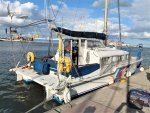
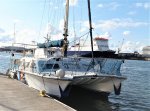
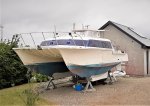
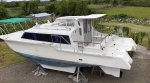
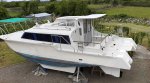
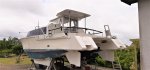
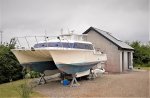
I thought I would share some shots of my Catalac 9M Longtail. It’s based on a 1976 Mk1 model that I bought for 13K euros. It came with the bonus of two old 14HP Beta engines which had only 650 hours on them (although the engines and their drive-trains looked terrible, the heart of these low hour engines were sound).
The problem with buying an old boat of 20 years old or more is that much of the superficial fabric and general hardware will be broken, corroded or worn-out, so be prepared?
I spent a couple of years looking for a small/medium cat to no avail, there was nothing around on the market, I took three trips abroad with no success and then gave-up and grabbed this Catalac 9M Mk1 in Dublin as soon as it popped up.
Although the Catalac had great internal accommodation, I was very un-impressed with the some of the vessels marine design features. So, I decided remodel it and bring it into 21st century both aesthetically and functionally, and in fact to endeavour to build the best Catalac 9M in the world. As its length is now increased to 10M long, I suppose it could be called the Catalac 9M Mk4?
A major benefit of these old boats is that they were solidly built with mostly solid oversized GRP in the hulls and topside mouldings with only limited coring here and there around topsides.
My plan was to maintain the hulls original integrity and to externally bond-on the new hull and topside mouldings.
To that end I fabricated 15 separate unique moulds/plugs and then laid-up the new 15 Polyester GRP mouldings. They were trimmed to size and then bonded-and-bolted on to the vessels external structure.
The new moulding units are: -
2 x Keel skegs, 2 x Pilot house topside mouldings, 2 x Rudder skegs, 2 x Rudders, 4 x Transom extensions, 2 x Pilot house side walls and an Aft Deck extension moulding.
I might mention that as a young man in 1977 bought a stage one Prout Snowgoose 37 Stage 1 Kit boat (Delivered with just the top and bottom mouldings lightly riveted together) and spent two years in a boat yard fitting it out. So, I do have some experience playing with boats.
So, I will leave it there as I could drone on and on.
Suffice to say that although my Catalac longtail project is very still much work-in-progress, I hope to emerge with a sexy modern looking catamaran with improved performance, (I have some interesting performance upgrade ideas).
In my view this modified 9M catamaran will be just perfect for family/single handed use at relatively low cost.
So, MS Journey, if you find yourself looking at your newly bought old Catalac 9M, remember it can be a very versatile craft, it’s up to you how far you want to go?
I hope you find the above interesting/helpful.
Tony H
Catalac 9M Longtail- A Reduced size.jpgCatalac 9M Longtail- A Reduced size.jpgCatalac 9M Longtail- B Reduced size.jpgCatalac 9M Longtail- B Reduced size.jpgCatalac 9M Longtail- C.jpgCatalac 9M Longtail- C.jpgCatalac 9M Longtail- Original boat, Reduced size.jpgCatalac 9M Longtail- Original boat, Reduced size.jpgCatalac 9M Longtail- A Reduced size.jpgCatalac 9M Longtail- B Reduced size.jpgCatalac 9M Longtail- C.jpgCatalac 9M Longtail- Original boat, Reduced size.jpgCatalac 9M Longtail- Original boat, front view. Reduced size.jpgCatalac 9M Longtail- Pole Dancer, Reduced size.jpgCatalac 9M Longtail- Original boat, front view. Reduced size.jpgCatalac 9M Longtail- A Reduced size.jpgCatalac 9M Longtail- B Reduced size.jpgCatalac 9M Longtail- C.jpgCatalac 9M Longtail- Original boat, Reduced size.jpgCatalac 9M Longtail- Original boat, front view. Reduced size.jpgCatalac 9M Longtail- Pole Dancer, Reduced size.jpgCatalac 9M Longtail- Pole Dancer, Reduced size.jpgCatalac 9M Longtail- A Reduced size.jpgCatalac 9M Longtail- B Reduced size.jpgCatalac 9M Longtail- C.jpgCatalac 9M Longtail- Original boat, Reduced size.jpgCatalac 9M Longtail- Original boat, front view. Reduced size.jpgCatalac 9M Longtail- Pole Dancer, Reduced size.jpg
 

Attachments

  • Catalac 9M Longtail- C (2).jpg
    Catalac 9M Longtail- C (2).jpg
    590.7 KB · Views: 9
  • Catalac 9M Longtail- A Reduced size.jpg
    Catalac 9M Longtail- A Reduced size.jpg
    914.9 KB · Views: 12
Hi There,
I thought I would share some shots of my Catalac 9M Longtail. It’s based on a 1976 Mk1 model that I bought for 13K euros. It came with the bonus of two old 14HP Beta engines which had only 650 hours on them (although the engines and their drive-trains looked terrible, the heart of these low hour engines were sound).
The problem with buying an old boat of 20 years old or more is that much of the superficial fabric and general hardware will be broken, corroded or worn-out, so be prepared?
I spent a couple of years looking for a small/medium cat to no avail, there was nothing around on the market, I took three trips abroad with no success and then gave-up and grabbed this Catalac 9M Mk1 in Dublin as soon as it popped up.
Although the Catalac had great internal accommodation, I was very un-impressed with the some of the vessels marine design features. So, I decided remodel it and bring it into 21st century both aesthetically and functionally, and in fact to endeavour to build the best Catalac 9M in the world. As its length is now increased to 10M long, I suppose it could be called the Catalac 9M Mk4?
A major benefit of these old boats is that they were solidly built with mostly solid oversized GRP in the hulls and topside mouldings with only limited coring here and there around topsides.
My plan was to maintain the hulls original integrity and to externally bond-on the new hull and topside mouldings.
To that end I fabricated 15 separate unique moulds/plugs and then laid-up the new 15 Polyester GRP mouldings. They were trimmed to size and then bonded-and-bolted on to the vessels external structure.
The new moulding units are: -
2 x Keel skegs, 2 x Pilot house topside mouldings, 2 x Rudder skegs, 2 x Rudders, 4 x Transom extensions, 2 x Pilot house side walls and an Aft Deck extension moulding.
I might mention that as a young man in 1977 bought a stage one Prout Snowgoose 37 Stage 1 Kit boat (Delivered with just the top and bottom mouldings lightly riveted together) and spent two years in a boat yard fitting it out. So, I do have some experience playing with boats.
So, I will leave it there as I could drone on and on.
Suffice to say that although my Catalac longtail project is very still much work-in-progress, I hope to emerge with a sexy modern looking catamaran with improved performance, (I have some interesting performance upgrade ideas).
In my view this modified 9M catamaran will be just perfect for family/single handed use at relatively low cost.
So, MS Journey, if you find yourself looking at your newly bought old Catalac 9M, remember it can be a very versatile craft, it’s up to you how far you want to go?
I hope you find the above interesting/helpful.
Tony H
View attachment 99858View attachment 99859
I like what you have done to the tramsom but the extended keels do alter the safety aspect of the Catalac. I have only heard of one capsize and that had much smaller modified keels. With the standard keels if over canvased you go sideways very nicely as I have found out a few times. The disadvantage of the standard hull is leeway that your keels should remove. Be interesting to know what apparent wind speed you start to reef at.
I've have fancied installing leeboards to give some improved windward performance and when the weather gets to much you haul them up for safety. This also maintains the shallow draft that I do appreciate.
 
I like what you have done to the tramsom but the extended keels do alter the safety aspect of the Catalac. I have only heard of one capsize and that had much smaller modified keels. With the standard keels if over canvased you go sideways very nicely as I have found out a few times. The disadvantage of the standard hull is leeway that your keels should remove. Be interesting to know what apparent wind speed you start to reef at.
I've have fancied installing leeboards to give some improved windward performance and when the weather gets to much you haul them up for safety. This also maintains the shallow draft that I do appreciate.


Hi Boathook,
Thanks for your both comments, ref the new transom comment and also that the new keel skegs alter the safety aspect, yes, I also agree the boat will be much safer with them!
To answer your three main points:

A) The new keel Skegs will now allow me to beach the boat and to sit happily on the level. Because the Mk1 was fitted with hinged rudders to allow one to pull them up to save from being damaged when the weight of the two engine systems, 4 big batteries and 65Lt hot water cylinder all located aft tipped one’s stern down into the sand/mud, leaving the boats bow stuck up high in the air. (The builders cured this problem later by means of a rudder skeg on the Mk2 which supported the stern).

B) Yes, the new keel skegs will make the boat much safer in that when you set a course one has a much better chance of keeping the course to where you want to go, particular useful in tight congested seaways/ dangerous coastal geography.

I have never sailed a Catalac 9M before but I have sailed a Prout Snowgoose 37 extensively. Since buying this cat I have read many articles and am amazed how the builders managed to spread the myth that their boat was somehow safer because it had very poor lateral resistance and then this idea that it's safer if your boat side slips seems to have been picked some of the more vocal Catalac owners who continue perpetuate this false notion.

The guy I bought my Catalac off complained bitterly how he couldn’t steer a course anywhere towards the wind and in fact he had to turn one of the engines on to come about, because without the engine the boat would just stop. This of course is a function of the Mk1’s undersized rudders as well as the boats side slip problem. There are very many reasons why boats capsize. Ref, the one you mentioned, it could be because it was coloured blue! Maybe? That could be a very unlucky colour for all we know??

If you go to one of the websites that references popular boats and you look at the profile view of a Snowgoose 37 you will see its keel skeg and will notice that they nearly a replica of my new skegs proportionally size wise. And as you will know Prout Snowgoose have safely traversed the globe many many times.

My advice is, don’t worry about lifting a lee board just in time before catastrophe. Fit some keel skegs, enjoy safe sailing and if and when required just flick the main sheet out of its pulley snatch lock and in 2 seconds, half the risky wind force on the boat will be gone, etc.

C) Yes, the boats draft will be 9” deeper, but what can one do?

Cheers,
Tony
 
This is quite a nice one - I was in a boatyard in Wales about 10 years when it was being re-fitted very carefully by the owners for a trip to the Med which I believe it did and then returned.
Buy Catalac 9m | Catalac 9m for sale

Hi C08,
Thanks for that, it looks like a very tidy boat. I am focusing on the outside first and have to yet start on the inside which is stripped out, for a full refurb.
Cheers,
Tony
 
Hi Boathook,
Thanks for your both comments, ref the new transom comment and also that the new keel skegs alter the safety aspect, yes, I also agree the boat will be much safer with them!
To answer your three main points:

A) The new keel Skegs will now allow me to beach the boat and to sit happily on the level. Because the Mk1 was fitted with hinged rudders to allow one to pull them up to save from being damaged when the weight of the two engine systems, 4 big batteries and 65Lt hot water cylinder all located aft tipped one’s stern down into the sand/mud, leaving the boats bow stuck up high in the air. (The builders cured this problem later by means of a rudder skeg on the Mk2 which supported the stern).

B) Yes, the new keel skegs will make the boat much safer in that when you set a course one has a much better chance of keeping the course to where you want to go, particular useful in tight congested seaways/ dangerous coastal geography.

I have never sailed a Catalac 9M before but I have sailed a Prout Snowgoose 37 extensively. Since buying this cat I have read many articles and am amazed how the builders managed to spread the myth that their boat was somehow safer because it had very poor lateral resistance and then this idea that it's safer if your boat side slips seems to have been picked some of the more vocal Catalac owners who continue perpetuate this false notion.

The guy I bought my Catalac off complained bitterly how he couldn’t steer a course anywhere towards the wind and in fact he had to turn one of the engines on to come about, because without the engine the boat would just stop. This of course is a function of the Mk1’s undersized rudders as well as the boats side slip problem. There are very many reasons why boats capsize. Ref, the one you mentioned, it could be because it was coloured blue! Maybe? That could be a very unlucky colour for all we know??

If you go to one of the websites that references popular boats and you look at the profile view of a Snowgoose 37 you will see its keel skeg and will notice that they nearly a replica of my new skegs proportionally size wise. And as you will know Prout Snowgoose have safely traversed the globe many many times.

My advice is, don’t worry about lifting a lee board just in time before catastrophe. Fit some keel skegs, enjoy safe sailing and if and when required just flick the main sheet out of its pulley snatch lock and in 2 seconds, half the risky wind force on the boat will be gone, etc.

C) Yes, the boats draft will be 9” deeper, but what can one do?

Cheers,
Tony
Tony.
I am fairly vocal about Catalacs and have pushed mine to the limit. Not so much now as older and wiser ....... I'm not to sure how yours will be safer apart from maybe going to windward a bit better.
Been sailing on a Mk1 version for over 40 years and it had the lift up rudders changed to fixed by the Lacks in the late 70's / early 80's. Yes yours will go to windard a lot better but is more likely to trip over if you don't reef in time. Catalacs don't really complain about to much sail until it is really bad. Hearing owners talk about modifying the keels always concerned the Lacks (who built and designed the boats). Its not just the wind force but a fairly narrow beam by mulithull standards though the Gemini 105mc is the same width and a meter longer plus a capsize on the RTI race. We have broached with the spinnaker up many years ago and I don't want to repeat it.
I am interested in how yours does perform so please do post results.
 
Hi Boathook,
It's good to hear that you have 40 years of faithful Catalac experience, well done. I think we are both of a very similar young age. And I guess you will agree with my statement that today’s sailing/cruising national and international regulations and laws have moved-on from virtually none in the old days to a stifling level of big brother’s control that has (for me at least) ruined that wonderful sense of incredible freedom one felt, that when you leave your port you could go practically anywhere without too much fear officialdom, red tape and fines etc.

Back to the point in hand, Keel skegs:
I believe that I will be much safer with my new keel skegs and hence a much-improved lateral stability/bite then you will have with your standard boat (with none).
The reason is simple, I will have much more control over my vessel knowing it will generally go where I point-it.

One just has to look at the whole modern catamaran market in today’s world. Now it’s all about the trade-off between maximum lateral stability (Bite) and the cost in skin friction/Drag. Depending on the boats main designed function is (e.g. Racing, Cruising or multifunction) builders/designers go from daggerboards-etc to skegs or modified skegs. No one is interested in building a hull that can’t be trusted to hold a course on certain compass bearings.

With respect, envisage a shop on the high-street that sells Catamaran model replicas. As you walk in the door it’s a square layout shop with shelves on three sides. On the right side its cluttered with many different catamaran types. On the left side there is the Catalac range and in particular the 9M model. Then on the back-wall shelves there sits a lonely raft, made of two big logs with a wood deck bolted on to the logs and a small rigged mast on top of that.

That’s how I see the Catalac 9M. It’s one or two units up from the raft and it’s two to seven units down from the gathered group of cats on the right side of the shop. In terms of lateral stability, it's in a class of its own, with a design (in my opinion) that will never be built again.

Just thinking? If one was very concerned about that very rare condition where squalls or sudden high gusts could flip the vessel when you were occupied below etc, you could custom-design an add-on safety unit that was max-load-calculated and set pop-off both sheets in that event??
Cheers for now,
Tony

PS: Having said that, I do like the skinny deep Vee design with its lifting chine profile and its rising smooth flow stern section (but not the vertical square transom).
I am very hopeful that my tweaking of its design with the new keel skegs, rudder skeg/rudder assembly and my new transom improving smooth flow buoyant extensions; I will have a much-improved boat, performance-wise. Time will tell?
 
Really interesting Tony, when is the maiden voyage? May I invite you to share experiences on facebook page Catalac catamarans? I myself am in the process of building a bow-e motor construction functioning as bow thruster as well as extra propulsion unit , pivoting it towards the wind aiming for better windward performance without having the noisy diesels to stand by.
 
Last edited:
I saw a catalac a few months ago approaching portsmouth harbour.
It had an outboard of a fair size mounted on each hull and was motoring a good 18 knts !
 
Top