Can you tell off the top of your head...

Be honest!


  • Total voters
    96
It’s a retro fit not the original builders work that’s the point .

I guess it saves drilling holes in that vertical pannal with the limber hole in - aside any residual water ( small amount ) I suspect will run back getting on the plane or running ,slightly bow high ,or rising up a wave in a swell .

No worries , from me and here’s why - - —-

We have two internal lateral metal pipes or I called them “ manifold s” as I don,t know the terminology.
It’s these that are cocked out at the stern below the WL .
They are high @ the front and angle down towards the stern .,like a drain pipe on a house but more horizontal ish. The dia increases as they run back / downhill to the stern .
Anything ( drains ) that’s connected has a short pipe run into them .
Lower stuff like that shower sump and bilge pump -near the bow area - water is pumped up
I like that idea as opposed to just drilling a hole in the hull nearest the thing you want to drain .
Remember it’s got a big cockpit ( relative to other boats ) and easily removable ER covers / cockpit soles .
There a lot of little drains for the gap s between these pannal s ( not to be confused with the main scuppers ) these too connect to the “ manifold “ thingys on the lateral aspect of the ER .These drains are gravity fed .

Just picking up on your point of standing water in pipes ,ie water “ having to run uphill “

How do bilge pumps generally work in that respect ?Not just my boat but everybody’s boat ! Inc yours and PeteM,s

Thinking aloud in my mind the pick up pump should be as low as possible cos that’s where gravity takes the water - this entails a below waterline placement scenario.
Then the exit is above the WL ? So water is pumped up hill to get out either through a hole drilled in the hull near or into something else like this internal “ manifold “ thingbob?
With no none return valve when the pump stops ,the pipes vol runs back - surely ?
With any form of none return valve the pipes vol stays in the pipe - yes ?

I think you are worrying too much about a drop un pressurised AC condensate in a 12 mm pipe , which sits there’s until planning .

In the bigger scheme

Reflect for a moment on the hydraulic hoses , fuel lines , engine cooling plumbing , engine oil plumbing , AC cooling plumbing , water maker plumbing and don,t forget the geny(s) add the domestic water and toss in the black tank arrangement .

In my book that little retro fitted AC drain is waaaay down the worrie list of - what if ————
Think we've done this to death. I'm honestly not worried about it at all :D. Ref bilge pumps, they have to pump uphill. The water doesn't stay in the pipe unless you fit a n/r valve (which btw I never would) so you have to mop your bilges after pumping if you want bilges nice dry/eat your dinner off them bilges
 
Last edited:
I didnt spec anchor wash because you don't need it with polished ss chain. If I did it would be freshwater.
I'm not sure to agree ref. wash being completely useless with ss chain.
But it's refreshing to hear that I'm not alone in thinking that it's worth wasting freshwater, if and when necessary! :encouragement:
A seawater pump for chain wash was standard installation on my DP, but it didn't work when I bought her.
So, while discussing with her builder the refitting program, he included it in the list.
When I told him that rather than replacing it, I was going to chunk it overboard and connect the hose to the freshwater circuit, he was shocked! :D
 
Mine is like a jet wash with two outlet nozzles eitherside of the box bit of the pocket anchor .
It’s sea water. But what is does best is blast weed off the chain / anchor and blows it out as the chain comes in.
Other wise your anchor locker has a tendency to fill up with weed .
You need a powerful pump to blast ,not just a gentle rinse .
If am bothered in the marina during hose down I can hose the chain in fresh otherwise rain drains do it anyhow .
 
I dont see the point of having a separate seawater pick up for the shaft seal
Just FYI (and/or for anyone else who might be curious about that), your comment made me also wonder what the point is, so I thought to ask.
I was told that most engine manufacturers (the chap I spoke with was sure of MAN and MTU, but he believes it's also true of Cat and VP) suggest to connect to the engine raw water cooling circuit only accessories (like the gearbox and v-drive, for instance) which use such raw water in a closed loop, without draining out any water.
The reasoning is that draining raw water from the engine raw circuit is bound to reduce to some extent the cooling of the exhaust wet section.

Obviously, such potential negative effect depends on the quantity of water which is drained from the engine raw circuit, and I suppose that any builder who decided to go that route must have calculated that the cooling pipe connected to shaft seals is not large enough to set the boat on fire...
But that's just to explain the logic behind alternative installations.
 
Just FYI (and/or for anyone else who might be curious about that), your comment made me also wonder what the point is, so I thought to ask.
I was told that most engine manufacturers (the chap I spoke with was sure of MAN and MTU, but he believes it's also true of Cat and VP) suggest to connect to the engine raw water cooling circuit only accessories (like the gearbox and v-drive, for instance) which use such raw water in a closed loop, without draining out any water.
The reasoning is that draining raw water from the engine raw circuit is bound to reduce to some extent the cooling of the exhaust wet section.

Obviously, such potential negative effect depends on the quantity of water which is drained from the engine raw circuit, and I suppose that any builder who decided to go that route must have calculated that the cooling pipe connected to shaft seals is not large enough to set the boat on fire...
But that's just to explain the logic behind alternative installations.

Yes I would tend to agree with that only to say that the quantity of water being drained off for the shaft seal cooling is very small (judging by the dia of the pipe at least on my boat). However, as I mentioned, the shaft seal cooling pipe on my boat is connected to the gearbox cooling circuit which is a simple open cirvuit
 
Yes I would tend to agree with that only to say that the quantity of water being drained off for the shaft seal cooling is very small (judging by the dia of the pipe at least on my boat).
However, as I mentioned, the shaft seal cooling pipe on my boat is connected to the gearbox cooling circuit which is a simple open cirvuit
Agreed ref. quantity, but with reference to what we are discussing I can't see the difference between picking up the raw water directly from the engine circuit or from the g/box.
Usually the raw water which goes to the g/box heat exchanger is picked from the engine circuit anyway, and it goes back to it before flowing out through the exhaust system.
So, it doesn't matter whether some of the sea water is drained out from the engine or the g/box circuit - it's still water "missing" in the exhaust flow, eventually.
Or does your gearbox have its own raw water circuit+pump? Can't remember to have ever seen such solution...
Just curious - either way, no worries! :encouragement:
 
Agreed ref. quantity, but with reference to what we are discussing I can't see the difference between picking up the raw water directly from the engine circuit or from the g/box.
Usually the raw water which goes to the g/box heat exchanger is picked from the engine circuit anyway, and it goes back to it before flowing out through the exhaust system.
So, it doesn't matter whether some of the sea water is drained out from the engine or the g/box circuit - it's still water "missing" in the exhaust flow, eventually.
Or does your gearbox have its own raw water circuit+pump? Can't remember to have ever seen such solution...
Just curious - either way, no worries! :encouragement:

Hopefully this will go some way to satisfy the (healthy btw ) curiosity.
With this set up the “T ed “ off water for the shaft seal is not robed from any riser cooling as it’s doner was not heading off to the riser anyhow , it’s got it’s own exit
[Note old pics ,things have been cleaned/ tidy since ]

https://imgur.com/a/LKsPv
 
Or does your gearbox have its own raw water circuit+pump? Can't remember to have ever seen such solution...
Just curious - either way, no worries! :encouragement:
If I remember correctly there is a separate raw water cooling circuit for the gearboxes/shaft seals. There is certainly a seacock under each gearbox and my memory says that the pipe goes straight to the intercooler on each gearbox but I will have to check for sure when I next go to the boat
 
Well folks, before I was just curious, but now I'm also confused! :rolleyes:

@PF: I don't know the 6L very well, but isn't the box in your first pic with the blue and red outlets the heat exchanger of the engine coolant?
If it is, your engine is obviously very different from mine, as well as Deleted User V12.
Btw, I'm not 100% positive, but IIRC the following is also true of Cat engines (no idea about VP).
In MAN V8/10/12 engines, the raw water pickup for the gearbox cooler is just downstream of the raw water pump, and the return is immediately afterwards (I'll elaborate further in a minute, with pics).
In your setup, the sea water seems to be routed at the gearbox cooler only at the end of the engine cooling circuit (after going through intercooler+heat exchanger), which afaik is unusual, because this way the poor gearbox is bound to be cooled by warmed up sea water - and the higher the engine rpm/load, the warmer sea water gets, right when also the g/box needs more cooling, which doesn't sound logical.
Otoh, I suppose that a somewhat larger cooler can deal with that, so obviously I'm not suggesting you to repair something that ain't broken... :)

That said, what I can't get my head round is the label under one of your pics: "Once through the G box cooler it’s sent to the underwater exhaust box to exist via its own hole - so it’s not robbing the riser anyhow because the G box raw water does not go to the riser".
Now, aside from the fact that this statement seems to me self-contradicting, also looking at your pics I would rather say that "Since the return from the g/box cooler goes straight to the exhaust box, it does subtract some cooling to the riser".
And by and large, I would think that this cooling reduction is more relevant than with shaft seals alone, simply because the g/box cooler pipes are larger.

Happy to be corrected if I misunderstood something, though!

@Deleted User: I'd be shocked if your gearboxes would only be cooled by dynamic flow of seawater.
I mean, surely when g/boxes are not engaged they generate just a tiny fraction of the heat compared to max rpm/load.
But ZERO cooling unless the boat is moving?!? That can make sense for shaft seals for obvious reasons (zero rotation, zero heat), but not for the gearboxes, imho.
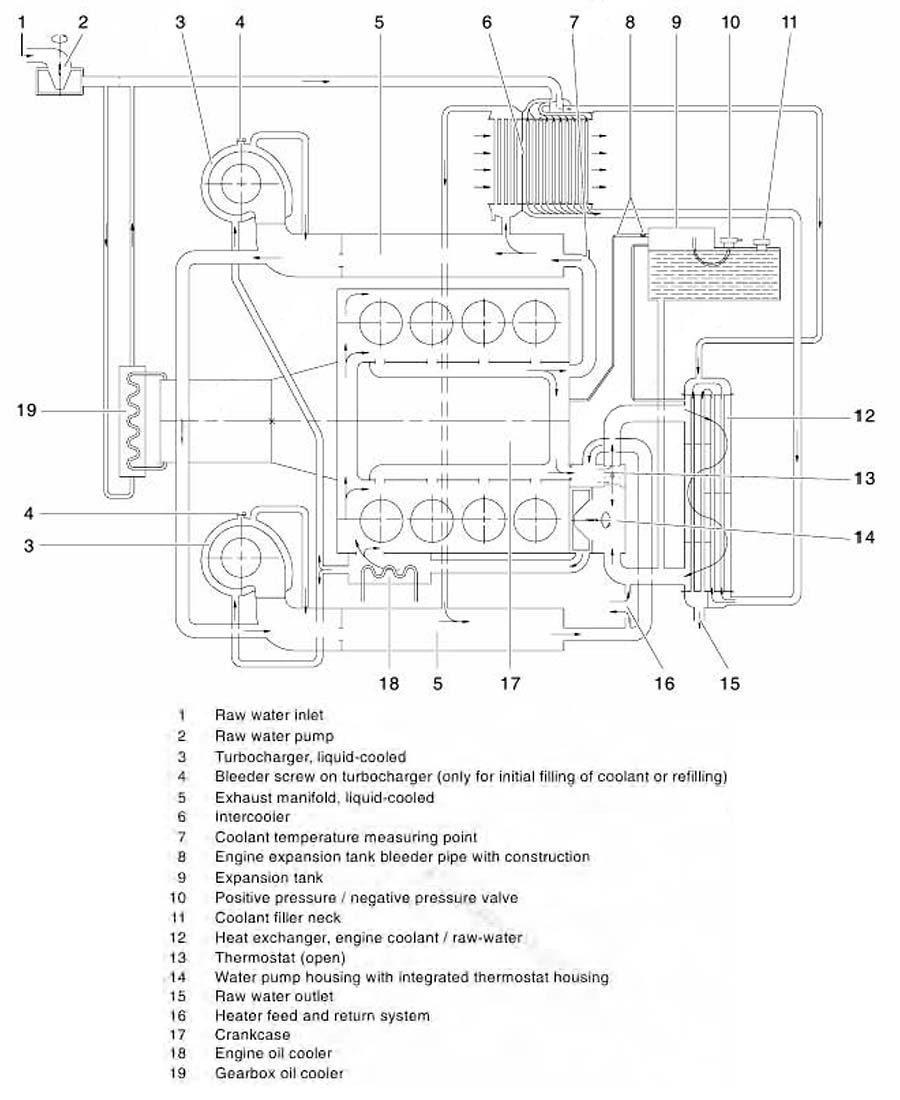
In fact, I just re-checked a couple of MAN manuals which I've got in my files, and I found a couple of pages which are enlightening.

This is the general diagram of the V8 cooling system (but I don't think there are relevant differences in the V12 - if any):
zjuy9yIB_o.jpg


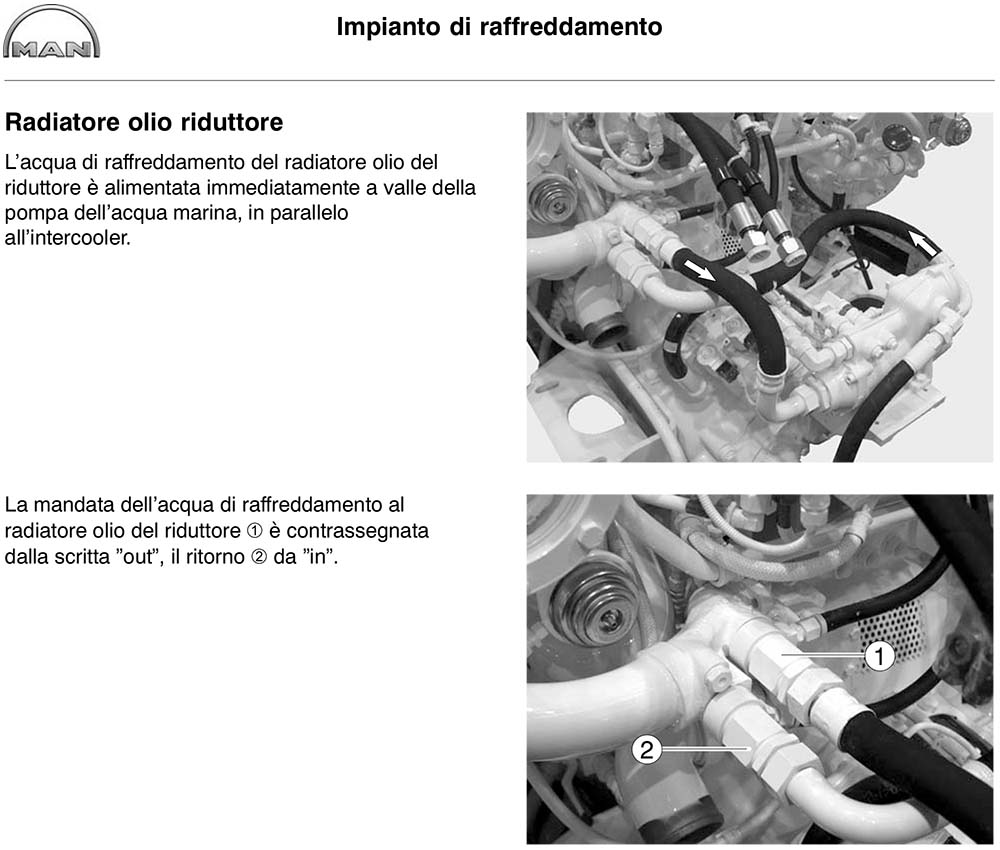
And below is a page of another manual (IT version, sorry) explaining the connection to the engine cooling system to the g/box oil cooler, with pics.
Worth mentioning that this other manual is specifically meant for CRM engines (D2848/40/42 LE423/433/443).
And as you can see, both in the diagram above and in the pics below, the raw water in/out pipes for the g/box oil cooler are just downstream of the engine raw water pump.

Bottom line, are you sure that those seacocks under the gearboxes aren't dedicated to cooling just the shaft seals, as they are on my boat?

90rDJIhE_o.jpg
 
Last edited:
Well folks, before I was just curious, but now I'm also confused! :rolleyes:

@PF: I don't know the 6L very well, but isn't the box in your first pic with the blue and red outlets the heat exchanger of the engine coolant?
If it is, your engine is obviously very different from mine, as well as Deleted User V12.
Btw, I'm not 100% positive, but IIRC the following is also true of Cat engines (no idea about VP).
In MAN V8/10/12 engines, the raw water pickup for the gearbox cooler is just downstream of the raw water pump, and the return is immediately afterwards (I'll elaborate further in a minute, with pics).
In your setup, the sea water seems to be routed at the gearbox cooler only at the end of the engine cooling circuit (after going through intercooler+heat exchanger), which afaik is unusual, because this way the poor gearbox is bound to be cooled by warmed up sea water - and the higher the engine rpm/load, the warmer sea water gets, right when also the g/box needs more cooling, which doesn't sound logical.
Otoh, I suppose that a somewhat larger cooler can deal with that, so obviously I'm not suggesting you to repair something that ain't broken... :)

That said, what I can't get my head round is the label under one of your pics: "Once through the G box cooler it’s sent to the underwater exhaust box to exist via its own hole - so it’s not robbing the riser anyhow because the G box raw water does not go to the riser".
Now, aside from the fact that this statement seems to me self-contradicting, also looking at your pics I would rather say that "Since the return from the g/box cooler goes straight to the exhaust box, it does subtract some cooling to the riser".
And by and large, I would think that this cooling reduction is more relevant than with shaft seals alone, simply because the g/box cooler pipes are larger.

Happy to be corrected if I misunderstood something, though!

Those two black pipes ( since renewed after that pic ) in pic 1 are the raw water out of the HE .
The IN is the metal pipe under from the water pump .
The engines closed cooled fluid in,s / out at the other end - you can see the header tank @ that end .

Yup the out to the G box water in must be warm , and eventually never sees a riser .

Remember everything on the block is a bolt on - so you can bolt a bigger one or smaller one on eventually find one that works - be it pump ,HE , alternator what ever .
I have reported several times that the water temp ( coolant circuit not raw ) fluctuate s
Running 1800rpm - 84 winter 86 summer , but tickover or low load drops to 79/80 by the time we are berthing .
The riser runs with a straight 6 are short ish ( 4.2 Mbeam ) I guess compared with the inboard of a V in a wider boat ?
Not sure if that has any effect on the vol of raw water needed to cool .
Remember all the parts that are related to the block like the liners ,heads ,valve gear etc are modular and interchangeable with the 6/8/12 cylinders .
So lam wondering in speccing the raw water pump and HE core size it’s it’s man enough to be able to divide the exit to sufficiently cool the gas in the riser and at the same time divert some off ( albeit warm ) to the gbox cooler after which presume a little even warmer goes to cool the shaft seal face plate ?
Everything when running is kept with temp tolerances .

Well it seems to work using 80 odd degree sea water to cool the g box oil .
The shaft seal lub water is only to extend the graphite face life .Blurb says 40,000 hrs , so if there’s a significant interruption of its “ warm “ water them warmed again from the g box I guess it will wear faster and won,t t make the 40000 hrs .
Boats 17 years with 840 hrs - so I,am not particularly worried about the shaft seal face plate longevity .

It could be the V configuration set ups inherently generated more heat - from the sum of two banks that focuses in the crank area so ,putting a higher thermal stress on the main engine oil cooling and centre of the block .
Hence the V configuration MAN,s needing timely cooling system overhaul , I guess sitting the CAC on top of the block between the V - stews / heat soaks the seawater more so than if the CAC was mounted on the side like the 6 .?

My MAN tech guy ( Y.E.S - SoF ) told me the 6 ,s don,t suffer as much as the V ,s from scale / salt build up in the coolers and go longer between strip downs .

So what I,am saying is perhaps with the V,s with two longer risers to cool and I figure extra capacity to store heat , inherent in the design - you have not got the luxuary to nick a bit of “ warm “ water off the main HE and eventually dump that where you please .
 
Last edited:
Everything when running is kept with temp tolerances.
Well it seems to work using 80 odd degree sea water to cool the g box oil.
Actually I don't think that seawater can reach a temperature anywhere near that, regardless of inline vs. V engine architecture.
Both the aftercooler and the heat exchanger are designed to use a large quantity of fast flowing cool fluid (sea water) to lower the temps of air and cooling liquid respectively.
So, in order to keep your cooling liquid around mid 80s, the seawater is bound to be MUCH cooler, even after flowing out of the HE.

Coming to think of it, I half recall to have read that the normal temperature increase of raw water between the inlet and outlet of the cooling circuit is between 10 and 15 degrees.
And if that is true, the g/box oil in your setup is being cooled (roughly) by 40 deg sea water rather than 25 - no big deal, I suppose.
Regardless, yup, as I said by no means I was suggesting to fix something that ain't broke!

With my post #124, I just thought to mention the explanations I got after asking what's the point of having separate pickups for shaft seals - which was the (very sensible) question raised by Deleted User.
But obviously, there are many ways to skin this cat...
 
Where does the little 12 mm pipe I have marked in red go ?
Looks like a typical shaft seal T ?
https://imgur.com/a/8SZqO
Good question, but I'm afraid I don't know the answer.
In fact, I don't think to have it in my non-CRM engines, though at the moment I can't be positive about it, because I don't have a pic showing that point.
The previous drawing which I posted (which is related to pre-CRM engines) seems to support my memory, anyway.
If you look at it, the only T connections downstream of the raw water pump are the in/out for the gearbox cooler.
Regardless, I don't think it has anything to see with shaft cooling, considering that it's going upward, towards the inner part of the cylinder banks, where the HP fuel pump is located.
Maybe CRM engines have an heat exchanger for cooling fuel? 'Dunno, just guessing now.

Mikes got V drive g box ,s so will they be cooled via there own seacock in s —- under the engines ?
This is tricky.
In Deleted User boat, there isn't a separate V-drive, because his engines are mated with gearboxes whose shaft exit is reversed and angled downward.
In other words, his gearboxes integrate the V-drive in a single box.
This is the reason why I would be surprised if they were cooled just by the dynamic sea water flow, which implies no cooling at all unless the boat is moving.
Btw, such solution implies a rather poor cooling also at low speed.
In fact, some previous Ferrettis (like whitelighter or markc boats) used the separate BPM v-drive which I've also got on my DP.
That is widely recognised as a bomb proof unit, but in Ferretti installations it was "only" dynamically cooled by its own seacock.
And sometimes, that could lead to overheating after cruising for longish periods at slow D speed (I half recall that whitelighter experienced that).
Another reason why I don't expect Deleted User integrated g/box & V-drive to be cooled that way.
But it's just a matter to wait for him to check and let us know, I reckon! :encouragement:
 
Yes you are right re seawater HE exist temp
I have the raw water pressure guage on the MMDS buy not its temp
Only engine coolant in the closed circuit

Anyhow fascinating stuff how they manage it all - successfully I might add
TBO they MAN are quite sophisticated when you scratch about
 
In Deleted User boat, there isn't a separate V-drive, because his engines are mated with gearboxes whose shaft exit is reversed and angled downward.
In other words, his gearboxes integrate the V-drive in a single box.
This is the reason why I would be surprised if they were cooled just by the dynamic sea water flow, which implies no cooling at all unless the boat is moving.
Btw, such solution implies a rather poor cooling also at low speed.
In fact, some previous Ferrettis (like whitelighter or markc boats) used the separate BPM v-drive which I've also got on my DP.
That is widely recognised as a bomb proof unit, but in Ferretti installations it was "only" dynamically cooled by its own seacock.
And sometimes, that could lead to overheating after cruising for longish periods at slow D speed (I half recall that whitelighter experienced that).
Another reason why I don't expect Deleted User integrated g/box & V-drive to be cooled that way.
But it's just a matter to wait for him to check and let us know, I reckon! :encouragement:

All correct including about the BPM units. I had those on my Ferretti 46 and at slow speed they got so hot that you couldnt put your hand on them. I have checked through all my photos of my current boat and I have no photo which confirms exactly how the gearboxes are cooled so my answer to this question will likely have to wait until I next visit my boat which is likely to be Easter
 
Top