
requiem
Well-Known Member
For me, the chart overlay adds too much clutter and makes it harder to spot small returns. I only tend to use it for quick verification checks.
Barnacle Bill posted a nice example of such a radar-assisted collision a few years back in this post. I think it's also similar to the Stockholm – Andrea Doria collision: each vessel sees the other ahead on radar, slightly to one side, but one thinks it's a port to port passing and the other a starboard to starboard, and both their attempts to widen the crossing end up narrowing it instead. (I unfortunately can't find any info on the Hual Trooper – Fesco Voyager collision.)
I think in all the cases, including the Wahkuna case, a decent understanding of the rules would have prevented it, in particular:
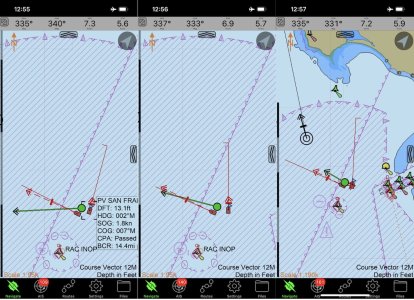
Barnacle Bill posted a nice example of such a radar-assisted collision a few years back in this post. I think it's also similar to the Stockholm – Andrea Doria collision: each vessel sees the other ahead on radar, slightly to one side, but one thinks it's a port to port passing and the other a starboard to starboard, and both their attempts to widen the crossing end up narrowing it instead. (I unfortunately can't find any info on the Hual Trooper – Fesco Voyager collision.)
I think in all the cases, including the Wahkuna case, a decent understanding of the rules would have prevented it, in particular:
- Making course changes large and obvious 8(a,b)
- Making a proper plot instead of eyeballing it 7(c)
- Continuing to monitor the situation 8(d)
- Allowing for error. 8(d) <— This is the big one for me. Radar is fuzzy and in low viz one shouldn't be trying to finesse a close passage.
Last edited:


