
Can someone explain radar to me please...

For me, the chart overlay adds too much clutter and makes it harder to spot small returns. I only tend to use it for quick verification checks.

Barnacle Bill posted a nice example of such a radar-assisted collision a few years back in this post. I think it's also similar to the Stockholm – Andrea Doria collision: each vessel sees the other ahead on radar, slightly to one side, but one thinks it's a port to port passing and the other a starboard to starboard, and both their attempts to widen the crossing end up narrowing it instead. (I unfortunately can't find any info on the Hual Trooper – Fesco Voyager collision.)

I think in all the cases, including the Wahkuna case, a decent understanding of the rules would have prevented it, in particular:
  • Making course changes large and obvious 8(a,b)
  • Making a proper plot instead of eyeballing it 7(c)
  • Continuing to monitor the situation 8(d)
  • Allowing for error. 8(d) <— This is the big one for me. Radar is fuzzy and in low viz one shouldn't be trying to finesse a close passage.
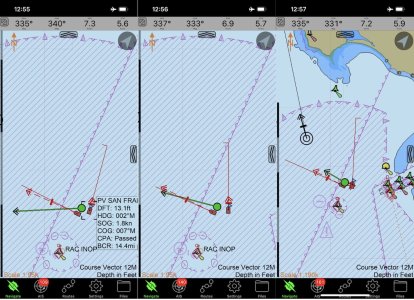
I think the only real radar-specific item of note people must remember is to let the radar have time to think after any party changes course or speed. You can see an example of MARPA (green vector) lagging AIS in this series:

marpa-lag.jpg
 
Last edited:
I'd be curious to hear more, as I've been fortunate to avoid encountering such issues.

Writing custom software would certainly explain a multi-year delay, but... to me that's just poor use of resources. Is such a NMEA dummy feed used elsewhere? Beck when I had instruction we simply sailed about and used the radar live.
The simulator simulates the examples in the book, or any other situation you care to use (you can draw ships and movements on an overlay and it generated the feed to the Radar display).
OpenCPN already has a NMEA recorder and replay - US Sailing and others just insert NMEA to the replay device.
 
I would respectfully disagree with the notion that the "modern" use of radar is for a chart overlay, and all the more that chart overlays have eliminated "radar assisted collisions". That is certainly not true on board commercial vessels.

On board commercial vessels the predominant radar view for collision avoidance is North Up (AKA "Stabilized"), Relative Motion, so -- "the screen centring on the vessel". They do have radar overlays on their ECDIS displays, but this is used more for navigation.

On board yachts I dare say the predominant mode is Head Up, Relative Motion. That's how I use it.

Radar assisted collisions occur because of misunderstanding of relative motion, and simple failure to do a proper radar plot. The classic case is the MV Hual Trooper v. MV Fesco Voyager collision.

Relative motion is actually REALLY easy to understand, if you just think about it. Every sailor should buy a pad of radar plotting sheets and learn to do a proper radar plot without using any of the electronic aids. Then, you can throw away the plotting pad and simply set the EBL and VRM on a target of concern, and you INSTANTLY see whether you have a problem or not. If the other vessel walks down the EBL, it's a collision course. It's immediately visible. I prefer this to AIS, actually, it's my own primary means of understanding collision risk. I use AIS to confirm what I've observed by radar, and to get a calculation of CPA and TCPA without bothering with a full plot. But if I have to deal with a target which is not broadcasting AIS (military vessels, North Sea fishing vessels), I can still calculate CPA and TCPA, without AIS.
If you think its necessary to do a plot then you’re not using integrated radar properly. Commercial folk can do what they like, they have plenty of people and are slow to change.
Relative motion of vessels is obvious when overlaid on a chart since you can see where they are and what direction theyre going. Doing a plot is entirely unnecessary and as a result, so is the course.
 
If you think its necessary to do a plot then you’re not using integrated radar properly. Commercial folk can do what they like, they have plenty of people and are slow to change.
Relative motion of vessels is obvious when overlaid on a chart since you can see where they are and what direction theyre going. Doing a plot is entirely unnecessary and as a result, so is the course.
I said on the contrary that actually doing a formal plot as a regular practice is NOT necessary -- only that it's very valuable to know how to do it, as then you much better understand what you are seeing.

Doing radar collision avoidance on a chart, however, is not correct procedure, whether for commercial folk, or for us. You will not see relative motion at all. You need to visualize relative motion for collision avoidance, and you don't get that at all from a chart display.

With the normal radar display you see relative motion directly, and you can use EBL and VRM to make it precise, and you have MARPA/ARPA.

As I said, the radar overlay on the chart is intended for navigation, not collision avoidance. Radar overlay allows you to confirm the accuracy of the chart, and to see uncharted objects. In bad visibility, radar overlay can fulfill the requirement of visual confirmation of chart objects. But even for navigation, the regular chart display in relative motion mode is needed for some techniques, like parallel indexing.

I would recommend taking a radar course.
 
The course is also useful for understanding what causes the rare occurrences like interference patterns, fake returns due to ducting that you may see once per year etc.

I think that most are now easy to install and use, but understanding of what can go wrong and how to fix it is needed (same with the VHF course)
 
The course is also useful for understanding what causes the rare occurrences like interference patterns, fake returns due to ducting that you may see once per year etc.

I think that most are now easy to install and use, but understanding of what can go wrong and how to fix it is needed (same with the VHF course)
Indeed. The course is also really useful in order to even understand how to actually use radar. It's not obvious. It's an extremely powerful tool, the most important piece of electronic gear on board in my view, but it requires KNOWLEDGE, you can't just twiddle the dials and figure it out.

RYA has a decent radar course, but if you really want to understand it completely, a proper IMO syllabus course for pro mariners is a lot better. These can be done online and cheaply, e.g. RADAR Plotting, for only 25 USD, and Radar Navigation for 80 USD. There are plenty of others.

It's possible to get an actual STCW radar observer cert online, e.g. here: RADAR Observer (Unlimited) - NEMO° | Online Maritime Courses.

I'm not aware whether the MCA courses can be done online or not.
 
only that it's very valuable to know how to do it, as then you much better understand what you are seeing.
This is simply not the case with modern sets. It might be useful to know how to do it if you’re likely to encounter legacy equipment but most only use their own so theres no benefit whatsoever to knowing legacy techniques which don't apply to modern kit.
If people are struggling to understand what they see with radar overlaid on a plotter they shouldn’t be at sea, let alone navigating.

I’ll agree these outdated skills are interesting, just like celestial nav is interesting. For the majority though they're just not relevant.
 
This is simply not the case with modern sets. It might be useful to know how to do it if you’re likely to encounter legacy equipment but most only use their own so theres no benefit whatsoever to knowing legacy techniques which don't apply to modern kit.
If people are struggling to understand what they see with radar overlaid on a plotter they shouldn’t be at sea, let alone navigating.
Sorry, "modern sets" don't work any differently than radar sets ever did. It's all still relative motion, true motion, SHU, NHU, as it has been for 50 years at least.

For collision avoidance purposes, you don't get any useful information from seeing a radar target overlaid on a chart, other than the fact that it is there, and roughly where. You cannot see whether the bearing is constant or changing, because you're not viewing relative motion in a chart display. The best you get from this is a signal to switch to the radar display where you can put the EBL on it.

It's often said that wisdom is knowing what you don't know (Aristotle, I think). You can also say that wisdom is knowing what you CAN'T SEE. A radar target overlaid on a chart is worthless for collision avoidance. You CAN'T SEE whether there a risk of collision or not, seeing it that way. And if you think you can, you're in a lot of trouble.

You really need to take a course.
 
You don't seem to understand how modern sets work and don’t seem open to trying so I’ll leave it here.

Its not relative motion at all given that everything is plotted in its absolute position on the chart and tracked as such.
 
I did the RYA course a couple of years ago, was pretty poor TBH. The training Centre I used (Mendez) supplemented it with an additional day on a professional radar simulator training set up (Wartsila), which was fantastically better than anything the RYA course taught me. Since then, at least one other training centre in the Solent has also started offering simulator-based training for radar.

My personal experience with this is that for leisure use at least, adding simulator training to the RYA course is absolutely worth every penny.
 
You don't seem to understand how modern sets work and don’t seem open to trying so I’ll leave it here.

Its not relative motion at all given that everything is plotted in its absolute position on the chart and tracked as such.
You will benefit from taking the course.

The position of a radar target on the chart is meaningless for collision avoidance. This gives you no clue as to whether a risk of collision exists, or what you need to do to mitigate it.

What you need to know is how the target is moving IN RELATION TO YOUR OWN MOTION, which is not visible on a chart display at all, or even measurable.

Collision avoidance is a science, and requires skill and knowledge to do competently. No equipment, modern or antique, does it for you. If you haven't learned how to do it, then you don't know how to do it.
 
I did the RYA course a couple of years ago, was pretty poor TBH. The training Centre I used (Mendez) supplemented it with an additional day on a professional radar simulator training set up (Wartsila), which was fantastically better than anything the RYA course taught me. Since then, at least one other training centre in the Solent has also started offering simulator-based training for radar.

My personal experience with this is that for leisure use at least, adding simulator training to the RYA course is absolutely worth every penny.
I'm sorry to hear that the RYA training is like that.

Then I guess one of the commercial courses would be the better choice.

I did an STCW course years ago in the States. About a week and a half in the classroom, including simulators. It was incredibly valuable. It covered both collision avoidance and radar navigation.

I think you can probably learn it also from reading. I have the ISO materials which I reread from time to time, to refresh.

There is nothing whatsoever simpler or less challenging to using a yacht radar, than using a radar on board a ship. It's a shame if even the RYA don't take it that seriously. Great that you had the chance to do the simulator training.

Here's a good article on the value of keeping up your hand plotting skills: Radar plotting: How to do it and its Significance in Collision Avoidance - MySeaTime
 
You will benefit from taking the course.

The position of a radar target on the chart is meaningless for collision avoidance. This gives you no clue as to whether a risk of collision exists, or what you need to do to mitigate it.

What you need to know is how the target is moving IN RELATION TO YOUR OWN MOTION, which is not visible on a chart display at all, or even measurable.

Collision avoidance is a science, and requires skill and knowledge to do competently. No equipment, modern or antique, does it for you. If you haven't learned how to do it, then you don't know how to do it.
Ive taken the (obsolete) course and have years of experience using both obsolete and modern types. Thats why i can confidently say you’re wrong and that you have no understanding of the modern systems I'm talking about.
Every post you’ve made refers to outdated tools and techniques and it’s clear that you don't understand the systems I'm talking about. Relative motion is absolutely bloody obvious when plotted on the MFD over the chart, same as with rocks and AIS, hence not needing to faff with plots and pencils. It’s about as useful as a three point fix when GPS is showing position accurately. Sure, some people still do a three point fix for fun, but most of us accept that GPS is reliable.
I realise you’ve invested time into these skills and its sad that they're no longer relevant, but that doesn't make it less true.

I have to say, you’ve not even successfully identified what additional value you think you're getting from paper and pencils when used alongside a modern integrated MFD on a private vessel.
 
Ive taken the (obsolete) course and have years of experience using both obsolete and modern types. Thats why i can confidently say you’re wrong and that you have no understanding of the modern systems I'm talking about.
Every post you’ve made refers to outdated tools and techniques and it’s clear that you don't understand the systems I'm talking about. Relative motion is absolutely bloody obvious when plotted on the MFD over the chart, same as with rocks and AIS, hence not needing to faff with plots and pencils. It’s about as useful as a three point fix when GPS is showing position accurately. Sure, some people still do a three point fix for fun, but most of us accept that GPS is reliable.
I realise you’ve invested time into these skills and its sad that they're no longer relevant, but that doesn't make it less true.

I have to say, you’ve not even successfully identified what additional value you think you're getting from paper and pencils when used alongside a modern integrated MFD on a private vessel.
Relative motion between two moving objects is impossible to discern on a chart display. That display mode simply does not provide such information. All you know is the position of the object in relation to the ground at that particular moment, which is utterly useless information for collision avoidance, unless it's a rock or something else which is fixed to ground.

As I said, I don't do manual radar plots on a regular basis. What I said was that knowing how is extremely useful for understanding how to use the electronic tools, EBL/VRM, MARPA/ARPA, as well as AIS.

You keep talking about "modern systems" -- why don't you explain in your own words what they actually do which is relevant to collision avoidance? This should be interesting.
 
Try one, its immediately obvious why you're wrong when you’ve used one. When you can see the object, its speed and course and you can see your own vessel and its speed and course, all drawn on a chart, i don't see how you could not understand collision avoidance. If that weren’t enough, tapping on the object will display CPA information which makes it even easier to understand whats going on.

The only reason radar was ever an issue is because the two positions were not fixed against a backdrop, making it necessary to work backwards to get that info. The users vessel was always displayed at the centre with other things relative to it rather than showing the positions of them, but thats no longer the case. With them fixed on something it’s just entirely obvious whats going on and both the users vessel and the radar objects being plotted with absolute coordinates and vector information. It’s simply no longer necessary to work out where the other object is or its vector. Why do you think you need to manually do this? That’s the real question, and the only answer i can come up with is not having used an integrated system.

Or perhaps I’m wrong, and some folk do need a course to point out the obvious. Ive never come across anyone else who couldn't understand whats going on with the MFD though.
 
If you think its necessary to do a plot then you’re not using integrated radar properly. Commercial folk can do what they like, they have plenty of people and are slow to change.
Relative motion of vessels is obvious when overlaid on a chart since you can see where they are and what direction theyre going. Doing a plot is entirely unnecessary and as a result, so is the course.
I agree with modern designs the actual hand-plotting is generally not necessary.

So far, examples of "radar-assisted" collisions I've seen have been the result of someone eyeballing the screen and coming to an incorrect conclusion. e.g. "I'm on course 000 and he's on course 180" when really the other vessel might have been on course 195. Combined with the lack of monitoring, the error is not realized until far too late. That the screen also happens to have charted objects displayed has almost no bearing on this.

You might argue that this is careless behavior on the part of the operator, not an issue with the radar display, and I'd largely agree. Simply dropping an EBL on the screen (edit: or acquiring it as a MARPA target) and letting things progress for a few minutes would easily reveal the faulty estimate. The danger comes when someone makes the initial faulty estimate, takes action based on it, then erroneously assumes they're in the clear and goes off to attend to other matters.
 
Radar assisted collision is a direct result of having two things on a screen, both of which are moving in the real world but only one moving on an otherwise featureless screen. This leads to incorrect assessment of the objects vector, and often led to a decision which turned directly into its path, hastening a collision rather than avoiding it.
Plotting was devised to prevent this and ensured correct decisions were made, taking into account relative motion and the users own vessel speed and direction.

Plotting the absolute positions on a chart entirely fixes this issue since the problem stops being a relative one. Anyone that can avoid a rock can now use radar to avoid another vessel, there are no longer any gotchas hiding from the user.
 
Try one, its immediately obvious why you're wrong when you’ve used one. When you can see the object, its speed and course and you can see your own vessel and its speed and course, all drawn on a chart, i don't see how you could not understand collision avoidance. If that weren’t enough, tapping on the object will display CPA information which makes it even easier to understand whats going on.

The only reason radar was ever an issue is because the two positions were not fixed against a backdrop, making it necessary to work backwards to get that info. The users vessel was always displayed at the centre with other things relative to it rather than showing the positions of them, but thats no longer the case. With them fixed on something it’s just entirely obvious whats going on and both the users vessel and the radar objects being plotted with absolute coordinates and vector information. It’s simply no longer necessary to work out where the other object is or its vector. Why do you think you need to manually do this? That’s the real question, and the only answer i can come up with is not having used an integrated system.

Or perhaps I’m wrong, and some folk do need a course to point out the obvious. Ive never come across anyone else who couldn't understand whats going on with the MFD though.
Maybe you're talking about AIS? Certainly it is correct that AIS will give you an accurate CPA and TCPA and even an alarm in case of dangerous CPA, instantly, so skipping the whole process of radar plotting. This does not use radar at all; AIS works from COG and SOG and position data transmitted from the target.

I agree that if the target is broadcasting AIS then that's the quickest and simplest way, and of course it's what we all do. Maybe what you mean by "modern systems" is AIS?

The question of radar plotting arises when a target is NOT broadcasting AIS (military vessels, North Sea fishing boats, many yachts), or when the AIS data is unreliable (happens more and more often since the Russians started interfering with GPS signals).

In that case, you need radar, and the MARPA/ARPA function in your radar will give you the same kind of data you get from AIS (calculated CPA and TCPA, and the target's calculated course and speed), but small boat radars don't typically do this well, since unlike with AIS, this function requires reliable heading and other data from your own boat, and not just COG and SOG and position. If you're sure you can rely on MARPA/ARPA, then yes, in that case too, you can keep looking at your chart display.

The real test of skill comes when you've got neither reliable AIS or MARPA/ARPA. Then you need to be able to look at and understand a radar screen, not the chart display. That's when skill with manual radar plotting is really useful, even if you're not doing actual manual radar plots, just because of how it changes the way you look at the screen. It's also useful to double check what you are getting from AIS. That's why training still includes this, and why professional mariners are still required to have this skill.

That's all I've been trying to say.
 
Can somebody put this in terms that I can understand?

Do the new systems recognise and track targets, thereby calculating a CPA/TCPA solely using the radar data?
If they simply pull that data from the AIS, then that's not exactly a huge upgrade on what I already have.

This morning, I've just had a sports fishing boat zoom past me in <1/4 mile visibility. He was easily doing 20kts. He wasn't on AIS.
 
Im not talking about AIS, and I’m giving up there as you seem uninterested in understanding or moving forwards with the technology
 
Top