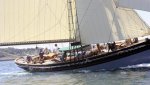
Building a new replica or ....

Wansworth

Well-Known Member
Joined
8 May 2003
Messages
38,759
Location
SPAIN,Galicia
Visit site
Restoring the original .There is a world of difference in time and effort between the two but does the restoring an old boat carry with it the essence or whatever of the old boat and is that important as the end result will be basically the same boat and maybe the allnew replica will have its own built in something?
 
You will find this subject debated endlessly in "classic" circles with no consensus, only entrenched positions depending on what either the individual or the yard doing the work prefer.
 
The hull of the paddle steamer Medway Queen was sent to be rebuilt, but the keel was replaced without realising it made the hull a new build and altered its status and has complicated the plans for the running of the ship. The new hull means all the latest safety rules apply, which she cannot meet without massive changes, so can only carry 12 paying passengers instead of hundreds. So, instead of joining the Waverly with lots of passengers generating money to keep her running, she is now part completed vessel with little chance of earning her keep, despite being a Dunkirk Little Ship (well a big one actually).
 
The blokes that carried out the woodwork on my Rival, A and R Way Ltd, build replicas and restore wooden boats. They said that a lot of the restorations are almost new boats by the time they finish despite a policy of trying to repair / restore with the original wood.

Some examples of their work here http://www.aandrwayboatbuilding.co.uk

I have no association with A&R Way beyond being a customer.
 
It's a good topic of conversation, and personally I have no particular axe to grind, nor dog in the fight.

Luke Powell, who has made enormous contributions to old skool sailing, ( Eve of Saint Mawes then onwards and upwards) is trying to get a project going to make an old English cargo schooner, based on some rotting skellington ribs, and the other remains which have been preserved and protected by the mud of the Medway.

She is the Rhoda Mary, a big old gaff tops'l schooner, quite a rare type, especially bearing in mind we had thousands of them, only a couple of generations ago.

I asked him 'wouldn't it be a lot less hassle to start from scratch, with your skills and unique track record'
and he said 'yes, but it's the connection with history which counts' .
Which makes a lot of sense, and a greatly more meaningful wood ship project, in a variety of ways.
 

Attachments

  • image.jpeg
    image.jpeg
    389.7 KB · Views: 0
Last edited:
Restoring the original .There is a world of difference in time and effort between the two but does the restoring an old boat carry with it the essence or whatever of the old boat and is that important as the end result will be basically the same boat and maybe the allnew replica will have its own built in something?

Sorry I can't do a link, but the philosophy is dismantled and examined by they who care.. now available as a free download, lucky us.
 

Attachments

  • image.png
    image.png
    381.2 KB · Views: 0
I think we are on to Bluenose 3.

Obviously a 2nd replica the original was wrecked in the Caribbean long ago. I think most Canadians still regard the new Bluenose as Historically significant. How much original oak is left on the Victory or The Constitution when she sailed again.

I saw a show on Netfix recently about a MK 1 Spitfire restoration which was dug up from Dunkirk. How much original Spitfire Flew again? Does it really matter? There is now one more museum quality MK1 Flying Spitfire even if the only original part is the plate with the serial # Is real or is it a replica. Serial # says its real.

Crashed Beavers are usually restored. Why you can't get a new one? Unless you get a "New One" rebuilt. and Beavers are still the best at what beavers do.
Classic cars talk about a Survivor as opposed to a Restoration.

I think it depends what you want. If you can afford to restore a classic. go for it. If you can afford to have a new Classic built why not.
 
The hull of the paddle steamer Medway Queen was sent to be rebuilt, but the keel was replaced without realising it made the hull a new build and altered its status and has complicated the plans for the running of the ship. The new hull means all the latest safety rules apply, which she cannot meet without massive changes, so can only carry 12 paying passengers instead of hundreds. So, instead of joining the Waverly with lots of passengers generating money to keep her running, she is now part completed vessel with little chance of earning her keep, despite being a Dunkirk Little Ship (well a big one actually).

Odd sticking point. How did they determine the Keel was replaced. Sounds like a bit of a bureaucratic excuse.
One question might be why is a vessel like the Waverly ok to sail with 1947 safety rules and this ship isn't. Which might tie the Waverly up.
it should be a question of its OK to restore passenger ships under the rules which existed at the time or its not. and a restored ship should meet current requirements. Should replicas meet current requirements.
If they carry passengers?
How about crew?
 
Odd sticking point. How did they determine the Keel was replaced. Sounds like a bit of a bureaucratic excuse.
One question might be why is a vessel like the Waverly ok to sail with 1947 safety rules and this ship isn't. Which might tie the Waverly up.
it should be a question of its OK to restore passenger ships under the rules which existed at the time or its not. and a restored ship should meet current requirements. Should replicas meet current requirements.
If they carry passengers?
How about crew?

I'm not sure what Concerto wrote is correct. The first application HLF was to build a new welded hull, HLF said no, should be a riveted hull as per the original. The new riveted hull was planned and priced and HLF agreed to fund it. It was well known from the outset that it was to be a new hull with as much of the original machinery, fittings, deck timber etc transferred over.
 
The Waverley does not operate under 1947 safety rules, she operates under current regulations.

Back on topic, even the Waverley is a new build: -

http://paddlesteamers.info/waverley.htm

She's newer than you might think : Although celebrating her 70th anniversary in 2017, little apart from most of her framework and much of her engine remains from her the Waverley of 1947. The greatest changes took place between 2000 and 2003 when she was substantially rebuilt, and although ship maintenance requires on-going replacement of parts, there have been other changes which have changed both her external appearance (albeit only slightly) and internal arrangements (much more substantially). Most noticeable was the difference in the rake of the two funnels after replacement in 1961/2 (lasting until 2001), the removal of the aft lifeboats in favour of other evacuation devices - and one change often overlooked : the replacement of the square windows in the sponsons (which were themselves replaced in 2001) by ports, recovered from the withdrawn Clyde buoy tender "Torch" and fitted in 1978 as a condition imposed by the DTI (Department of Trade and Industry) for her to undertake her visits to the Thames and Solent.
 
Restoring the original .There is a world of difference in time and effort between the two but does the restoring an old boat carry with it the essence or whatever of the old boat and is that important as the end result will be basically the same boat and maybe the allnew replica will have its own built in something?

Éric Tabarly inherited his Pen Duick 1 (William Fife design built in Cork in 1898) from his father but it was in such bad state that he used the hull as a mold to build a grp replacement.

https://fr.m.wikipedia.org/wiki/Pen_Duick
 
Last edited:
Odd sticking point. How did they determine the Keel was replaced. Sounds like a bit of a bureaucratic excuse.
One question might be why is a vessel like the Waverly ok to sail with 1947 safety rules and this ship isn't. Which might tie the Waverly up.
it should be a question of its OK to restore passenger ships under the rules which existed at the time or its not. and a restored ship should meet current requirements. Should replicas meet current requirements.
If they carry passengers?
How about crew?

To be honest this was all told to me by member of a society that run an old tug. I believe the original keel was supposed to be used, but was found to be too rotten. The shipyard just went ahead and replaced it at the start of what became classed as a new hull. Hence the problem, but it is not mentioned on the web page about restoration.
http://www.medwayqueen.co.uk/rebuilding-the-hull.html

Again I believe the crew were exempt, the rule was for fare paying passengers.
 
Joshua Slocum said: "Now, it is a law in Lloyd's that the Jane repaired all out of the old until she is entirely new is still the Jane. The Spray changed her being so gradually that it was hard to say at what point the old died or the new took birth, and it was no matter. " However, the USS Constellation, although she contains timbers from the Constellation of the war of 1812, is regarded as a new build (in 1860 something) as she was dismantled and then a new vessel rebuilt incorporating the timbers of the original - but opinions vary on that, as you'll find out if you visit her!

All old vessels are to some extent like Trigger's broom!
 
A new keel means it's a new boat, but keep the old keel and change everything else and it's still the original. Up to a point that makes sense, but what happens if the old keel is replaced, but nothing else is changed?
 
A new keel means it's a new boat, but keep the old keel and change everything else and it's still the original. Up to a point that makes sense, but what happens if the old keel is replaced, but nothing else is changed?
The idea of a vessel having an identity is a purely human construct and not the result of anything in nature. Those of us who consider ourselves human are therefore at liberty to use whatever definition we wish. Nevertheless, it makes a great subject for argument, being essentially insoluble.
 
Of the original 23 Lister Jaguars known to have been built at least 33 are known to still exist ... :encouragement:

That quote is plagarised from the late Bob Currie's book on British Racing Motorcycles:-

"The Triumph GP Model. The only racing motorcycle produced by the Triumph factory using a highly tuned engine based on the lightweight generator engine produced for the RAF. 200 were made of which about 250 have survived."

This was because they were built using mainly production parts which allowed the builing of replica's or fakes quite easily.

My old boss the Grand Prix rider Arthur Wheeler from Epsom had one. He said he made a chicken wire enclosure for the crankcases. When I asked why, he replied that it was to catch the bits when it invariably blew up.

I had a genuine one once-even had the test bed dyno sheets giving the power output on both high octane and pool petrol.

Be woth 25K plus today. I think I sold it in 1983 for 1500 quid.
 
What I find interesting is what the original builders would have thought, this goes for old buildings too. I am convinced they would have happily torn down a derelict to glean building materials for something new, and would have had no qualms what so ever about using the latest bright new materials and techniques to patch up.
 
I live in Galicia and it’s only recently that people have returned to restoring the thousands of abandoned stone and wood houses preferring to build a horrible brick and concrete house.Interestingly the Germans and the Dutch and British seem to find these abandoned houses great for restoring.The main reason Galicians built brick houses was it was cheaper but as the economy has improved they to have rediscovered their heritage.It could be that wealthier people can afford to indulge in restoring old stuff and have an interest in what went before
 
This is a rebuild:-

cornubia-sailing-720x405.jpg

Apparently there is one small piece of wood in the cockpit which is from the original boat.

However, the owner will explain to you that this is 100% original as it was rebuilt in the same airspace!

I also understand that the rig is bigger than the original (taller mast).

This is mine:-

0x0_370_7297396059c3d1052eba5.jpg

It is designed by Ed Burnett (RIP) and Nigel Irens based on the lines of a Pilot Cutter from 1893. It also has a bigger rig than the boat it was based on.

Both have engines, electric lights, toilets, showers, have Dacron sails, synthetic ropes, sikaflex sealing the decks etc. Which of course such boats never had originally.

So what is an original? What is a replica? How much can you change an original (e.g. using Dacron sails, synthetic ropes, sikaflex) and it is still an original? How much wood (e.g. all of it), can you replace and still maintain it is an original?

Some people really care and get quite worked up with this.

I prefer to go sailing.
 
Top