Brass Screw Heads on Raw Water Pump

[p.s. Hunterlees types faster than me!]

If I were you I'd try to get the screw you are working on hot (e.g using a soldering iron or pin-point flame), while avoiding as far as possible getting the plate (and pump) hot (perhaps even using a freeze spray on it). The heat may extend the screw (relative to the plate) just enough to reduce its grip.

I think getting the pump off before you tackle the seized screws will likely be worth it. You'll be able to get better pressure and torque on the screws, and avoid chewing them up further. I know only too well the tedium of unscrewing nuts and bolts a tiny fraction of a turn at a time, and having to turn the spanner over every time, but one does get there eventually.

I bought a decent set of ratchet ring spanners a while ago, and while they were expensive they have proved their worth, often making such a task a relative doddle, but can't always be used because of the space needed around the nut/bolt head to accommodate the thicker than standard ring of the spanner.
 
Is there enough metal protruding for these to grip? They come in a wide range of sizes and I've found them very effective. https://amzn.eu/d/hz7lZTb

Neat, but I suspect the heads are too small. The depth of the head (of an undamaged screw) is 3.5mm but the diameter is only 6.4mm and the smallest tool in your link is for 8mm. Thanks for the suggestion.
 
I got two snapped impeller faceplate brass screws out using left handed drill bits. They actually came out fairly easily. I had first removed the pump to give better drill access. Good luck.
 
I'd cut the heads off the bolts, take off the plate and likely you will find that with no pressure on the bolts they thread out easily, once you cut a new slot in the bolt and use enough lubricant to remove any corrosion.

I replaced my bolts with longer brass bolts and nuts threaded on which allows me to get good pressure on the plate and little chance of pulling the threads out of the pump body.
 
I'd cut the heads off the bolts, take off the plate and likely you will find that with no pressure on the bolts they thread out easily, once you cut a new slot in the bolt and use enough lubricant to remove any corrosion.
That makes a lot of sense.
 
Be aware there are different thread sizes which look the same. I found a supplier who offered a variety for Jabsco pumps.
If you need to know, I can attempt to find a reference. The ones from ASAP did not fit my pump.
 
Success 😁👍, Christmas has come early!

A virtual pint is awarded to AntarcticPilot for the suggestion at #45 - thank you sir! If there’s ever the chance to buy you a real pint or two in appreciation I’d be delighted to do so.

I purchased one of the Irwin ‘Powergrip’ screw extractor sets and the 1/4” extractor fitted to a 3/8” drive had all three screws out in very quick time and saved me a lot of work which would have been required if it had come to pump removal or cutting off the heads, re-drilling, tapping etc.etc. Having replaced the pump previously, that removal alone would have been several hours at least and involved a lot of contortions.

A big thank you to all who contributed suggestions and I’m sure that many or all of the suggested techniques could have worked and are stored away in the memory bank for future reference but tbh, the screw extractor route was by far the quickest and easiest on this occasion and it will be, I’m sure, a useful addition to the toolbox.

Thanks again all of you, your assistance is really appreciated.
 
Interesting

Can you describe how the Irwin ‘Powergrip’ screw extractor work. Do they grip the outside of the screw head and allow the screw to turn anticlockwise
 
Interesting

Can you describe how the Irwin ‘Powergrip’ screw extractor work. Do they grip the outside of the screw head and allow the screw to turn anticlockwise
Exactly. The left hand internal spiral bites into the nut or screw head and allows you to use a 3/8 ratchet for leverage. I have had quite a lot of success with them and there is no chance of them breaking off like the easy out ones. You do need a reasonable amount of screw head for it to grip.
 
Exactly. The left hand internal spiral bites into the nut or screw head and allows you to use a 3/8 ratchet for leverage. I have had quite a lot of success with them and there is no chance of them breaking off like the easy out ones. You do need a reasonable amount of screw head for it to grip.

OK thanks very much.

I have tied to use the normal stud extractor with little success, but these look much better providing there is some stud to get a grip on to.

Thank again will try if I can get a set local to me
 
Exactly. The left hand internal spiral bites into the nut or screw head and allows you to use a 3/8 ratchet for leverage. I have had quite a lot of success with them and there is no chance of them breaking off like the easy out ones. You do need a reasonable amount of screw head for it to grip.
I first got onto them some years ago, when I needed to remove the badly damage anode holder on a Volvo 2003. It's nominally a 1/2" square, but had been badly rounded before I bought the boat. I'd tried several different methods - mole grips, filing flats for a spanner, tap spanner and others, but none worked as either there wasn't enough space to get a good grip or the metal was too soft (by the time I'd got decent flats there would have been little metal left!). The bolt-grips just worked, without fuss. In that case I lightly tapped the bolt grip onto the square and then used a ratchet driver; the anode holder unscrewed without any fuss.
 
I don't know your engine type but if it does come to removing the whole pump there ia a useful tip for my Volvo 2020D.
It sounds drastic but is actually quite straightforward to put a wooden wedge under the engine and remove the engine mount that prevents access to the nuts on the back of the pump. From experience it is much less time consuming and frustrating than struggling with the awful access. I have a saildrive so there is no danger of upsetting the shaft alignment.
 
  • Like
Reactions: jdc
I don't know your engine type but if it does come to removing the whole pump there ia a useful tip for my Volvo 2020D.
It sounds drastic but is actually quite straightforward to put a wooden wedge under the engine and remove the engine mount that prevents access to the nuts on the back of the pump. From experience it is much less time consuming and frustrating than struggling with the awful access. I have a saildrive so there is no danger of upsetting the shaft alignment.

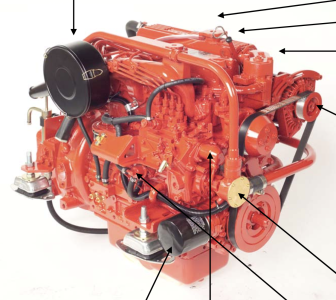
Thanks for the thought, but an entirely different access issue on my Beta BV2203.
 
I hadn't realised that you had a Beta 2203, which is what I have also. But the access on mine is really easy, I can walk around the engine, especially the front where the pump is and remove the whole pump in 2 mins flat.
Screenshot 2024-12-13 at 17.12.11.png


Screenshot 2024-12-13 at 17.14.48.png

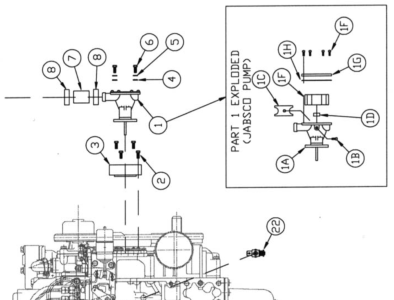
Items (2) are 6mm Allen head bolts, so should be easy enough to shift I'd have thought. What boat do you have? (mine's an R42, so a grey rather than red engine).
 
I hadn't realised that you had a Beta 2203, which is what I have also. But the access on mine is really easy, I can walk around the engine, especially the front where the pump is and remove the whole pump in 2 mins flat.
View attachment 186677


View attachment 186678

Items (2) are 6mm Allen head bolts, so should be easy enough to shift I'd have thought. What boat do you have? (mine's an R42, so a grey rather than red engine).

I wish my pump is where yours is! My engine dates from ‘95 so maybe things changed? My pump is much higher and the frame for the engine driven watermaker HP pump is pretty well where your pump is. Boat is a Bowman 40 so the engine is under the centreline galley ‘island’ with front access under the saloon seat.

Edit: The penny has dropped - I think I know your boat and we have been on a mooring not far away. Now wintering in the marina,
 
Last edited:
Top
