dankilb
Well-Known Member
Well, more recently still, Erik the Viking motored into a rock and tore the nuts out of his Contessa. Granted, it didn’t sink…


Yes at 10m they will certainly be closer but the bigger one will be more expensive.Oi! Less of that you!
I’ve currently got a 10m boat and I’m convincing myself that going up to 12.5m (biggest that will fit on the swinging mooring I own) won’t be that much of a cost jump. You coming along and damaging the foundations of my man maths is not appreciated!
In seriousness for a minute, mooring costs during the summer would remain same for both boats. Both have 12mm dyneema halyards so the only cost difference is the length. Same with sheets - no reason not keep same diameter.
Antifouling, sure, that would be more but I’m sure some more man maths will find stumping up for coppercoat on the bigger boat to be better value than the shogun on the 10m boat.


You explain it well.The margin of safety of the boat is huge - far in excess of yours! That is you will fall short way before the boat does. Lets face it, all boats are uncomfortable in heavy weather, but none of the size you are looking at are incapable of handling it whether they be heavy or lighter. The myth that older heavier boats are "better" is just that - perpetuated largely because effectively you can't buy them new any more. As I said earlier (and reinforced by the comment about charter boats and sailing school) if modern boats were less good how have all the new boat buyers managed over the last 30 years.
It is true though that 30 or 40 years ago performance in heavy weather was much more highly "valued" than it is today because sailing was essentially a challenging pastime. Boats were advertised as suitable for all weather passage racing or adventure sailing because that was where the market was. Of course all long before good weather forecasting, accurate position fixing, immediate communication and an all encompassing rescue service, particularly in N European waters. Claims that small boats were capable of crossing the Atlantic or suitable for JOG passage racing were the cornerstone of many builders promotions. The 1979 Fastnet disaster played a big part in focusing minds on heavy weather and exposed the failings of many designs at the time, including many that we would now consider heavy displacement. What came out of it though was a recognition of the importance of stability which underpinned the RCD stability standards and demonstrated that it was mainly a function of design and not weight.
This myth is embedded in the yachting culture particularly in the UK and to an extent in the US but largely alien in Europe which in general came late into the leisure yachting scene and missed out on what I described above. So no surprise that their approach and design of boats was different - bit of a generalisation but broadly true. UK builders found their products losing appeal as even died in the wool UK buyers soon recognised the attractions of the newer designs. I was buying in the tail end of that transition when, for example the last of the Westerlys, the Ocean 33 was over £100k and a fully specced Bavaria 34 was £70k. Of course buyers were sceptical, but the new designs soon showed they were quite capable of fulfilling the role of an all weather cruiser.
The feeling of comfort and safety with a heavy boat is, I think largely illusory - just as the adjective "heavy" is misleading. Look at the figures that I gave earlier. The Sigma and the Bavaria weigh virtually the same at around 5.5 tones. My Bav 33 (and 37) were both 5,5 tonnes. The difference is where the weight is. Older boats have more weight in the keel because they need it to stay upright. By and large the stability curves are similar - although it is difficult to directly compare because older boats were never subject to stability analysis as newer boats are. However many 70s and 80s boats with the type of keel and ballast ratio the Sigma has were short of stability. Unsurprising because the IOR rule which influenced a lot of designs penalised stability. I have seen stability curves for some well known older designs that suggest the boats would not get into Cat A. Indeed my own boat a GH 31 which has a reputation as a very successful ocean passage maker has relatively poor stability and the last few needed substantial modification to get into Cat A. That also weighs close to 5.5 tonnes - very heavy displacement by any standards but I don't "feel" any more safe in that than I did in my Bavarias.
You may find these 2 interesting. Both have cruised extensively in their Bavarias (but could have been any other production boats) one smaller and one larger than the size you are looking at. Their experiences speak for their capability and that of their boats in a wide range of conditions - far in excess of anything you are likely to experience. You can also find lots of examples in books, blogs, youtubes magazine articles of people doing similar things in a wide range of types of boats and you quickly realise it is the crew that is more important than the choice of boat. Boats are always a compromise - hence the importance of trying to identify what is important to you and the way you are going to use the boat.
youtube.com/channel/UCEZSvXwSH6flqA0q_EEDDBQ/videos
mjambo.de
Some older designs hobby horse, or have issues sailing downwind, and pretty much always end up slower for a given boat length meaning more time at sea risking heavy weather. That's assuming you can get out of a tight marina berth with the poor handling. No design is perfect, people just ignore the bits they want to ignore.Some flatter bottomed designs can generate mast shuddering slams

I dunno what results you're looking at.Which is the thrust of Flaming's point.
However I am not fully convinced. I have looked at the results and see the fastest Sigma 362 went round in c 9h 30. Looking at the Bavaria Owners, where we assume most of the "family" racers go, the fastest comparable boat was over and hour behind and the average probably about 1.5 hours. That is in nominally 10 hours of sailing.
Regardless, I don't see anything that would question the general sentiments of post 84.
.


Oh my goodness, that's it settled then, I mean nothing ever hit a submerged object and sank in the good old days, would never have happened to an older design ....
I read the article, and what he actually said was ...
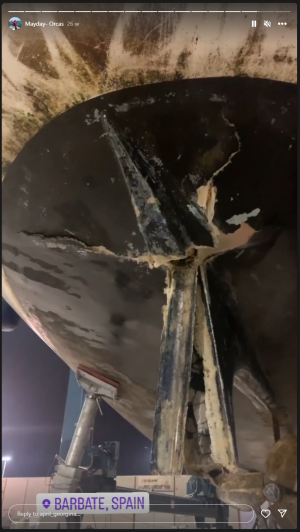
I suspect that an underwater collision tore off the rudder and also tore a hole in the hull at the stern. Hence the loud bang. Jambo quickly filled up and initially listed to starboard. A hole may also have been torn in the starboard hull.
He went on to say ...
Having to give up Jambo is very difficult for me. We sailed together for many years and experienced so much. I lovingly fitted her out over the years and invested a lot of time, work and money in her. In the end she was finished, I was able to sail very long passages with her and she was a cozy and comfortable home for me. I sailed almost 7000 nm with her from New York without any technical problems.
.... sounds like a typical sailor very sad at the loss of his beloved boat rather than an argument supporting an older design over a newer one.

Anecdotes could be traded all day long but it wouldn't prove anything one way or another, and as time progresses, fewer and fewer older designs will be plying the worlds oceans as their value drops and they fall into disrepair, automatically taking them out of the disaster statistics ....Well, more recently still, Erik the Viking motored into a rock and tore the nuts out of his Contessa. Granted, it didn’t sink…
Little is known of exactly what occurred but in the middle of October they were caught out in a bad storm sweeping the area and Demon of Hamble was overwhelmed by the wind and seas. It is presumed that she rolled over (as happened in the 1976 OSTAR) and that the large central cockpit filled with water, weighing the boat down. She may also have lost her mast. Whatever happened, a decision was made to abandon ship and take to the life raft. Angus then launched a raft which inflated itself. Angus got Erica safely into it. Erica said later that Angus then launched another raft which capsized whilst he was trying to get into it and Angus was swept away never to be seen again. Then the yacht went down, leaving Erica on her own in a life raft in the middle of a storm, 180 miles off the coast of South Carolina.
My father and I have installed mast support beams on both of our Contessas. They are 2" x 2" laminated curved oak beams that are fitted to the curve of the cabin roof. The beam is located on the forward side of the bulkhead under the mast. Six bolts go through the bulkhead , existing fibreglass beam and the new oak beam. These have worked great and taken any flex out of the deck or shroud loosening during heavy going.
That does not mean other types of boats do not sink. A sister ship of my GH (heavy displacement, long keel attached rudder) hit a whale and sank in the Pacific. Just a couple of years ago an HR sank mid Atlantic after hitting something which dislodged the keel. The rescue was well reported including here. I could go on - but there is no evidence to suggest "mass production" yachts systemically sink any more than any other yacht. With a bit of effort I could find reports of recent sinkings and rescues involving well found Westerly and Oyster yachts, both the consequence of collisions. As Baggywrinkle says we can trade anecdotes and choose those that support our prejudices but all it shows is that s**t happens at times and it does not discriminate according to design of yacht.My take-away was entirely different.
The sinking is actually something we see especially in mass produced yachts and this event is confirmation and more evidence of the foolishness of two features often seen in boat design, inappropriate corner cutting and parsimoniousness in an excessively lightweight structure and a failure to isolate the vulnerable rudder area into a watertight compartment.
A boat shouldn’t sink if it hits something like a container or whale like this did.
I dunno what results you're looking at.
Fastest Sigma 362 was Phoenix 2, with an Elapsed time of 9:54:29.
Fastest Bav 37 was Ilios with an Elapsed time of 10:29:37.
Your point in post 84 was that you would be 12 miles behind after a day's sailing. I think we can all agree that the RTI of 10 hours constitutes a days sailing. Doing 50 miles in 5 hours gives an average VMG of 5 knots. So to be 12 miles behind you'd need to be about 2.5 hours behind. Whereas the actual delta is well within what we observe in one designs sailing the same course on the same day. For example the gap from 1st to second in the Sigma 38s was larger than the gap between the fastest 362 and the fastest Bav 37. Put simply, the same crew sailing the bav or the sigma would probably make almost exactly the same progress. Which is what you'd expect from the ratings....
The Sigmas are great boats, but the reality is that the first was launched in 1983.... It is a 40 year old design, which was designed as a cruiser racer. The Bav is not a cruiser racer, it's a cruiser.
If you want to compare the 362 to a 36 foot modern C/R, you could look at the JPK 1080. The fastest of which went round in 7 hours 4 minutes. So nearly 3 hours faster than the Sigma. Or something from the 2010s... A J109, the fastest of which was under 8 hours.
Speed isn't everything, but I don't think the claim that a 40 year old Sigma is faster than a 10 year old Bav stands up to scrutiny.
They are weaker, too weak and they often don’t make rudder areas a watertight compartment. Scandalous penny pinching in my view.That does not mean other types of boats do not sink. A sister ship of my GH (heavy displacement, long keel attached rudder) hit a whale and sank in the Pacific. Just a couple of years ago an HR sank mid Atlantic after hitting something which dislodged the keel. The rescue was well reported including here. I could go on - but there is no evidence to suggest "mass production" yachts systemically sink any more than any other yacht. With a bit of effort I could find reports of recent sinkings and rescues involving well found Westerly and Oyster yachts, both the consequence of collisions. As Baggywrinkle says we can trade anecdotes and choose those that support our prejudices but all it shows is that s**t happens at times and it does not discriminate according to design of yacht.
The report of consequences of grounding in post#101 for example is almost an exact mirror of a well documented case of a Hanse hitting a rock in the same way. The description of the damage and the work required to repair the Contessa could be applied almost word for word to the Hanse.
Here we go again ..... boats have been sinking for centuries, regardless of attempts by designers to stop them ... we as humans design things for specific usage scenarios, and as soon as something happens that is outside that design envelope, disaster strikes and we learn another lesson. There is best practice I agree, but it comes at a price and it is up to individuals to navigate that price/benefit decision - the only other choice is to continue to sit in that armchair and wax lyrical about proper boat design instead of chasing your dreams.My take-away was entirely different.
The sinking is actually something we see especially in mass produced yachts and this event is confirmation and more evidence of the foolishness of two features often seen in boat design, which in my view is inappropriate corner cutting and parsimoniousness : an excessively lightweight structure and a failure to isolate the vulnerable rudder area into a watertight compartment.
A boat shouldn’t sink if it hits something like a container or whale like this did.
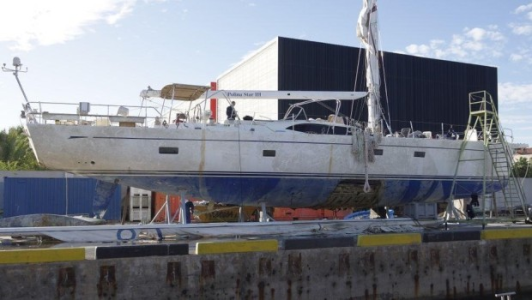
I'm sure that will come as a massive relief to the owner of Pollina Star IIIThey are weaker, too weak and they often don’t make rudder areas a watertight compartment. Scandalous penny pinching in my view.
An example, which illustrates my point, an Oyster owner I know smacked his boat into a rock earlier this year at over 8 kts. No water came in, although the hull was damaged. His rudder is skeg protected - very strong and will withstand a collision better than most. It is most importantly in a watertight compartment, so a collision will not sink the boat.

The irony is, when I suggested that you might be hours behind in a day's sailing, I was envisioning a long Channel crossing. The point I was thinking to make (but didn't) was that you might be 2 hours behind after 24 but so what?
.
Here we go again ..... boats have been sinking for centuries, regardless of attempts by designers to stop them ... we as humans design things for specific usage scenarios, and as soon as something happens that is outside that design envelope, disaster strikes and we learn another lesson. There is best practice I agree, but it comes at a price and it is up to individuals to navigate that price/benefit decision - the only other choice is to continue to sit in that armchair and wax lyrical about proper boat design instead of chasing your dreams.
Your analysis is also flawed - in German when you use the verb "vermuten" (or "glauben" for that matter), it means that you don't know and what you are explaining is a guess or a belief - this is a fact and an attribute of the way Germans use language. So my take away is that he doesn't know where the damage occurred - he lost steering, and his boat saloon filled with water and sank - where the hole was and the extent of the damage isn't actually known.
But in general, anyone who believes their boat design will save them if they hit an object at sea is living in cloud cuckoo land and can go down in the annals of history with the makers of the Titanic.
A totally different issue. It hit nothing. A stupid engineering error. You are on shaky ground here. Bavs can do this well. How many is it now that lost their keel? Just dropped off.
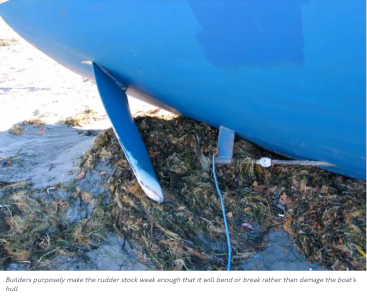
Actually, almost all modern boats don't have watertight bulkheads ahead of the rudder stock - but I don't see an epidemic of boats sinking as a consequence. Do you really think the designers are stupid and don't think of these things, coming to the conclusion that such a feature is not necessary. There are literally tens of thousands of boats of this type in use all round the world without any issues.They are weaker, too weak and they often don’t make rudder areas a watertight compartment. Scandalous penny pinching in my view.
An example, which illustrates my point, an Oyster owner I know smacked his boat into a rock earlier this year at over 8 kts. No water came in, although the hull was damaged. His rudder is skeg protected - very strong and will withstand a collision better than most. It is most importantly in a watertight compartment, so a collision will not sink the boat.
Bavarias in charter fleets smack their rudders off the seabed every other day, they don't tend to sink, I see them all lined up at my marina at the end of every season with the rudders undergoing repairs or pulled out .... I personally watched a German crew smack a chartered Farr designed Bavaria 50 into rocks attempting a med moor in a part of the harbour that was too rocky and too shallow ... the boat stopped dead, the crew on deck all fell over and I could see straight through the bow thruster as the bow lifted out of the water. The boat didn't sink and continued its charter the following day ... probably bent the rudder post and needs an inspection and repairs, but it was far from a disaster.Obviously all boats can sink. I did not make that point. My arguments focus on probability of withstanding damage and of excessive design weakness.
There is no flaw in my analysis. When you lose steering and water floods in it can only be a damaged rudder. Bavarias don’t make their rudder areas watertight. They should, it costs buttons.