Battery cable lengths?

  • Thread starter Thread starter prv
  • Start date Start date

prv

Well-Known Member
Joined
29 Nov 2009
Messages
37,358
Location
Southampton
Visit site
Although I'm ignoring it for now in favour of going sailing, KS is urgently in need of an electrical refit. I'm thinking things through now ready to do the work over winter. As well as taming the impressive rats' nest one of the things I'd like to do is fit a significantly bigger service battery, since it's rare for me to have shore power (never, so far, including at the home berth) and I often sail single-handed relying on the tillerpilot which must draw some amps.

Unfortunately, KS is not trimmed terribly well fore and aft. The previous owner fitted a bigger engine, and also placed a holding tank where the fuel tank belongs, forcing me to fit a new fuel tank right in the stern. To mitigate this he put a small chunk of lead in the forward locker and upgraded the ground tackle to all-chain, but she's still down at the stern and up at the bow by a couple of inches each.

The point is, I'm considering mounting the new battery up forward instead of in the current battery locker under the cockpit. I'd leave the engine battery where it is (possibly fitting a smaller-capacity, high-cranking type) but put the service battery which is likely to weigh 50Kg ish under the forepeak. Clearly this would be a nonsense from an electrical point of view in a 35-footer, but on KS this would only be 10 feet or so from the engine and panel (in a straight line; add another couple of feet for wiggling around). The biggest current flow is likely to be charging; otherwise the biggest loads are probably fridge and tillerpilot.

Is this too far?

I'd also end up running the cables alongside the sounder one; I guess DC shouldn't be causing interference?

Cheers,

Pete
 
I would certainly vote for a proper engine start battery, my engine starting problems evaporated when the leisure battery was replaced with a heavy duty engine start battery. As for cable size I would suggest as big as you can afford/fit. At the end of the day the biggest load will be engine start when something goes wrong with the engine start battery. Cables need to be sized to cope with this potential problem no matter how remote you see the possib ilkity is.
 
Go for a start battery such as a Red Flash or Odyssey which is small light and can be mounted in any orientation, close to the engine. No problem with the service battery forward - the batteries on my Bavaria are all at least 3m away from the engine. Use a battery cluster of switches and VSR such as made by BEP. If you are re-wiring completely there is value in going to somebody like Merlin with your plans and they will quote for all the kit and provide wiring diagrams specific to your installation. They are not the only supplier, but they do specialise in this sort of job and you know it is done correctly.
 
Good point about sizing the cables for an emergency start; I only came up with this battery-forward idea in the last couple of days and that one hadn't occurred to me yet. This is why letting the ideas percolate for a few months while I get some sailing in is no bad plan.

Red Flash was on my radar for a start battery, although since I favour maintainable fast-charging traditional technology for the service battery the manufacturers have suggested that it might not be appropriate (or at least requires a more complicated charging setup to apply different voltages to the different batteries). With the kind of sailing I'm doing at the moment, a typical day or overnight trip gets 20-30 minutes of engine-charging as I motor down the river at the start, and usually less than that at the end. With no other means of charging, I need to stuff as much energy into the battery as I can while I can, and I understand the best way to do that is with relatively high voltage, accepting that a little water will be boiled off to be replaced with regular maintenance. The manufacturers of the deep cycle industrial batteries I've looked at seem to regard that as normal duty.

I'm pretty confident with the circuit design, and as always cost is a consideration, so I'll be shopping around for parts rather than getting someone to create me a package system.

Cheers,

Pete
 
I think people get their knickers in a twist too much about theoretical considerations on this forum
Have you ever looked at a Mini or Austin 1100/1300? Most of them have survived years of regular daily starting using 10 feet of battery cable from the back of the car to the starter at the front.
 
I think people get their knickers in a twist too much about theoretical considerations on this forum

Nah - if I was worried about theoretical considerations I'd look up the volt-drop calculations etc and actually work it out. But asking for an experienced gut feel on here is easier :-)

Have you ever looked at a Mini or Austin 1100/1300?

Nope - bit before my time. My granny used to have a Mini, but she set fire to it (by driving with a blanket over the engine) before I was old enough to take notice of things like where the battery was.

Most of them have survived years of regular daily starting using 10 feet of battery cable from the back of the car to the starter at the front.

Well, that's good to know, then. I've never encountered a car with the battery anywhere other than in the engine bay, even when I used to earn a few quid in the 6th form by installing ridiculous thumpa-thumpa stereos for those that liked that kind of thing.

Pete
 
Nope - bit before my time. My granny used to have a Mini, but she set fire to it (by driving with a blanket over the engine) before I was old enough to take notice of things like where the battery was.

Pete

With being still wet behind the ears, how about most present day Merc's, Bmw's and the big Jag's, are all in the boot, you know that place where you push chair went......... http://www.ybw.com/forums/images/icons/icon12.gif

___________________________________________________________________
 
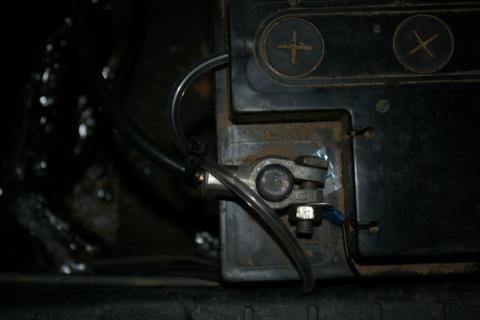
As well as going for the best cable you can (note the use of the word best, not biggest - not all large diameter cables are made the same) you should also ensure that ventilation is provided for the battery. Here is the winch battery in the boot of my off-roader with vent tubes fitted to take any gas to safe place.

winchwiring2.JPG
 
With being still wet behind the ears, how about most present day Merc's, Bmw's and the big Jag's, are all in the boot, you know that place where you push chair went.........
icon12.gif

:-) Never been any Mercs, BMWs or Jags around. Parents now have VWs (as do I) and Dad thinks that's dead posh. Previously it was Metros, Montegos and bean-tin Fiats.

But I guess a big Jag is longer than a Mini, so that's another hint that my proposed battery cable length is not excessive. Just need to have a closer look at the space up forward to see if it's possible without taking up too much locker space.

Pete
 
:-) Never been any Mercs, BMWs or Jags around. Parents now have VWs (as do I) and Dad thinks that's dead posh. Previously it was Metros, Montegos and bean-tin Fiats.

But I guess a big Jag is longer than a Mini, so that's another hint that my proposed battery cable length is not excessive. Just need to have a closer look at the space up forward to see if it's possible without taking up too much locker space.

Pete

Nothing wrong with VW's, I reserve judgement on the rest as I would not like to offend.....!

For cable, I would advise on welding/booster type, this is muti core, flexible, easy to work and feed through,16mmsq/196/0.31@80A/o.d. 8.5mm - 25mmsq/294/0.31@110A/o.d. 10mm -The amperage (A) is for a continuous rating.
You should get away with 16mm with allowing for a occasional boost to you engine battery but if the price is not an issue go for the 25mm.

____________________________________________________________________
 
I used to re-wire rally cars with bigger cables. A good and cheap source of new cable is any truck body firm that fits tail-lifts.
The kit comes with great coils of very heavy duty cable which they often don't use.
Worth a try.
 
While that cable will do the job, the salt will gradually turn it to green mush; you really need tinned wire in boats. Make sure you're sitting down when you read the price of the stuff though...
 
While that cable will do the job, the salt will gradually turn it to green mush; you really need tinned wire in boats. Make sure you're sitting down when you read the price of the stuff though...

Only if you're a purist.

Vasaline at the terminations and it could last the life of the boat under normal conditions.

Then you don't have to sit down so much.....

_____________________________________________________________________
 
Well, that's good to know, then. I've never encountered a car with the battery anywhere other than in the engine bay, even when I used to earn a few quid in the 6th form by installing ridiculous thumpa-thumpa stereos for those that liked that kind of thing.

Pete

Well my first car had it two batteries ( 6 volts in series to give 12). Back end batteries are not that uncommon in reality, though perhaps not in the sort of cars bought by thumpa thumpa enthusiasts. One knows the man by the company he keeps
 
Actually, come to think of it, I had a BMW 523i Touring and the battery was hidden somewhere under the rear floor in that. I reckon there must be a fair few motors with the battery at the back.
 
While that cable will do the job, the salt will gradually turn it to green mush; you really need tinned wire in boats. Make sure you're sitting down when you read the price of the stuff though...
Only if you're a purist.

Vasaline at the terminations and it could last the life of the boat under normal conditions.

Then you don't have to sit down so much.....

On reflection there is an argument to be made in the case here; tinned cable of the size required is eye-bleedingly expensive, so I would be tempted to use, say, 50CSA welding cable and seal the terminals with a couple of layers of adhesive lined heatshrink. For smaller sized wiring, particularly any that goes on deck to instruments or whatever, I would use tinned as the extra cost is small.
 
On reflection there is an argument to be made in the case here; tinned cable of the size required is eye-bleedingly expensive, so I would be tempted to use, say, 50CSA welding cable and seal the terminals with a couple of layers of adhesive lined heatshrink. For smaller sized wiring, particularly any that goes on deck to instruments or whatever, I would use tinned as the extra cost is small.

My thinking entirely.

Pete
 
Top