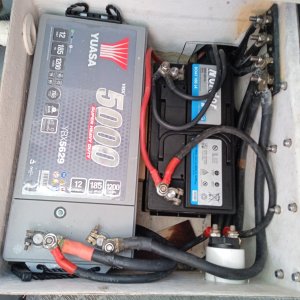
Azimut 46 - new battery charger system plus service/house batteries, engines battery and gen. battery

See post #77: essentially, my only point was that your comments are pointless.
Why ?
You have not pm d the op .
The gen public are reading this .
Some with mech older diesels other with expensive ( AKA in some manufacturers case “ un obtainium “ ) ECU riddled modern .

Clarity is needed differentiating between the two in terms of risks running them disconnected to there batteries.
I never mentioned the OP s or had a dig at yours and PeteM s .

Also they have choices on how they can be linked the domestic and engine batts should they consider replacing or adding to the OEM stuff already installed.
 
Last edited:
Most” modern “certainly MAN EDC and suspect many other EDC,
If you need for what reason to replace a fuel filter on the engine the secondary, you need power to open the solinoid.
To bleed air out .
My “ modern “ were 2003 btw . You couldn’t bleed them without the ignition turned on …..hear a click as the fuel valve opened .
Again important distinction need to be made if in the future if some one reads this thread chasing a dead boat leccy wise unable to run .

Maybe added hassle of replacing secondary filters overlaying dead batteries…..wondering why they won’t bleed disconnected .

So sure the distinction between old vs modern needed clarity .

Thankfully the OP s is old er tech but nether the less if he had spring loaded X over switches instead of permanently enabled batt bank connectors ( how ever labeled , how ever knowledgeable he has of own systems) This thread would not exist .
 
Fitting X overs will prevent his predicament happening.
Also i was , quoting Paul R .
Pushing back on marine diesels running without being connected to batteries ( assuming you got them stated )
Modern ones can’t . Simply clarifying that .
You know things drift off on tangents and such . Helpful.
Try reading how the system i described works, if you can grasp it.

It doesn't say anything about running engines without being connected to batteries. On the contrary, you run the engines from the domestic bank.

With your momentary switch you temporarily parallel the batteries to start an engine with a flat battery, then you carry on running from the engine battery. How does this system work if the engine batteries are unusable ? Don't say connect them with jump leads, that's ridiculous, stupid, dangerous.
 
Most” modern “certainly MAN EDC and suspect many other EDC,
If you need for what reason to replace a fuel filter on the engine the secondary, you need power to open the solinoid.
To bleed air out .
My “ modern “ were 2003 btw . You couldn’t bleed them without the ignition turned on …..hear a click as the fuel valve opened .
Again important distinction need to be made if in the future if some one reads this thread chasing a dead boat leccy wise unable to run .

Maybe added hassle of replacing secondary filters overlaying dead batteries…..wondering why they won’t bleed disconnected .

So sure the distinction between old vs modern needed clarity .

Thankfully the OP s is old er tech but nether the less if he had spring loaded X over switches instead of permanently enabled batt bank connectors ( how ever labeled , how ever knowledgeable he has of own systems) This thread would not exist .
More and more utter nonsense, please stop posting this misleading garbage.
 
See post #77: essentially, my only point was that your comments are pointless.
I agree with that. There seems to be some confusion about the distinction between "mechanical" and "electronic" engines and what the electronic bit does. Many mechanical engines are controlled by electrical or electronic controls, but running is mechanical - that is fuel injected by a mechanical pump. This was true of most engines up to about 15 years ago when single rail injection started to appear. The fuel injection is totally electronic - no mechanical pump and they do indeed need electrical power to run.

Previous mechanical engines may well be difficult to operate without electrical power because important things like the fuel rack and stop control are operated electrically. However that does not mean they will not run until fuel and air run out if these controls are disabled. If the battery is still connected the alternator will charge
 
I agree with that. There seems to be some confusion about the distinction between "mechanical" and "electronic" engines and what the electronic bit does. Many mechanical engines are controlled by electrical or electronic controls, but running is mechanical - that is fuel injected by a mechanical pump. This was true of most engines up to about 15 years ago when single rail injection started to appear. The fuel injection is totally electronic - no mechanical pump and they do indeed need electrical power to run.

Previous mechanical engines may well be difficult to operate without electrical power because important things like the fuel rack and stop control are operated electrically. However that does not mean they will not run until fuel and air run out if these controls are disabled. If the battery is still connected the alternator will charge
But the system i described is essentially the same as the one on your boat, the engine doesn't run without a battery, it runs from the domestic batteries.
 
But the system i described is essentially the same as the one on your boat, the engine doesn't run without a battery, it runs from the domestic batteries.
Don't think I was questioning that. I was trying to correct the misunderstanding about the distinction between mechanical and electronic. A mechanical engine does not need a battery to run once it is started whereas a single rail does.
 
Try reading how the system i described works, if you can grasp it.

It doesn't say anything about running engines without being connected to batteries. On the contrary, you run the engines from the domestic bank.

With your momentary switch you temporarily parallel the batteries to start an engine with a flat battery, then you carry on running from the engine battery. How does this system work if the engine batteries are unusable ? Don't say connect them with jump leads, that's ridiculous, stupid, dangerous.
You said this in post #68
“Momentary parallel relays are all well and good, but what happens when you get a catastrophic battery failure ? Suppose the engine battery has exploded, internally shorted etc, You can't use your momentary button now.”

I am saying if this occurred with the x over system you have connectors ready to swap banks .
So use the domestic . They not jump leads either . Bolt ons thick enough.
But this never happened in 19 yr .

Also not sure what would happen in the above scenario you quoted if if you did flick a permanent switch labelled or not …..
With the exploded / overheated engine batts still linked , linked up the doms with the engine s running attempting to recharge them .
So some one’s going to have to go in with spanner’s any how to disable said knackered engine batts ….for sure .
 
More and more utter nonsense, please stop posting this misleading garbage.
What’s the issue with this ?
My “ modern “ MANs ( 2003 ) and I think there are many more manufacturers need power to open the fuel , let it run .
I know this from experience, Infact doing 2 nd filter changes as Tarona infers .
You can’t bleed them without the ignition on and you can hear the solinoid click as the helper turns them on .
This is pre high pressure fuel common rail as well .

If the ops boat ( lead acids ) was wired with x over switches he wouldn’t have gone to bed with the engine batts , geny bat linked all linked up to his fridges and depleting the power overnight resulting in a no start in the AM .
 
What’s the issue with this ?
My “ modern “ MANs ( 2003 ) and I think there are many more manufacturers need power to open the fuel , let it run .
I know this from experience, Infact doing 2 nd filter changes as Tarona infers .
You can’t bleed them without the ignition on and you can hear the solinoid click as the helper turns them on .
This is pre high pressure fuel common rail as well .

If the ops boat ( lead acids ) was wired with x over switches he wouldn’t have gone to bed with the engine batts , geny bat linked all linked up to his fridges and depleting the power overnight resulting in a no start in the AM .
No such thing as an "ignition" switch on a diesel engine. It is simply a power on switch. Just because your boat had a pressure pump for bleeding when it is not running does not mean it is electronic. Once it is running the fuel is metered mechanically and does not need battery power to run so long as it has fuel and air.

I though I had explained that single/common rail is different in that the metering requires electrical power.

Anyway all nothing to do with the OP who now seems to have a clear idea about how he can make small changes to his electrical system to bring it up to date, make it more reliable and meet his cruising needs.
 
You said this in post #68
“Momentary parallel relays are all well and good, but what happens when you get a catastrophic battery failure ? Suppose the engine battery has exploded, internally shorted etc, You can't use your momentary button now.”

I am saying if this occurred with the x over system you have connectors ready to swap banks .
So use the domestic . They not jump leads either . Bolt ons thick enough.
But this never happened in 19 yr .

Also not sure what would happen in the above scenario you quoted if if you did flick a permanent switch labelled or not …..
With the exploded / overheated engine batts still linked , linked up the doms with the engine s running attempting to recharge them .
So some one’s going to have to go in with spanner’s any how to disable said knackered engine batts ….for sure .
Still don't get it, do you ?

You isolate the dead battery THEN connect the engine to the domestic BATTERIES.

Going down to the engine room with spanners to disconnect overheating batteries is a recipe for an explosion and loss of sight and/or injury.
 
What’s the issue with this ?
My “ modern “ MANs ( 2003 ) and I think there are many more manufacturers need power to open the fuel , let it run .
I know this from experience, Infact doing 2 nd filter changes as Tarona infers .
You can’t bleed them without the ignition on and you can hear the solinoid click as the helper turns them on .
This is pre high pressure fuel common rail as well .

So what ? Why would you be be changing filters if the batteries were dead ? Besides, i you hadn't noticed the batteries were dead you can parallel with the domestics, as i've said a thousand times.
If the ops boat ( lead acids ) was wired with x over switches he wouldn’t have gone to bed with the engine batts , geny bat linked all linked up to his fridges and depleting the power overnight resulting in a no start in the AM .
That's user error and a less than perfect system, it isn't the system i described. The emergency relays or switches should be labelled and fitted with keys to prevent accidental use.
 
Many mechanical engines are controlled by electrical or electronic controls, but running is mechanical - that is fuel injected by a mechanical pump.
This was true of most engines up to about 15 years ago when single rail injection started to appear.
Correct.
And makes me think of a folkloristic note - TOTALLY irrelevant to the original subject of this thread, but... Hey-ho! It's by now firmly derailed anyhow.
Don't tell Porto, but the so-called EDC MANs he's referring to and that powered his boat fall exactly in the category of mechanical pump and injectors, controlled by an electronic governor. Best thing since sliced bread, if you ask him.
Worst of both worlds 'fiuaskme, because they offer almost none of the advantages of a fully computerized and calibrated injection, adding at the same time a layer of complexity. And making them fully dependent on a perfectly running DC system.
As any modern electronically controlled engine is, obviously. I mean, REALLY modern ones, as opposed to MAN EDC, by now forgotten even by MAN dealers.
In fact, it's no coincidence that MAN converted to EDC just some engines and for just a few years, eventually adopting common rail on their whole lineup.

PS for the OP: nothing of this is in any manner relevant and worth reading (let alone understanding!) for your Cat 3208 powered boat.
 
Last edited:
Just another aside at the other end of the engine scale. I have just installed a new Beta 30 in my boat. Old fashioned mechanical engine designed getting n for 40 years ago. It has an electric lift pump, which of course means it is easy to bleed if you ever need to, but of course won't run without power. My last engine was its direct competitor the Volvo D1 30, Again a mechanical engine. However in their wisdom Volvo us a troublesome electronic interface between the mechanical controls nd the electronic control panel. Fortunately for me neither engine has given any trouble.
 
Thanks for all the helpfull information: I will proceed step by step to the new battery solution:
Yesterday I have fitted a new battery for the KOHLER generator: normal, good quality lead acid - 100 Ah.
Mesurements have shown that the existing Cat. starter battery is ok and in good condition.

And I have checked the wiring to the engine- and gen. battery: only ONE emergengy switch to connect them - gen. battery stand alone with generator.
They should no more have any connections to the service system.
N_NewGenBat_20250805_1.jpg

Let's go back to the main question: Service Battery charger + new Service Batteries
The new charger / inverter will be a Victron Multi plus II 12 / 3000 /120-22 with Color Control GX and interface to my on board IT system.

After having read xxxx posts and articles about batteries on board I am total confused, WHAT to fit? Every expert tells me an other storry ...
I would expect a lifetime of about 6 years +; the boat will be 20% offshore / at anchor and 80% a year in port / shore power
I will also fit on the deck / rooftop 2 PV panel with ca. total 1.5m2 resulting ca. 280W peak.
I need a professional, "nautical standard grade", service battery system.

AGM - GEL - LiFePo4 ???
In my battery box I have space to fit +/- 3x 200 - 240 Ah types. Total installation for the boat should be + 600 Ah.
My battery case is in the motor room / back of 2 Cat engines - on side of fuel tank) = great temparature differences: normal time on port = 12-22 deg / summer time med. = 30 deg / and running - cruising with the 2 Caterpillar in summer time = up to 70 deg ! (=hot sauna)
 
Top