
NO Felice
Well-Known Member
Is it now perfect or an suggestion: no tension on any cable, all screws perfect fitted, no movements, no touching ...???Felix on the Yuasa battery the pos cable should not be touching the neg terminal.
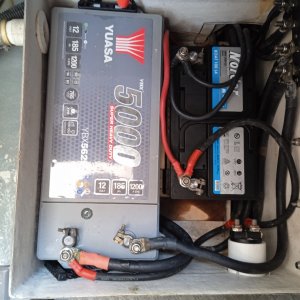

Is it now perfect or an suggestion: no tension on any cable, all screws perfect fitted, no movements, no touching ...???Felix on the Yuasa battery the pos cable should not be touching the neg terminal.

I have to explain:Excuse my ignorance but you are all talking about domestic and starter batteries . On my gobbi 375 , as well my previous searay 240 , there is no such a thing .
Two identical batteries with a 1-2-both-off switch and ( on the gobbi ) separate isolation switches for each battery , EDC , engines and bow thruster .
usually you start and run the engines in "both" , isolating one battery is useful for anchoring without shore power . both batteries can be used to start the engines.
Never had a problem with such a setup
That really is not a very good system for all sorts of reasons and not used in recent boats. Dedicated engine start battery individually switched and dedicate house battery bank to suit the level of consumption also individually switched. The type of battery required for the 2 functions is very different and the last thing you want to do is compromise your ability to start the engine by using its battery for domestic use. However you may well want to include switching that enables you to use the house bank to start the engine(s) in an emergency or in the unlikely event of your start battery failing. You do of course need some form of split charging from the alternator but there is nothing difficult about that.Excuse my ignorance but you are all talking about domestic and starter batteries . On my gobbi 375 , as well my previous searay 240 , there is no such a thing .
Two identical batteries with a 1-2-both-off switch and ( on the gobbi ) separate isolation switches for each battery , EDC , engines and bow thruster .
usually you start and run the engines in "both" , isolating one battery is useful for anchoring without shore power . both batteries can be used to start the engines.
Never had a problem with such a setup

1 Engine battery for both engines Jake, see #101@Skipper Felice just go with Victron LiFePO4 batteries if you want the name brand option.
They will be so much wildly better than the lead acids. I promise worth the money.
I’d take a 100Ah lifepo4 bank in preference to even a 300Ah lead acid bank.
You will need to do a little reconfiguration of the charging system though. You will need a Victron Orion XS that charges the lithium battery from the engine battery when the engine is running because they will pull too much current from your alternators otherwise.
Do you have 1 start battery shared by both engines or 1 battery per engine? How does the engine charge the domestic battery bank at the moment?
That's a rubbish system. When the switch is on both the 2 batteries are in parallel, making it possible to accidentally flatten both or for a fault to do so.Excuse my ignorance but you are all talking about domestic and starter batteries . On my gobbi 375 , as well my previous searay 240 , there is no such a thing .
Two identical batteries with a 1-2-both-off switch and ( on the gobbi ) separate isolation switches for each battery , EDC , engines and bow thruster .
usually you start and run the engines in "both" , isolating one battery is useful for anchoring without shore power . both batteries can be used to start the engines.
Never had a problem with such a setup
I would get the Multiplus 2, much cheaper and has all the features of the original Multiplus.Well while we are at it ... may I ask for a opinion ?
On my Azi there is a rather beefy charger (Dolphin with 3 outputs, services - starter 1 - starter 2), but no inverter. Not sure if it was removed at a certain stage or never there at all (or maybe is there, is not working, and I did not find it until now).
Im going to add a Victron Multiplus 3Kw 24v inverter: this model has a trickle charger for the starter batteries (only 4 A) beside the 70A charger/inverter.
Now I would use the trickle charger with a argofet charger splitter to top-up the starter batteries when Im connected to shore or genset.
The drawback I see is that in case the starter batteries die overnight the trickle charger will be of no use (but in this case I will have to parallel the services / connect with cables / etc anyway to start the engines).
Another idea was to leave the Dolphin in place but switched off and connected only to the splitter for the starter batteries - as a sort of backup charger only for the starter batteries in case the inverter gives up for some reason.
Basically: Services batteries connected to the main of the inverter/charger.
Starter batteries connected via splitter with the trickle output of the inverter and to the "backup" dolphin charger (which will be turned on when it will be needed).
The reason I want the inverter is that the Dometic fridge is actually working on DC only, is 15 y/o and very unefficient. I would like to replace it with a "normal" household fridge that runs on 220v (same setup I had on the trawler). Also the kids nag me all the time about starting the genset to reload Ipad, Laptops, Starlink antenna etc so the inverter should take care of this.
I have 4x200 ah Gel batteries (2 x 2 batteries in series, 24v) btw.
I have the bypass too.Paul yes I got the Multiplus 2 this one here "Victron Multiplus II 24V - 3000VA - 70A". Same as yours.
>Why not leave the dolphin as it is, so if the Multiplus fails you have backup charging for all batteries ?
So given the negative is common to both of the inverter/charger, just run a cable from the services battery positive to the Multiplus positive. And leave the Dolphin as it is a backup just turned off. I already have a switch that will enable to exclude the 220v "passthru" of the Multiplus so that in case of problems I can exclude it

We have 900W of solar, but i think you'll struggle to fit that much, we have a canvas enclosure or the cockpit, i fitted the panels on a stainless frame over the cover.completely.
I guess this is the easiest setup - thank you !
You also have solar ... hmm problem is where I put the things on the azi and how many would I need ? my only information is the Ampere draw on the display of the azi, it indicates between 6 and 8 A (24v) when fridge is running etc (2-3 A of this is the stupid Starlink if noone remembers to switch it off). So assuming 5A 24 hours at 24 V... this makes 2.8kw consumption.
I have seen flexible panels which could be sewn in / attached on top of the bimini for example (so that they are not visibile). Question is how much would I need of it to make a dent in my 2.8kw ... boat is in Greece so we almost never see rain. But even getting half of it would be something, in greece you often have mooring in the towns quay and even fancy ones like Fiscardo have no electricty or just 1 box for 20 boats, running the genset there annoys everyone and I really dont like it (cue irate swedish santa-claus sailor yelling at me....)
I fully agree with Paul - and I will have a more or less similar system when the clean up is done.I would get the Multiplus 2, much cheaper and has all the features of the original Multiplus.
Why not leave the dolphin as it is, so if the Multiplus fails you have backup charging for all batteries ?
We have an all electric galley, including the fridge (normal domestic model) and a Multiplus 2 3000-24V-70A, which runs everything fine, batteries charged by solar when off grid. Also have a Victron charger as a backup, so all very similar to what you suggest above.
This is incorrect, you need to use 12V for USB sockets, the sockets sort out the voltages needed for charging you devices. You need good quality, latest spec sockets or some devices will take forever to charge. Many modern laptops, tablets or even phones use varying voltages for charging, some in excess of 12V.I fully agree with Paul - and I will have a more or less similar system when the clean up is done.
My galley is also full electric (can only be run with shore or generator in full) - but my fridge is a large DOMETIC (inkl. freezer) on 12 V domestic. Set to a medium level it draws +/- 1.5 Ah.
Funny thing is I found also 2 small Dolphin Chargers in the motor room: they had not been connected or to some dead ends: (1x 12V10A and 1x 12V15A).
I will install them as backup for the engine battery and the generator battery.
For all the small USB devices (10 ... 20 ... ???) it makes for me no sense to take the power from domestic/services > go to the converter (=230V) and plug x chargers into the 230V net to get the 5V USB power. USB is 5 V and I will install a main DC/DC 12V/ 5V power supply from the service system and add USB outputs to all 230V AC plugs.
3 x 260w panels will make a big dent in your power needs. My 900W runs the whole boat on reasonably sunny weather here in the UK.Yes usb-c can go 100W - I mean once you have the inverter in place just use the normal 220v charger that comes with the phone/ipod etc and thats it.
Btw this is the solar panel real estate situation The view from above
There is place for the panels on the bimini, or in front of the fly. The bimini could easily swallow 3x260w modules, one in each of the 3 segments, not sure what happens if a lot of wind comes, I have seen them installed clipped to the bimini (tenax) with a kind of frame around so that the wind does not get under the panel. Bimini is probably 4 meter long and 2.5 wide.
Look like a nice October project if I find a sailrite sewing machine or similar.
Turns out this wasn’t quite right. Corrected version isI’ve got one bank of 4x 12v in series/parallel for domestic, plus two banks of 2x12v in series for each engine start, plus a single 12v dedicated generator start, plus a bank of 2x12v in series for bow thruster. Victron AC (shore or generator) to 24V charger for domestics; CTEK AC (shore or generator) to 12V charger for gen start; DC-DC Victron charger for the bow thruster batteries; plus alternator charging for the engine start batts.
No BMS.
I think that's mostly standard Princess fare for the age of the boat. My domestic, engine and generator setup is the same as yours, although i had to add the genny charger, coincidentally i went for a Ctek, same as yours. My bow thruster and windlass both run off of the engine batteries, i suspect your may have done originally, as the Victron Orion is a pretty new product, either that or the thruster itself is a late addition.Turns out this wasn’t quite right. Corrected version is
I’ve got one bank of 4x 12v in series/parallel for domestic, plus one bank of 2x12v in series for engine start, plus a single 12v dedicated generator start, plus a bank of 2x12v in series for bow thruster. Victron AC (shore or generator) to 24V charger for domestics and engines, two channels; CTEK AC (shore or generator) to 12V charger for gen start; Victron Orion DC-DC charger for the bow thruster batteries; plus alternator charging for the engine start and domestic batts.
Mine was also built with no way of emergency starting, as i was in the middle of a million things at the time i bought the boat i fitted a simple, manual switch. I have since updated almost all of the electrical systems, including LifePO4 batteries, a little more to finish off on the power/battery systems, so will be adding remote relays for emergency starting and bypassing the BMS to allow starting from the lithium domestics.I don’t have any way of cross-linking for emergency start so that might one day be an issue, although I’ve no way of flattening the engine batteries with the fridge either!
