Azimut 46 - new battery charger system plus service/house batteries, engines battery and gen. battery

Is it ok to install a LiFePO4 pack into the AZI box in the motor room - distance for cables to charger 1.3 m / cables to main distribution 1.5 m ?
Subject to correct size cables and appropriate fusing, yes.

Paul, wouldn't an install outside the e/r be better for the longevity of LifePO4 in the Med? I have mine under a sofa in the salon, much cooler than in the e/r where the original service/starter batteries live.
 
I have to explain:
On a Azimut 46 (and others from Azimut) there are (in most cases) 3 Batteries:
1. Battery - connection (only) to the on board generator (in my case KOHLER 7kW), charged by gen. set.
2. Engine Starter Battery (1 or 2): they are only for starting the CAT engines, they charge over the alternator from the CAT engines.
3. Large "Service" battery (2-4 x 150/200 Ah): power for the whole 12V system: lights, fridge, inverter (for some small 230V units), instruments, navigation, GPS, VHF radio etc.

For emergency situations there are some switches to connect them together.

Yes , exactly but with the difference any of the two banks can be used as domestic and any can be used as starter . Both banks can power up any system

No dedicated starter and domestic battery , just remember to isolate one bank if you stay without shore power for a long time .

Genny has its own battery so you can at least start the genny and recharge if you really drained all main batteries .
 
Yes , exactly but with the difference any of the two banks can be used as domestic and any can be used as starter . Both banks can power up any system

No dedicated starter and domestic battery , just remember to isolate one bank if you stay without shore power for a long time .

Genny has its own battery so you can at least start the genny and recharge if you really drained all main batteries .
But the battery types are (or should be) different. At least ensure that the batteries in each bank are the appropriate type for that bank’s normal use.
 
Yes, could be, depends on his engine room temps i suppose. (y)
In post #95 I gave you the figures of the temp in the angine room of an AZI 46, summer, Med., around 34deg outside, 2 Cat engines running at 2000 rpm:
(real mesurements):
My battery case is in the motor room / back of 2 Cat engines - on side of fuel tank) = great temparature differences: normal time on port = 12-22 deg / summer time med. = 30 deg / and running - cruising with the 2 Caterpillar in summer time = up to 70 deg ! (=hot sauna)
 
In post #95 I gave you the figures of the temp in the angine room of an AZI 46, summer, Med., around 34deg outside, 2 Cat engines running at 2000 rpm:
(real mesurements):
My battery case is in the motor room / back of 2 Cat engines - on side of fuel tank) = great temparature differences: normal time on port = 12-22 deg / summer time med. = 30 deg / and running - cruising with the 2 Caterpillar in summer time = up to 70 deg ! (=hot sauna)
70° is a cool sauna. 110° is a proper sauna and 90° is a wimpy sauna.
 
summer time med. = 30 deg / and running - cruising with the 2 Caterpillar in summer time = up to 70 deg ! (=hot sauna)
If by cruising you mean the actual temperature while the engines are spinning at 2000+ RPM, I think you have an e/r ventilation problem.
Batteries aside, which obviously are also unhappy to be cooked every time the engines are running, a 40 deg difference is WAY too high, and can only be due to poor air circulation.
To the point of making me guess that also the engines might be restricted in their need for air, and this ain't good for them.
Have you ever tried to open the e/r hatch while under way at cruising speed?
If the e/r air intakes are obstructed for whatever reason, the engines aspiration is bound to create a negative air pressure inside the e/r, which translates in the hatch being harder to open than when the boat is static, because the suction effect tends to keep it closed.
This is just a quick and easy check of course, that doesn't tell you how big the problem is, but it confirms that the problem exists.
And if by running with the e/r hatch open that 40 deg difference isn't drastically reduced, there must be another reason well worth investigating.
 
  • Like
Reactions: vas
If by cruising you mean the actual temperature while the engines are spinning at 2000+ RPM, I think you have an e/r ventilation problem.
Batteries aside, which obviously are also unhappy to be cooked every time the engines are running, a 40 deg difference is WAY too high, and can only be due to poor air circulation.
To the point of making me guess that also the engines might be restricted in their need for air, and this ain't good for them.
Have you ever tried to open the e/r hatch while under way at cruising speed?
If the e/r air intakes are obstructed for whatever reason, the engines aspiration is bound to create a negative air pressure inside the e/r, which translates in the hatch being harder to open than when the boat is static, because the suction effect tends to keep it closed.
This is just a quick and easy check of course, that doesn't tell you how big the problem is, but it confirms that the problem exists.
And if by running with the e/r hatch open that 40 deg difference isn't drastically reduced, there must be another reason well worth investigating.
Air flow in the AZI 46 engine room: I don't know if I have a specific problem - I did the mesurements with a calibrated "laser gun" thermometer:
An example: Today, boat on port mooring / Loano IT we have around 30deg in (cold engines) machine room / outside approx. 33 degrees in the shade and around 50 deg. under the sun/air temp intake.
My engines run at 90deg. under normal power (panel indicator) - so what is wrong with about 70deg in a (+/- closed) AZI 46 engine room?

How can I improve this? What is the solution. For the Service and Engine batteries I have no other place for the placement?
I do not find any kind to open / close the e/r hatch?
 
My engines run at 90deg. under normal power (panel indicator) - so what is wrong with about 70deg in a (+/- closed) AZI 46 engine room?
What is wrong is that the e/r should NOT be closed.
There must be air intakes large enough to allow the engines to draw all the air they need, at their rated max RPM.
And such air volume is MASSIVE: believe it or not, your pair of 3208 when spinning at 2000rpm draw more than 80 (eighty, not a typo!) cubic meters of air per minute. This constant flow of fresh external air, on top of its main purpose of letting the engines run as they should, as a bonus side effect also cools down the e/r.
Of course, not to the point of keeping the e/r at the same temp as outside, because as you say there are also two big lumps of hot iron that work against the cooling effect of fresh air. But as a rule of thumb, in planing boats running at cruising speed, the e/r should never get warmer than 15/20 degrees celsius above external air temperature. And I've seen boats where this delta temperature is around just 10 degrees. You've got 40, which is way OTT!

As an aside, I'm specifying planing boats because, counterintuitively, the e/r temperature can get much warmer in displacement boats. In fact, a single smallish engine spinning at low RPM creates much less air circulation, possibly requiring to cruise with e/r fans turned on. But this doesn't apply to your boat.

I do not find any kind to open / close the e/r hatch?
Pardon? Isn't there an opening in the cockpit for entering the engine room?
That's what I suggested to open while under way, checking if it's harder to pull compared to when the boat is static, due to negative pressure inside the e/r.
And also keep it open for some time while cruising, checking if the e/r temp gets lower.
BTW, any half decent surveyor should have checked the temperature difference between the exterior and the engine room while under way.
And possibly also the exact negative pressure - opening the access hatch is a very simple but quite rough way to check that.
 
Lead acid car batteries in Africa / Gulf states work fine in the summers. As do the same batteries in Med boat engine rooms .What kills them is repeated deep discharge and ( when in port unattended) further discharge and lack of trickle charge.
If the whole system is balanced in terms of capacity/ uses age / charge = no issues:
If one of those 3 things is out of kilter ….ps don’t blame the ambient temps or worse still throw €€€€ in to the “ next best new kid on the block “ eg Lithium bcz it cost more therefore it must work ! Crazy advice,
 
Lead acid car batteries in Africa / Gulf states work fine in the summers. As do the same batteries in Med boat engine rooms .What kills them is repeated deep discharge and ( when in port unattended) further discharge and lack of trickle charge.
If the whole system is balanced in terms of capacity/ uses age / charge = no issues:
If one of those 3 things is out of kilter ….ps don’t blame the ambient temps or worse still throw €€€€ in to the “ next best new kid on the block “ eg Lithium bcz it cost more therefore it must work ! Crazy advice,
Who's recommending lithium "because it costs more"?
 
What is wrong is that the e/r should NOT be closed.
There must be air intakes large enough to allow the engines to draw all the air they need, at their rated max RPM.
I guess you mean with "e/r" = engineroom?

I think that the engine room of an Azimut 46 is properly designed by Azimut for the 3208 engines: On both sides of the hull you have "large air windows". There is nothing to close or open. I do not understand your point.

As an aside, I'm specifying planing boats because, counterintuitively, the e/r temperature can get much warmer in displacement boats. In fact, a single smallish engine spinning at low RPM creates much less air circulation, possibly requiring to cruise with e/r fans turned on. But this doesn't apply to your boat.


Pardon? Isn't there an opening in the cockpit for entering the engine room?
That's what I suggested to open while under way, checking if it's harder to pull compared to when the boat is static, due to negative pressure inside the e/r.
The Azi has a large "door" on the cockpit floor - about 100 x 140 cm - the full access into the motor room. I makes absolutely NO sense to open it as this is a very heavy door and shoul only be oppened while NOT cruising. It is NOT build to be open while under way.


Perhaps some other AZI 46 / 50 owners can help? Of course I will run the engines with the correct air flow! But perhaps I have no full understanding about the engine room air flow? But I see nothing that I can open or close. I checked the owners manual - there is no task that you have to do for air flow management - the only thing to switch on/off are 2 blowers in the engine room.
 
I guess you mean with "e/r" = engineroom?
You wrote: what is wrong with about 70deg in a (+/- closed) AZI 46 engine room?
I replied: What is wrong is that the e/r should NOT be closed.
And now you ask me what I mean by e/r? Comedy gold, or what?!?

It seems to me that there's none so deaf as he who will not hear.
So, I'm not trying to explain why air intakes can get obstructed, or what an engine room hatch is, for fear of getting other pointless questions in return.
If you're happy with your boat, i couldn't be happier too.
Fair winds.
 
It seems to me that there's none so deaf as he who will not hear.
So, I'm not trying to explain why air intakes can get obstructed, or what an engine room hatch is, for fear of getting other pointless questions in return.

Meine Muttersprache ist Schweizerdeutsch ... damit denke und verstehe ich ... Aber normalerweise in Deutsch-Deutsch. Daneben speche ich auch Englisch - perhaps my English is far away of perfect - but I use no AI and GOOGLE - I use my brain ... and sometimes I do not understand your perfect Brit. English ... with your 1000 skipper abreviations. Mais nous pouvons aussi parler en français ; beaucoup de gens le parlent et l'écrivent chez nous - E ora è disponibile anche in italiano. Ogni giorno imparo molte cose interessanti dai miei colleghi italiani.
 
Meine Muttersprache ist Schweizerdeutsch ... damit denke und verstehe ich ... Aber normalerweise in Deutsch-Deutsch. Daneben speche ich auch Englisch - perhaps my English is far away of perfect - but I use no AI and GOOGLE - I use my brain ... and sometimes I do not understand your perfect Brit. English ... with your 1000 skipper abreviations. Mais nous pouvons aussi parler en français ; beaucoup de gens le parlent et l'écrivent chez nous - E ora è disponibile anche in italiano. Ogni giorno imparo molte cose interessanti dai miei colleghi italiani.
It’s the modus operandi of a person with a defeated argument.
1- they insult you by “going for the man not the ball “
2- they flounce off

Being new to them ( they know who they are ) don’t worry what you write and the logical explanation make perfect sense to the other 98 % reading inc me .

Thank you for the interesting thread subject .
 
I guess you mean with "e/r" = engineroom?

I think that the engine room of an Azimut 46 is properly designed by Azimut for the 3208 engines: On both sides of the hull you have "large air windows". There is nothing to close or open. I do not understand your point.


The Azi has a large "door" on the cockpit floor - about 100 x 140 cm - the full access into the motor room. I makes absolutely NO sense to open it as this is a very heavy door and shoul only be oppened while NOT cruising. It is NOT build to be open while under way.


Perhaps some other AZI 46 / 50 owners can help? Of course I will run the engines with the correct air flow! But perhaps I have no full understanding about the engine room air flow? But I see nothing that I can open or close. I checked the owners manual - there is no task that you have to do for air flow management - the only thing to switch on/off are 2 blowers in the engine room.
My Azi 42 is a similar vintage to your 46, and probably has a similar approach to the engine room access, and the air intakes. As you state, the air enters the engine room through the side intakes. These are designed to baffle out any water ingress, and do a great job. Your fire extinguisher system should automatically close these intakes with flaps to limit oxygen into the engine room in case of fire. You should have a door into the engine room from your lazerette, for doing the daily checks of oil and coolant levels, plus a visual inspection. There will probably be a hatch in the saloon, in my case under the saloon carpet. This will be the same for you, unless you have a wooden floor in the saloon. In this case you will clearly see the hatch. This is used for more major inspection and maintenance. I’m able to do my oil and filter changes from the lazerette door on my 42. I would expect your engine room to be bigger than mine, so you should be able to do the same?
On no account should either the door or hatch be opened when you are cruising. This is a safety issue. Happy boating.
 
On no account should either the door or hatch be opened when you are cruising. This is a safety issue. Happy boating.
It's a hot day today - around Liguria ... 35deg. I went out for swimming - the sea around 26deg!

I like to give you some insight on the two hatches into the engine room / and the airintake into the engines:
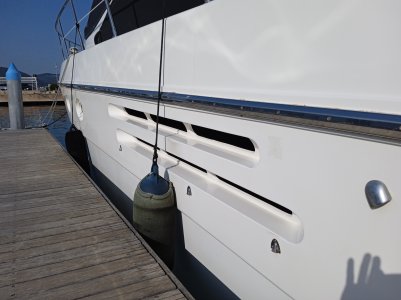
Each side of the the hull has large air intake "windows" - I think they are more than enough and can not be closed (only with the fire emergency switch).
N_BBairinlet_20250810_1.jpg

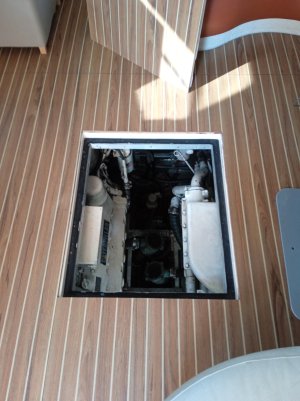
Engine room access is with one small hatch (for bilge check and special access) in the salon floor:

N_mr_hatch_salon_20250810_1.jpg

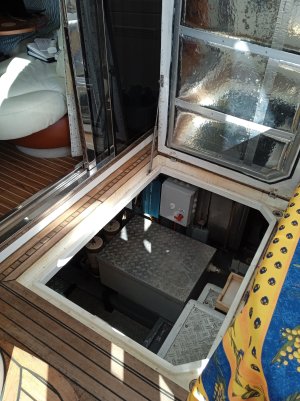
Main engine room access is in the cockpit; large hatch ... but nothing while cruising. And I checked it today: there is no underpressure while cruising - you can easy open it, if you do it.
N_mr_hatchcockpit_20250810_1.jpg

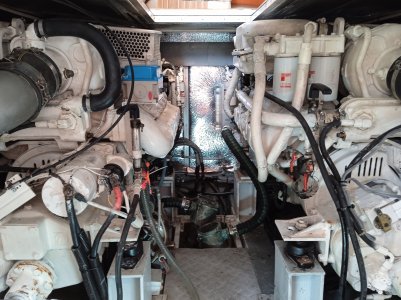
And two steps down into the "cellar", you sit into the engine room of an Azimut 46 / around 2000.

N_motorroom_01_20250810.jpg
 
Top