Azimut 46 - new battery charger system plus service/house batteries, engines battery and gen. battery

P, just for clarity: I only suggested that as a temporary/quick/rough check of negative pressure inside the e/r, nothing else.
But while you are mentioning your 42, did you ever experience a delta T of 40°C inside her e/r at cruising speed? Or on your previous 39?
Never had a reason to test this P.
 
since Porto obvs knows better than ppl that are trying to help and have been using LifePO4 banks in mobos for the last 4-5yrs, I'd suggest OP should follow his suggestions and stick to stock Azi design.
Since I cannot be bothered to google and find relevant (or irrelevant) articles supporting what i've been doing for years now, I'll just keep quiet

V.
 
since Porto obvs knows better than ppl that are trying to help and have been using LifePO4 banks in mobos for the last 4-5yrs, I'd suggest OP should follow his suggestions and stick to stock Azi design.
Since I cannot be bothered to google and find relevant (or irrelevant) articles supporting what i've been doing for years now, I'll just keep quiet

V.
But you don’t use your geny to full advantage and have solar .

So we are in agreement interms of if you have and prepared to use a functional geny . Plus if
you motor about . A lot a well .

The dichotomy here is if you have a working geny * and use it .

It seems to be lost on folks .

* defining working geny as unobtrusive to the boat users and anchoring neighbours .
It’s sound proofing and water exit noise mitigation. Also large enough to cope with what ever other systems you run as well as the obvious charger .

Really big boats have permanent genys running . A whole suite often different sizes . They don’t 9iss around with batt bank management and litter the top sides with solar .
 
This is perfect professional electrical installation on a new yacht - great - I would love to have this on my 25 year old azimut:

Flemming yacht electrical installations
But I have some restrictions - and I will fit it with an actual, proven, professional solution.
Of course there are many high-tech options and very modern energy solutions available today - my Azimut will stay with a reliable, proven and high availability solution. For emergency situations I will have some manual switchover / redundancy.

All the "mysterious" switches and installations from the former owners are already cleaned up or taken away.
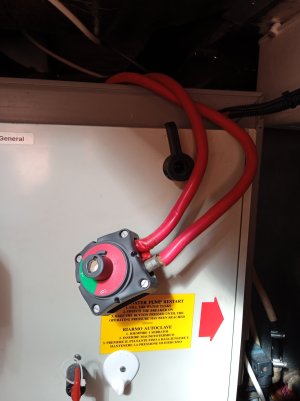
This was one of the bad examples:
N_switch-XYZ_20250810_1.jpg


The new / refitted installation, most circuits based on the original Azimut switching, will be:

KOHLER GenSet 7kW - standalone Battery 100Ah, Lead Acid sealed - already replaced - and only with manual switch connection to engine battery (emergency). As a shore backup charger I will use a Dolphin Charger 12V10A that has been unused on the boat. The AC Power from the generater supports whole offshore battey charging, + oven, water heater, galley etc.

The existing engines starter battery ( YUASA, 185Ah, 1200 A(EN) is around on 95% capacity is still perfect - no replacement, it is charged by Stbd engine with 40A alternator - good, reliable solution. As a shore backup charger I will use an second Dolphin Charger 12V15A that has been unused on the boat.

The service battery / house battery bank (12V DC system) has to be replaced: It will be 3x Victron (LA) GEL deep cycle 220Ah (a total of around 660Ah) with a new Victron Multiplus II charger with integrated inverter - this AC inverter will power all the smaller devices: some lights (already installed) TV, Sat, network, PC ... Nespresso Machine ... etc.). All controlled by the Victrom GX controller / display. Offshore, engine running the service batteries are charged by the port engine - as in the original installation.

Thank you all for your valuable input - over the last four weeks I have learned many things about nautical electrical installations.
 
But you don’t use your geny to full advantage and have solar .

So we are in agreement interms of if you have and prepared to use a functional geny . Plus if
you motor about . A lot a well .

The dichotomy here is if you have a working geny * and use it .

It seems to be lost on folks .

* defining working geny as unobtrusive to the boat users and anchoring neighbours .
It’s sound proofing and water exit noise mitigation. Also large enough to cope with what ever other systems you run as well as the obvious charger .

Really big boats have permanent genys running . A whole suite often different sizes . They don’t 9iss around with batt bank management and litter the top sides with solar .
Still haven't learned anything, have you ?
 
since I raised the temp issue, and regardless what Porto says, IF you go the LifePO4 route, DON'T put them down there in the engine room with such temps.
By the way - this is one major restriction: All connectors, main circuit and the battery boxes on an AZI 46 are in the engine room. I have no other place on the boat to install a large battery pack.
 
By the way - this is one major restriction: All connectors, main circuit and the battery boxes on an AZI 46 are in the engine room. I have no other place on the boat to install a large battery pack.
The life span of lead acid batteries is severely shortened if kept in a 40 deg environment.
 
The life span of lead acid batteries is severely shortened if kept in a 40 deg environment.
Beware, you're mixing up numbers - unsurprisingly, in a surrealistic debate like this! 😅
Unbelievable as it may sounds, we are talking about a 40 deg delta temp between the exterior and the e/r.
The OP said that with 30 deg outside, he has 70 deg in the e/r, no less... :oops:
Worth checking the water level of FLA batteries and top them up after each and every boat usage, methinks...!
 
Beware, you're mixing up numbers - unsurprisingly, in a surrealistic debate like this! 😅
Unbelievable as it may sounds, we are talking about a 40 deg delta temp between the exterior and the e/r.
The OP said that with 30 deg outside, he has 70 deg in the e/r, no less... :oops:
Worth checking the water level of FLA batteries and top them up after each and every boat usage, methinks...!
I understand the delta temps, but lead acid batteries start to suffer badly at 40 deg and above. Despite earlier comments, LifePO4 don't like 60 deg and above.
 
lead acid batteries start to suffer badly at 40 deg and above
I appreciate that 40°C isn't ideal for FLA batteries - let alone 70°, of course!
But I've got to say, while personally I dislike the placement inside the e/r, that's a rather widespread solution not only in Azimuts, but also in boats built by several other builders, mine included.
And in the Med summer, where 30°+ outside temp is quite common, 40°+ inside the e/r is to be expected.
But in my experience, good FLA batteries withstand that rather well.

For instance, so far I sticked to the OEM FLA batteries arrangement in my boat - though I'm planning to at least consider LFP, upon the next replacement.
That's made of two banks in parallel of four Trojan 6V batteries each, for a total of 450Ah @24V.
They were last replaced in 2017, and being inside the e/r, they are often warmed up to 40 deg or so.
Sometimes even a bit more, in very hot days - though never above 50, which would even trigger an alarm.
And as of today, they are still doing their job just fine.
In fact, based on their usual service pattern, I'd be surprised if they wouldn't last another couple of years, hopefully a bit more.
So, if they'll make it to a decade or so of service, I think it would be unfair to complain, even if there's plenty of FLA batts much cheaper than Trojan.
BUT, I do take care of them, never discharging them very deeply, always recharging them "softly" (I've set to 30A the max bulk recharge, even if the Multiplus could supply up to 70), checking levels regularly, etc.
When I hear of boat batteries only lasting 3 or 4 years, I can't help thinking that they are at least to some extent neglected...
 
I appreciate that 40°C isn't ideal for FLA batteries - let alone 70°, of course!
But I've got to say, while personally I dislike the placement inside the e/r, that's a rather widespread solution not only in Azimuts, but also in boats built by several other builders, mine included.
And in the Med summer, where 30°+ outside temp is quite common, 40°+ inside the e/r is to be expected.
But in my experience, good FLA batteries withstand that rather well.

For instance, so far I sticked to the OEM FLA batteries arrangement in my boat - though I'm planning to at least consider LFP, upon the next replacement.
That's made of two banks in parallel of four Trojan 6V batteries each, for a total of 450Ah @24V.
They were last replaced in 2017, and being inside the e/r, they are often warmed up to 40 deg or so.
Sometimes even a bit more, in very hot days - though never above 50, which would even trigger an alarm.
And as of today, they are still doing their job just fine.
In fact, based on their usual service pattern, I'd be surprised if they wouldn't last another couple of years, hopefully a bit more.
So, if they'll make it to a decade or so of service, I think it would be unfair to complain, even if there's plenty of FLA batts much cheaper than Trojan.
BUT, I do take care of them, never discharging them very deeply, always recharging them "softly" (I've set to 30A the max bulk recharge, even if the Multiplus could supply up to 70), checking levels regularly, etc.
When I hear of boat batteries only lasting 3 or 4 years, I can't help thinking that they are at least to some extent neglected...
Exactly ^
What theoretically may happen from a doom mongering pov with FLA doesn’t in practice .
The ER is imho the better option for placement on our size boats as well . It’s got an auto fire extinguisher system ( well mine had ) and adequate ventilation. Plus for starting short connects and a whole load of other switches and paraphernalia.

Mine were “sealed for life “

From a practical pov as I mentioned you just had to monitor the discharge and do something about it when touring ( anchoring off ) or stuck on a visitor berth with no shore power .

Eg run the geny or simply run the boat .
If it was flat calm on anchor and the next destination say 40 miles , we would run 4 hrs at D speed as opposed to blast there in a hour and a bit .
Leaving the engine alternators to recharge . This is after a 1 hr or so morning breakfast ( full electric boat ) geny run .

At anchor a whole day parked up if windy we would run the geny by 3-4 o clock .
I added additional sound proofing to the inside of the generator box ( auto soundproof from e bay ) . You couldn’t hear it .certainly not if snoozing on the bow .
Evening meal time again a geny run to work the hob / kettle .

We had an inverter on our 48 ftr but I very rarely used it . Preferred the geny for the 220 v sockets to change devices .
Never found FLA (maintenance free ) a problem in 19 yrs of touring the med .
The Itama was particular very good cruising as widened the weather / wave window and could if called upon shorten a trip , typically easily covering 100 miles in 3 hrs .

We had the latest dolphin charger fitted by a boat sparky .

The only caveat re ER temps is the charger . It needs to have big fans to cool itself in the hostile environment. What ever the “ delta “ is let’s just say extreme it needs to cope . That’s why when calculating my guy went larger . Bcz it’s operating at a fraction of max capacity with its fans bringing down that delta internally. Remember it’s all singing and dancing with a multitude of stages .
I never saw it ( had gauges ) bang in it full amount. Barely 1/2 after a long stint @ anchor say 7-8 hrs when were asleep at night .

With these type of med boats and typically usage pattern you learn to LOVE your geny ….. end of all this batt anxiety.
 
Last edited:
Btw we carried spares for the geny . The belt was identical to a Citroen AX so a fiver . I had a whole spare water pump as well as spare € 10 euro impellers:
The belt went once in 9 yrs took 1/2 hrs to fix in the @ sauna 😀. I carried 2 spares
Once at the porqerolles I fitted a whole replacement pump €180 from the ship shop in the marina . Johnson something or other ubiquitous pump .
I took the old home and fitted new bearings and seals . Re furbed it as a spare .

As said work on the sound proofing side and change its oil regularly.

With its matched “ smart “charger it will look after your FLA batts .
 
Since updating my power system a year ago i haven't used the genny once.

Suits me just fine.
Forgot to bring in air conditioning.
We ran a 42K btu system.
Even while motoring to our next anchorage I would run the geny ( charger off as alternators on ) to run the AC . To chill the boat down so we could sleep.

We had a zero gas boat ….. so inevitably needed 220 v sometime during a day . 3 burner hob

I suspect these would kill via an inverter only …. Very shortly a battery system. Even yours expensively:

The geny gobbled 2 -3 L/hr of diesel.
The main engine s 180 to 200 out of 2000 L tank age .

Running the silent geny was a no brainer . The ops AZ 46 I suspect will copy this usage pattern .
It’s well trodden path in the Med once Mobos get over a certain size .

That’s the dichotomy I was referring to .
 
Forgot to bring in air conditioning.
We ran a 42K btu system.
Even while motoring to our next anchorage I would run the geny ( charger off as alternators on ) to run the AC . To chill the boat down so we could sleep.

We had a zero gas boat ….. so inevitably needed 220 v sometime during a day . 3 burner hob

I suspect these would kill via an inverter only …. Very shortly a battery system. Even yours expensively:

The geny gobbled 2 -3 L/hr of diesel.
The main engine s 180 to 200 out of 2000 L tank age .

Running the silent geny was a no brainer . The ops AZ 46 I suspect will copy this usage pattern .
It’s well trodden path in the Med once Mobos get over a certain size .

That’s the dichotomy I was referring to .

We are, as i said earlier, 100% electric. We run the whole boat off of the inverter all of the time, no issues regarding the inverter coping. Our discrete solar array, above the cockpit enclosure, keeps up with consumption most of the time in the Summer, in the OK (would keep up all of the time in the Med). If the Sun doesn't shine enough the inverter/charger is programmed to cut in for a short time to keep the batteries happy.

NOT using the genny is the no-brainer.

We are full time liveaboard on a 100% electric 45ft mobo. You are stuck in the dark ages with no concept of how modern power systems have evolved.
 
Top
