Azimut 46 - new battery charger system plus service/house batteries, engines battery and gen. battery

Good comment: My goal of the refit of the main electrical system is to GO FORWARDS with a professional charger/inverter/battery system and have a good freedom to stay on anchor for 2-3 days (with additional gen set.

I clearly see that the 3 owners before me DID NOT DO IT ... there are many electrical (amateur) installations from the former owners that are not at all professional - I will replace / reengineer them.

The question is: Lithium or GEL/AGM ?
I myself have still many concerns about fire hazards and incidents with Li / but I know that LI is the better technology. My insurance company (Pantaenius) is asking questions when you install LI / the insurance will be higher ...

So - at the end of the day we will have the discussion about old/conventional batt. technology or LiFePo4 for daily use on a motoryacht.
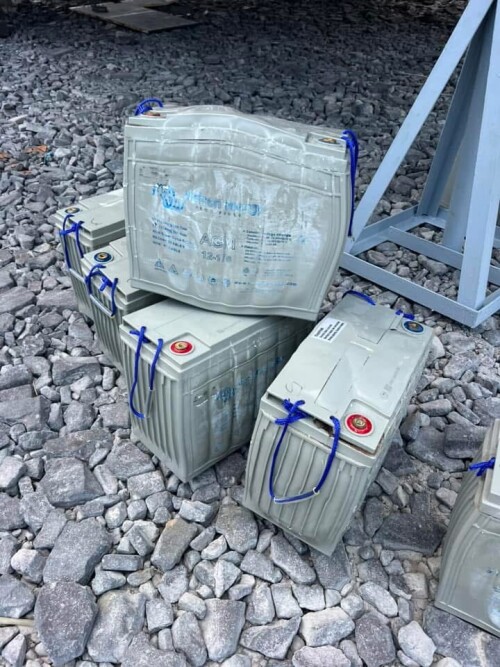
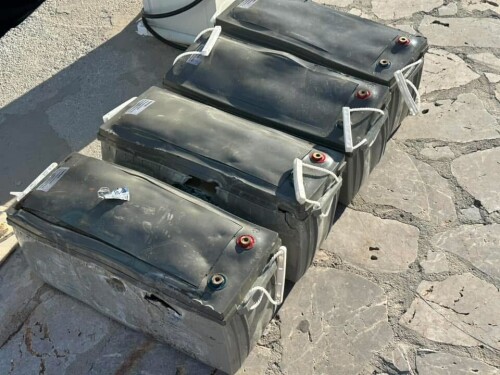
 
Good comment: My goal of the refit of the main electrical system is to GO FORWARDS with a professional charger/inverter/battery system and have a good freedom to stay on anchor for 2-3 days (with additional gen set.

I clearly see that the 3 owners before me DID NOT DO IT ... there are many electrical (amateur) installations from the former owners that are not at all professional - I will replace / reengineer them.

The question is: Lithium or GEL/AGM ?
I myself have still many concerns about fire hazards and incidents with Li / but I know that LI is the better technology. My insurance company (Pantaenius) is asking questions when you install LI / the insurance will be higher ...

So - at the end of the day we will have the discussion about old/conventional batt. technology or LiFePo4 for daily use on a motoryacht.
you are far more likely to have a fire on a boat from some dodgy USB phone charger or lithium ion battery in a rechargeable toy than you are a fire from a well installed LiFePO4 battery bank.

It’s kind of amazing that despite the terrible installation practices used by most LiFePO4 setups, there are still no fires.
 
Why is that a problem that needs "diagnosis"? They are pretty standard batteries and not difficult to look at the diagram on the spec sheets to order batteries with the same post location.

You seem to have a habit of creating problems that do not exist.
There’s a guy Matteo on the marina who will come look assess go away turn up with a mate with the correct fitting batts on a trolley- dive into the ER remove old , fit .
All while the OP enjoys his meal + wine sat on the FB .

Why risk a mail order Italian fiasco ?

The ops already interested in post # 34 “ I cannot handle 65 kgs of battery “

That’s been my advice from my first post on here .

And it seems I got my diagnosis correct of a decaying old charger .

There’s nothing wrong with lead acid batts if …..
Are you listening?
-The charger is a new ish version with all the various stages inc permanently leaving it on trickle when unattended. So the batts are in tip top condition most of there lives .
- The new chargers can cope with stuffing ie my point about getting a larger one .
- The new charger is on top of the job in the harsh ER environment of a mobo ….
- The engine alternator pulls its weight ..so after a long ish motor say to Elba or Corsica he arrives with batteries as best charged as they can be . Not anchoring with them @ say typically 75 % or worse at the get go .
- he uses his geny periodically @ anchor. ( with the functioning charger on ) …say 1 hr at evening meal and 1 hr @ breakfast to brew up etc .

A modern charger will get the new lead acids stuffed up by the time he lifts his anchor and the engine alternator should finish them off , top up by the time he drops the hook @ lunchtime after a few hrs cruising the new area .

On my boat we had fortunately full gauges ….so I could see the state of both banks .
Spending a day @ anchor ( two fridges btw ) I never really let out , if that’s the correct terminology more than 40-80 ( you choose and Paul happily choose units ) 😀
So I simply ran the geny with the charger for an hr to top up . It was pretty silent anyhow . Go for a paddle board or have a snooze . No biggie
The gauges I could see the charge going in the whole cycle the different stages . As said once saw 80 going in but only for a short initial 15-20 mins then it quickly dropped to 40 to 20 to 15 to end up around 5 before switching the charger / geny off .
The engine batts also 2x180 s never really altered, aside we had a cross over switch ( which worked ) and even a cross over switch for the geny .
Geny batt was 12 v .The rest 24 v ,however there was a gizmo that could rob the 24 v side of 12 if the geny batt was duff .
We could and did live remotely for days upon days .

The limiting factor was water .NOT power .Our tank was 500 L

It’s power anxiety the op s has . The ability to stay out of marinas ( weather permitting);

Even water ….we have been known to turn up at a marina ..sneak into an empty berth ( fingers X the owners doesn’t turn up ) I fill up with water while wife walks slow to the marina office to enquire for a space .
Then decline if offered and leave restocked with 500 L to continue the anchoring off life .Although we did ring first to be told they had no space …..but they didn’t know my wife new when she was at the desk ….

Never had a power anxiety .
 
Last edited:
you are far more likely to have a fire on a boat from some dodgy USB phone charger or lithium ion battery in a rechargeable toy than you are a fire from a well installed LiFePO4 battery bank.

It’s kind of amazing that despite the terrible installation practices used by most LiFePO4 setups, there are still no fires.
I think the op has already said his insurance premiums will be adjusted?

They the ins Co will have actuarial support when calculating premiums. So there will be reasons why this is happening.

On a similar vein I noticed today a WW car transporter/ shipper and stoped moving EV s around the globe .
The boards made a choice . There Co , there vessels , there crew , there premiums there business .
You are very welcome to speak to the board and attempt to reverse there decision.
 
I think the op has already said his insurance premiums will be adjusted?

They the ins Co will have actuarial support when calculating premiums. So there will be reasons why this is happening.

On a similar vein I noticed today a WW car transporter/ shipper and stoped moving EV s around the globe .
The boards made a choice . There Co , there vessels , there crew , there premiums there business .
You are very welcome to speak to the board and attempt to reverse there decision.
@Skipper Felice didn't say if it was Lithium Ion batteries or LiFePo4 that his insurers allegedly would be charging more for.
 
There’s a guy Matteo on the marina who will come look assess go away turn up with a mate with the correct fitting batts on a trolley- dive into the ER remove old , fit .
All while the OP enjoys his meal + wine sat on the FB .

Why risk a mail order Italian fiasco ?

The ops already interested in post # 34 “ I cannot handle 65 kgs of battery “

That’s been my advice from my first post on here .

And it seems I got my diagnosis correct of a decaying old charger .

There’s nothing wrong with lead acid batts if …..
Are you listening?
-The charger is a new ish version with all the various stages inc permanently leaving it on trickle when unattended. So the batts are in tip top condition most of there lives .
- The new chargers can cope with stuffing ie my point about getting a larger one .
- The new charger is on top of the job in the harsh ER environment of a mobo ….
- The engine alternator pulls its weight ..so after a long ish motor say to Elba or Corsica he arrives with batteries as best charged as they can be . Not anchoring with them @ say typically 75 % or worse at the get go .
- he uses his geny periodically @ anchor. ( with the functioning charger on ) …say 1 hr at evening meal and 1 hr @ breakfast to brew up etc .

A modern charger will get the new lead acids stuffed up by the time he lifts his anchor and the engine alternator should finish them off , top up by the time he drops the hook @ lunchtime after a few hrs cruising the new area .

On my boat we had fortunately full gauges ….so I could see the state of both banks .
Spending a day @ anchor ( two fridges btw ) I never really let out , if that’s the correct terminology more than 40-80 ( you choose and Paul happily choose units ) 😀
So I simply ran the geny with the charger for an hr to top up . It was pretty silent anyhow . Go for a paddle board or have a snooze . No biggie
The gauges I could see the charge going in the whole cycle the different stages . As said once saw 80 going in but only for a short initial 15-20 mins then it quickly dropped to 40 to 20 to 15 to end up around 5 before switching the charger / geny off .
The engine batts also 2x180 s never really altered, aside we had a cross over switch ( which worked ) and even a cross over switch for the geny .
Geny batt was 12 v .The rest 24 v ,however there was a gizmo that could rob the 24 v side of 12 if the geny batt was duff .
We could and did live remotely for days upon days .

The limiting factor was water .NOT power .Our tank was 500 L

It’s power anxiety the op s has . The ability to stay out of marinas ( weather permitting);

Even water ….we have been known to turn up at a marina ..sneak into an empty berth ( fingers X the owners doesn’t turn up ) I fill up with water while wife walks slow to the marina office to enquire for a space .
Then decline if offered and leave restocked with 500 L to continue the anchoring off life .Although we did ring first to be told they had no space …..but they didn’t know my wife new when she was at the desk ….

Never had a power anxiety .
Fail to see how any of this is relevant to the OP's question. Who cares what you used to do when you had a boat?

He asked for advice on what batteries to buy and whether what he has been offered is both appropriate and good value. He has had comprehensive answers to both questions.

There is nothing in your post that addresses these question, nor is there any connection with my post.

So no idea why you are wasting your presumably valuable time typing all this irrelevant stuff :((n)
 
Open question is: AGM or GEL ???

And I know Vivtron batt. are expensive - I will try to make a good deal but it has to be delivered ... I can not handle a 65kg piece of battery!
This is a reasonable summary of the differences northeastbattery.com/agm-vs-gel-technology/#:~:text=A%20gel%20cell%20battery%20is,without%20the%20threat%20of%20spilling. Either is suitable for your application - as are FLA, EFB, Lead Carbon. They are all competing technologies for similar applications, although each usually has some little twist that differentiates it, but most are not really different for deep cycle applications such as yours. The main differences are related to the number of cycles and essentially the higher the number the longer they will last. If you think of a day as a discharge/charge cycle and your bank is sized to give you a daily discharge of 50% of notional capacity you can estimate life (assuming you look after them) in relation to your usage pattern. So if you spend 60 days a year on board and you have FLAs with a typical 300 cycle life they will last 5 years. If you spend more and go for one of the more advanced technologies you will get longer life under the same conditions.

AGM and Gel are somewhat similar in price and will give similar lives (7-10 years in the scenario above), but the Victron ones you are looking at are typically 25%+ more expensive than other well known brands. Difficult to accept they will give a similar increase in life.

Hope this helps
 
Last edited:
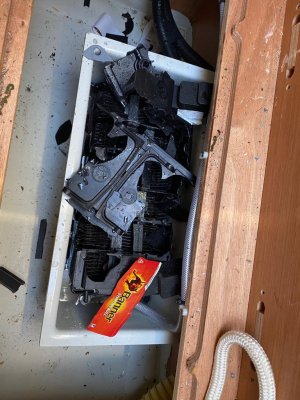
Lead acid ;

View attachment 196977

Hard to see how this would happen with a properly installed LifePO4 system
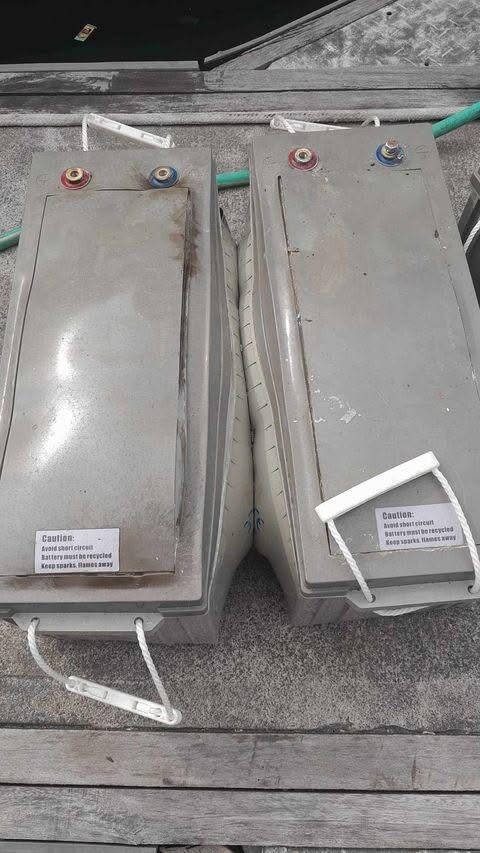
That's what happened to one of the VMF batteries I took off Hunter, our son transported them in his car from Holland to Belgium when we replaced them with the new batteries, a week later one of the batteries exploded in the garage showering acid over a lot of stuff. So glad it did not happen either in the boat or the son's new car. The battery had just been sitting in the garage waiting to get picked up and taken to the recycling depot.
I used a syringe to remove the rest of the acid from the battery.
 
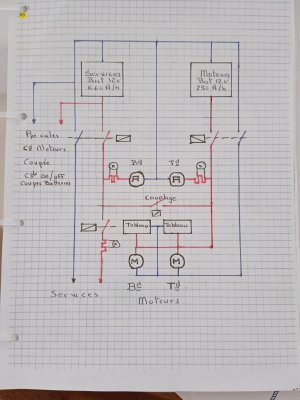
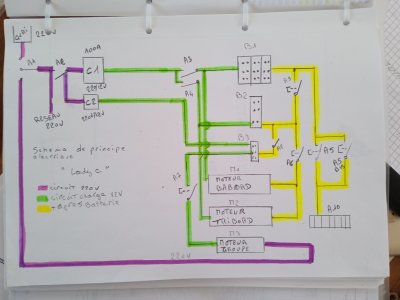
From the previous owner I got some "drawings" and "schematic" of the electrical / battery installations. It seems there are major (bad) modifications to the original AZIMUT schema.
I would never - ever connect the generator battery to any kind of on board systems ...

What do you think ?

Nel_01_IMG_093258.jpg

Nel_01_IMG_093339.jpg
 
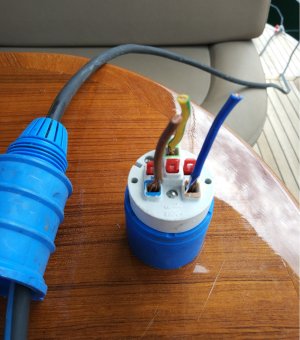
Another problem – unfortunately found on many old installations: On the first day, I repaired the shore power cable. You can see the problem caused by the stupid French mechanic.
NA_electric_powerx04.jpg

LN PE ... wrong connections!

A request to all amateurs who don't understand electrical systems: Keep your hands off electrical installations.
 
What is stupid about the generator wiring ?
To make the story short: We had been one night on anchor, we did not know, that where the irregular connenctions / switches from the generator bat. and the engine bat. to the service bat. system ... next morning, after 8 hours our boat was in an emergengy situation: gen battery down (10.8V) - no generator start!, engines bat. down to 11.5V and service bat. down to 10.5V ... ...: we could no more move the boat: no service = caterpillar electric will not start, no generator = no charging overall.
The solution was: the boat engeneer from a big yacht nearby provided an emergency battery starter => we could start KOHLER gen. => charging service bat. => start of main engines ... ...
 
To make the story short: We had been one night on anchor, we did not know, that where the irregular connenctions / switches from the generator bat. and the engine bat. to the service bat. system ... next morning, after 8 hours our boat was in an emergengy situation: gen battery down (10.8V) - no generator start!, engines bat. down to 11.5V and service bat. down to 10.5V ... ...: we could no more move the boat: no service = caterpillar electric will not start, no generator = no charging overall.
The solution was: the boat engeneer from a big yacht nearby provided an emergency battery starter => we could start KOHLER gen. => charging service bat. => start of main engines ... ...

I’d suggest investing in a jump pack yourself. It’s a good fallback to have and I’ve used mine to get myself and others out of shitty situations numerous times before.

NOCO Boost GB150

You can get bigger ones that would spin your main engines up with ease but they are more money

NOCO GB251+ Boost MAX 3000A 24V UltraSafe Lithium Jump Starter with Power Bank
 
To make the story short: We had been one night on anchor, we did not know, that where the irregular connenctions / switches from the generator bat. and the engine bat. to the service bat. system ... next morning, after 8 hours our boat was in an emergengy situation: gen battery down (10.8V) - no generator start!, engines bat. down to 11.5V and service bat. down to 10.5V ... ...: we could no more move the boat: no service = caterpillar electric will not start, no generator = no charging overall.
The solution was: the boat engeneer from a big yacht nearby provided an emergency battery starter => we could start KOHLER gen. => charging service bat. => start of main engines ... ...
Agreed, not a good situation. Genny battery should be totally separate as it your last resort. I also would keep engine batteries isolated at anchor and not be tempted to use them for domestics, run genny instead. You can also turn stuff off e.g. we have a number of fridges on board, so if low on power we turn off the drinks fridges and just power the food one / freezer.
 
next morning, after 8 hours our boat was in an emergengy situation: gen battery down (10.8V) - no generator start!, engines bat. down to 11.5V and service bat. down to 10.5V
I think that could only happen because the disconnectors meant to put the battery banks in parallel were closed, right?
I am referring to the disconnectors between:
- the genset and the engine battery (A8 in the drawing, bottom right in the last pic of your post #27);
- the engine and the domestic battery (A9 in the drawing, not sure of where it is physically because it's not visible in your pics).

If those disconnectors were closed, it's to be expected that anything you keep running and draining the domestic bank will eventually drain also the others.
But it isn't the wiring to be blamed, it's a wrong usage of disconnectors that are only meant to be closed in an emergency.
And the other way round, BTW - like for starting the engine or the genset with the domestic bank when their own dedicated batteries fail for any reason.
Normally, both those disconnectors should be kept open.
 
I’d suggest investing in a jump pack yourself. It’s a good fallback to have and I’ve used mine to get myself and others out of shitty situations numerous times before.

NOCO Boost GB150

You can get bigger ones that would spin your main engines up with ease but they are more money

NOCO GB251+ Boost MAX 3000A 24V UltraSafe Lithium Jump Starter with Power Bank
If the switches are used correctly there are ample options to start the engine or generator from other batteries. This was simply a case of user error.
 
Top