Avon Redcrest floor

pandos

Well-Known Member
Joined
15 Oct 2004
Messages
3,201
Location
Ireland, (Crosshaven)
Visit site
Could anyone give me details of the floorboards in an Avon Redcrest?

I pumped up mine yesterday after 15 years in the shed, and it is perfectly serviceable, the handles and rope patches need a bit of glueing.

I now realize that I could put this in my locker and not have to live with my one with the solid transom and wheels rolled up on the foredeck ( which blocks my view)

This punt came on my first boat and I only realized, a few years later, that the pieces of plywood I found in the locker, and dumped, were in fact the makings of the floor.

I have a vague recollection that they were 12mm Plywood, in a few full width sections and were attached to a piece of solid wood which formed a keel.

I could guess, but sometimes the manufacturer gets it right....
 
I also have a Redcrest rolled up in a locker! Before you get too technical with the floorboards, I find a simple rectangle of 10 mm ply in the after section does the trick. My boat happens to come already fitted with four of these - the saloon under -settee locker lids!
 
I also have a Redcrest rolled up in a locker! Before you get too technical with the floorboards, I find a simple rectangle of 10 mm ply in the after section does the trick. My boat happens to come already fitted with four of these - the saloon under -settee locker lids!
I am a bit of a chubby chap ( probably can't say fat baxxxxd) so I need/like a decent floor getting in and out and especially mounting the engine whilst afloat, also I don't have an inflatable twart so when rowing I sat on a box which needs some support...(Reminder to self....find a new proper sized box)
 
The ply boards for mine are :

10mm and 240mm x 870mm rectangles with rounded corners.

They are held within sleeve pockets of 'hypalon'. That way they can be concertinad for storage. The 'hypalon' sleeves are narrow enough to fit between the inflatanle floor tags.

The floor I have for 'serious work is 12mm ply and solid in two pieces ... but boy is that heavy !!

Original and full floor :

2lIlBFUl.jpg


FQAb3jml.jpg


9P9TlBRl.jpg


oN7fytbl.jpg


Dk3pJMEl.jpg
 
I am a bit of a chubby chap ( probably can't say fat baxxxxd) so I need/like a decent floor getting in and out and especially mounting the engine whilst afloat, also I don't have an inflatable twart so when rowing I sat on a box which needs some support...(Reminder to self....find a new proper sized box)

The slatted floor as original is more than enough for chubby fat ba****s like me ... I'm 110kg. But definitely not enough when out of water.

The concept is that the dinghy is in water and fully supported .. the slats then carry the weight while flexing a bit.
 
I had ply floors but discarded them, as they are unnecessary in both my Redstart & Redcrest
However, they were in 2 parts, joined with a small galvanised clip, rather like 2 "C;s" back to back. These just aligned the meeting edges
There were no longitudinal timbers
They fitted tight under the buoyancy chambers & had to be inserted prior to inflation
If one wanted to get the shape , inflate the dinghy & turn it upside down & trace the line of the floor seam & cut the ply so it is inside that seam
Align the joint under the thwart & remember to drill holes for the thwart toggles.
 
Last edited:
I seriously consider putting back the slatted floor and not using the full one again ... once fitted - the dinghy has to stay inflated / on water as its just so heavy and cannot fold.

If the 'hypalon' sleeve is lost - I would suggest using webbing in X form to create hingeing ....

avon floor slats.jpg
Two runs set apart by the width of the inflatable floor tags.
 
I seriously consider putting back the slatted floor and not using the full one again ... once fitted - the dinghy has to stay inflated / on water as its just so heavy and cannot fold.

If the 'hypalon' sleeve is lost - I would suggest using webbing in X form to create hingeing ....

View attachment 195716
Two runs set apart by the width of the inflatable floor tags.
How do you get the floor out if you cannot separet the slats. they need to go full width because sods law dictates that small items will slide below the floor & need retrieving. The original floor tucks under the side tubes. Are you suggesting that the new floor does not cover all the bottom width of the dinghy?
 
How do you get the floor out if you cannot separet the slats. they need to go full width because sods law dictates that small items will slide below the floor & need retrieving. The original floor tucks under the side tubes. Are you suggesting that the new floor does not cover all the bottom width of the dinghy?

I never had trouble installing or removing the slatted floor in one ... of course the slats are full width .. where do you get such other idea from ??

How would you install it one by one ??

The method of the slatted pocket floor ...... unroll dinghy ... slats into the sleeves of Hypalon and then place in bottom of dinghy ... putting ends under the tubes ... start inflating anf make sure slat ends are properly engaged under the tubes into the joint of fabric floor to tubes. Once happy with placement - inflate fully. Finally place inflatable seat in and hook its loops onto tabs ..

The slatted floor does not cover fully stem to stern .. only the main section leaving ends as fabric floor only. The reason the slatted ply is not fixed in the Hypalon sleeve is to allow you to stow as you want .. to be able to replace a slat etc. Has nothing to do with installing / removing from dinghy.

The full floor I have is just that full floor .. and needs to be in half sections as it would otherwise be near impossible to install .. but again its done before inflating ... part inflate - checking its in position under tubes etc and then finish inflation.
 
The slatted floor as original is more than enough for chubby fat ba****s like me ... I'm 110kg. But definitely not enough when out of water.

The concept is that the dinghy is in water and fully supported .. the slats then carry the weight while flexing a bit.
Thanks for the inputs..and the photos..

I have a dinghy with slats and it's ok but I think a full floor may be better. I am not too worried about weight once I can roll up the dinghy and put it in the quarter berth or even the cockpit locker.

Perhaps my "keel" was just an invention by the previous owner, although my memory is that it was more like a manufactured item than a DIY addition..

I have a sheet of good marine plywood so maybe I'll get the tools out...

Although I should wait to see if I can locate an inflatable seat..

Thanks to all who made constructive replies.
 
The 3rd party inflatable floors are far better addition ... not cheap - but really do a good job. Also being infalatble - they roll away with the dinghy ...

I believe Avon do their own - but likely a lot more expensive !
 
I never had trouble installing or removing the slatted floor in one ... of course the slats are full width .. where do you get such other idea from ??

How would you install it one by one ??

The method of the slatted pocket floor ...... unroll dinghy ... slats into the sleeves of Hypalon and then place in bottom of dinghy ... putting ends under the tubes ... start inflating anf make sure slat ends are properly engaged under the tubes into the joint of fabric floor to tubes. Once happy with placement - inflate fully. Finally place inflatable seat in and hook its loops onto tabs ..

The slatted floor does not cover fully stem to stern .. only the main section leaving ends as fabric floor only. The reason the slatted ply is not fixed in the Hypalon sleeve is to allow you to stow as you want .. to be able to replace a slat etc. Has nothing to do with installing / removing from dinghy.

The full floor I have is just that full floor .. and needs to be in half sections as it would otherwise be near impossible to install .. but again its done before inflating ... part inflate - checking its in position under tubes etc and then finish inflation.
I think that the issue might be that my old Avon Redcrest is constructed differently to yours. I do not have any sleeve etc Furthermore, my floor is 2 piece. No slats. Like that for both dinghies. The first one was 1959-1968 second one 1968 to now & still going strong. Because I look after it. I cannot recall deflating & rolling it up since 1968 apart from one time when I moved home in 2001
I suspect that the floor would cause abrasion if fitted
 
Thanks for the inputs..and the photos..

I have a dinghy with slats and it's ok but I think a full floor may be better. I am not too worried about weight once I can roll up the dinghy and put it in the quarter berth or even the cockpit locker.

Perhaps my "keel" was just an invention by the previous owner, although my memory is that it was more like a manufactured item than a DIY addition..

I have a sheet of good marine plywood so maybe I'll get the tools out...

Although I should wait to see if I can locate an inflatable seat..

Thanks to all who made constructive replies.


You are not wrong about the "keel" it was commonly found on the transom models to give a bit of directional stability.

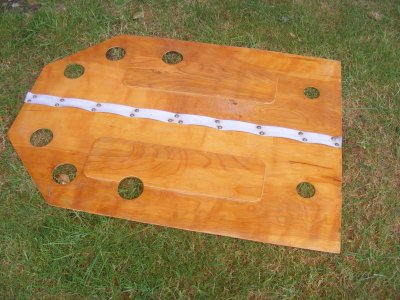
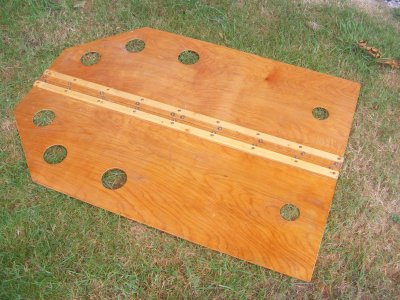
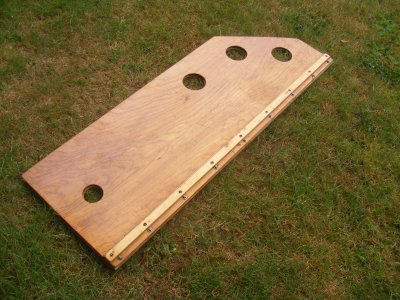
I made this for my Redcrest, shorter than the originals and a lot lighter being 6mm ply. It mainly covers the rear of the craft, the two forward holes are for the inflatable seat fastening.


1751725226500.jpeg

1751725272855.jpeg

1751725574227.jpeg

Width is 34in.


.
 
Top