Antares 760 thread

Hi
Many thanks for the quick answer - I was hoping it wasn't going to be too expensive - 450E is still a lot for a bit of metal but that's a bit less than what I expected thankfully. At least it's not a Volvo part!

Thanks for the rubbing strip details too - that's also good to know.
Do you know if it's an easy job or hard work to fit? I was wondering if it is fixed one end with a locking screw then simply pressed in all the way round then fixed at the other...
Hopefully :)

Thanks
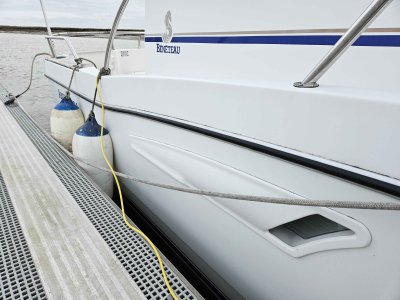
I have recently replaced my PVC rubbing strip insert. I measured it as 18.01m long so ordered, in December 2024, 19m of PVC-1022 from PVC 1022 for £111 including VAT and postage. This insert is manufactured by Wilks, in Tollesbury, UK, but Wilks were charging £210 including VAT but excluding postage. I called Wilks, who are a 30minute drive from my house, to ask why the big price difference but they said that was due to the big discount they gave Technix Rubber and could not give me the same discount. When I ordered from Technix Rubber the package came despatched from Wilks in Tollesbury! luckily this insert is sold in standard lengths, one of which was 19m, just right.

However, this insert is bigger than the Beneteau insert and takes considerable effort to force it into the aluminium extrusion and took me 4 hours, even with some lubrication (Vaseline), to force it in so you need patience and a lot of effort. If you look closely, there is a very slight bulge in the insert where it fits over each of the screws holding the aluminium extrusion to the hull. You have been warned!

I made a join at the bow which is mostly hidden from view under the bow-roller and anchor.

The aluminium end caps, either side of the transom gate, were very corroded so had to fit new ones.
20241231_152220a.jpg
 
Last edited:
Hi, it is easy to fix. It’s soft. You start at one end and then go slowly around the boat and insert it. At the end you cut both ends and fix them with the cap.
And don’t forget to reseal all screws around the alu profile.
Many thanks - that sounds like a reasonably easy job.... Probably one for a warm day...
Yes agree would be sensible to tighten up and seal up the holes attaching the alu backing strip after the old rubber is removed.
 
I have recently replaced my PVC rubbing strip insert. I measured it as 18.01m long so ordered, in December 2024, 19m of PVC-1022 from PVC 1022 for £111 including VAT and postage. This insert is manufactured by Wilks, in Tollesbury, UK, but Wilks were charging £210 including VAT but excluding postage. I called Wilks, who are a 30minute drive from my house, to ask why the big price difference but they said that was due to the big discount they gave Technix Rubber and could not give me the same discount. When I ordered from Technix Rubber the package came despatched from Wilks in Tollesbury! luckily this insert is sold in standard lengths, one of which was 19m, just right.

However, this insert is bigger than the Beneteau insert and takes considerable effort to force it into the aluminium extrusion and took me 4 hours, even with some lubrication (Vaseline), to force it in so you need patience and a lot of effort. If you look closely, there is a very slight bulge in the insert where it fits over each of the screws holding the aluminium extrusion to the hull. You have been warned!

I made a join at the bow which is mostly hidden from view under the bow-roller and anchor.

The aluminium end caps, either side of the transom gate, were very corroded so had to fit new ones.

Thanks for the info - that's very helpful. Black looks smart.
I was wondering about alternative products. Useful to know it was a bit larger than spec.
Supplier discounts are always an eye opener!
I've just had a price from the Beneteau dealer of £100 plus delivery of the original blue strip so might go with that - esp as it should fit without too much swearing and shouting... Hopefully :)
The dealer suggested finding the middle of the strip and starting the install at the bow and working back from either side (allowing for the stern wrapping around longer on the port side obvs).
To me that sounds like it could be done in the water leaning over...

Did you fit it whilst the boat was in the water or out on blocks?
Also did the old strip come out ok? Mine looks quite hardened and tough...
 
Thanks for the info - that's very helpful. Black looks smart.
I was wondering about alternative products. Useful to know it was a bit larger than spec.
Supplier discounts are always an eye opener!
I've just had a price from the Beneteau dealer of £100 plus delivery of the original blue strip so might go with that - esp as it should fit without too much swearing and shouting... Hopefully :)
The dealer suggested finding the middle of the strip and starting the install at the bow and working back from either side (allowing for the stern wrapping around longer on the port side obvs).
To me that sounds like it could be done in the water leaning over...

Did you fit it whilst the boat was in the water or out on blocks?
Also did the old strip come out ok? Mine looks quite hardened and tough...
The old strip came out really easy, need a stiff brush to clean out the accumulated dirt from the aluminium extrusion. I did not touch any of the screws as i don't beleive any of mine leak. Did mine from the marina pontoon.
 
I have recently replaced my PVC rubbing strip insert. I measured it as 18.01m long so ordered, in December 2024, 19m of PVC-1022 from PVC 1022 for £111 including VAT and postage. This insert is manufactured by Wilks, in Tollesbury, UK, but Wilks were charging £210 including VAT but excluding postage. I called Wilks, who are a 30minute drive from my house, to ask why the big price difference but they said that was due to the big discount they gave Technix Rubber and could not give me the same discount. When I ordered from Technix Rubber the package came despatched from Wilks in Tollesbury! luckily this insert is sold in standard lengths, one of which was 19m, just right.

However, this insert is bigger than the Beneteau insert and takes considerable effort to force it into the aluminium extrusion and took me 4 hours, even with some lubrication (Vaseline), to force it in so you need patience and a lot of effort. If you look closely, there is a very slight bulge in the insert where it fits over each of the screws holding the aluminium extrusion to the hull. You have been warned!

I made a join at the bow which is mostly hidden from view under the bow-roller and anchor.

The aluminium end caps, either side of the transom gate, were very corroded so had to fit new ones.

View attachment 191196
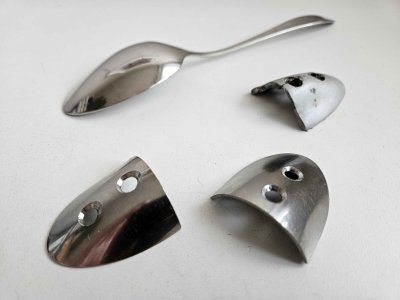
As mentioned above, the two aluminium end caps that cover the ends of the rubbing strip were badly corroded and one fell into two pieces on removal. I could not find a direct replacement so made two stainless steel end caps from spoons retrieved from the marina skip!!!
20250313_085029a.jpg
 
The old strip came out really easy, need a stiff brush to clean out the accumulated dirt from the aluminium extrusion. I did not touch any of the screws as i don't beleive any of mine leak. Did mine from the marina pontoon.
That's good you can fit it from the pontoon... I was hoping you'd confirm that.
Sounds like a reasonably straightforward job - thanks for all the advice as always.
 
Time to wash my coppercoat hull, check and replace anodes. Usually have boat taken out at local Marina for sling wash. Harbour has a tidal concrete base. Is it ok to settle my boat on to this base or would damage the skeg protecting the prop. Grateful for any advice.
 
Time to wash my coppercoat hull, check and replace anodes. Usually have boat taken out at local Marina for sling wash. Harbour has a tidal concrete base. Is it ok to settle my boat on to this base or would damage the skeg protecting the prop. Grateful for any advice.
I dry mine out on scrubbing posts 2 or 3 times each year and have never had a problem. Although the extension of the skeg that goes to the rudder lower bearing is horizontal, as soon as the skeg grounds the bow continues to fall so that skeg extension raises up so no load on the rudder. If the base of the drying area has a slope on it, even better. The bow has (at least mine has, original) a stainless steel strip to protect the gelcoat.

The ideal is a drying area with a timber base (old railway sleepers) as the one I use has.
 
Last edited:
Plum, many thanks..
Also. I have a single Volvo D3 1901C 190hp engine. The manual says max speed is 24kts. My max speed at full throttle is just 14kts at about 3500 revs. Boat was built in 2006 and I think original prop. I bought the boat in 2021. Any thoughts on this and how I might look to increase the speed. Again, grateful for any advice.
 
Plum, many thanks..
Also. I have a single Volvo D3 1901C 190hp engine. The manual says max speed is 24kts. My max speed at full throttle is just 14kts at about 3500 revs. Boat was built in 2006 and I think original prop. I bought the boat in 2021. Any thoughts on this and how I might look to increase the speed. Again, grateful for any advice.
Hi. I have never heard of an Antares 760 with a D3. I assume it has been re-engined? The D3 190hp should reach 4000rpm underway, or at least 3800, so you are a little down on revs but not much. Is the hull bottom and prop completely clean? The 24knots I have seen quoted is for the 760 with the usual 200hp VP TAMD41 engine but that is from a test run by Beneteau with no extra weight on board and no antifouling so a perfectly smooth hull as it left the factory. The max I have had with 200hp is 22knots. If yours has been re-engined has it ever, since, done more than 14 knots, and what hp was the original engine, 200 of 150? Was the gearbox changed for one of a different ratio? If you have the original prop it may now not be matched to the engine and gearbox ratio that you have.
 
Hi. I have never heard of an Antares 760 with a D3. I assume it has been re-engined? The D3 190hp should reach 4000rpm underway, or at least 3800, so you are a little down on revs but not much. Is the hull bottom and prop completely clean? The 24knots I have seen quoted is for the 760 with the usual 200hp VP TAMD41 engine but that is from a test run by Beneteau with no extra weight on board and no antifouling so a perfectly smooth hull as it left the factory. The max I have had with 200hp is 22knots. If yours has been re-engined has it ever, since, done more than 14 knots, and what hp was the original engine, 200 of 150? Was the gearbox changed for one of a different ratio? If you have the original prop it may now not be matched to the engine and gearbox ratio that you have.

I would have thought a 190hp D3 could get you circa 15knts cruising maybe 19knts top whack when clean...

I can echo Plum's findings above. Mine is the TAMD41 200hp and can just about reach 22knts immediately after antifouling and polishing at full throttle 3800rpm but that's not a realistic use of the boat.
I do hoard a bit too much stuff in the lazarettes but i would never see 24knts...

Normally at 3200rpm with a bit of slime and some barnacles on the prop during the season it cruises about 16knts. Drops to 15knts when it needs another clean and the prop is rough.
I would say your prop and gearbox need looking at as maybe they could be tweaked (depending on your budget...)

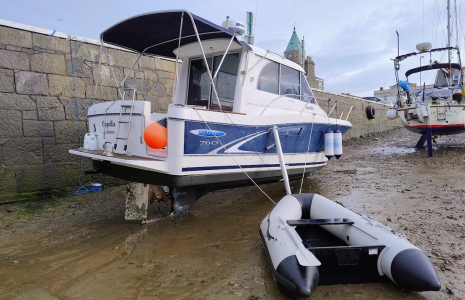
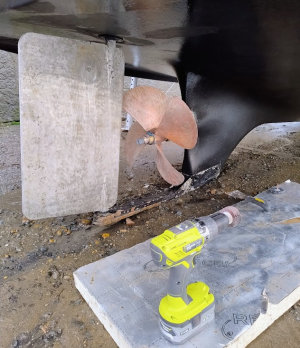
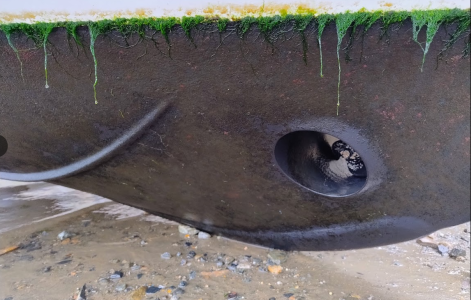
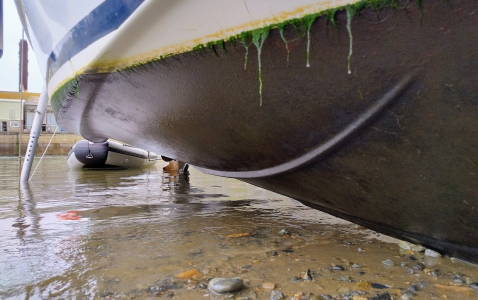
Here's some pics of mine dried out on the local slipway the other week for a pressure wash, polish of the prop/rudder and anode swap... All done on one tide.
They are fine to ground on their keel and legs as long as the floor is not too rough (skeg is tough but pebbles can chip the bow).
I've had a thicker shoe glassed on at the bow where the stainless band used to be (the original fell off a few years ago and water started leaking into the bilges through the screw holes which was a bit of a palava at the time - thankfully we noticed and it got lifted out and sorted before any water damage inside).

I know Brake said they are lucky enough to have Coppercoat but I can highly recommend black Micron 350 btw, the second pic is after washing but the other pics are what it looked like nearly 12months after it was antifouled (it hasn't been pressure washed since coating).
Bit of slime and waterline fuzz where the water slaps on the mooring but that was it, rest of the hull underneath was remarkably clean. Quick once over wash with a small Karcher K2 and it was done.
It's a bit more than I used to spend on Trilux33 but twice as effective.

1744640893816.png

1744640945550.png

1744641656951.png

1744641815421.png
 
I can highly recommend black Micron 350 btw, the second pic is after washing but the other pics are what it looked like nearly 12months after it was antifouled (it hasn't been pressure washed since coating).
Bit of slime and waterline fuzz where the water slaps on the mooring but that was it, rest of the hull underneath was remarkably clean. Quick once over wash with a small Karcher K2 and it was done.
I too use Micron 350 and have been for 6 years but only lifting out every second year with drying out on the scrubbing posts 2 or 3 times each year, mostly for prop cleaning. Does not come out quite as clean as yours after 2 years but I save lift-out and antifouling cost on the intermediate years. I will lift-out next month as the 2 years are up but last weekend I was still getting 20knots top speed at 3750rpm so the fouling is minimal. Does black work better? I use the dark blue.
 
That's good to know Plum. 20knts top is still decent after that amount of time. Mind you if you do the prop 2-3 times a year that makes a big difference. I always intend to do mine more than I get round to!
Yes I suspect this coming year will be less protected now it's had 12 months soaking and it'll need recoating next year but still, 2 full years in-between painting is more than welcome. It's nice getting the intermediate year for free.

Don't know if Black vs Dark Blue would be noticeably different but I had read that the darker AF you use the less growth you get for any given paint. Whether that's scientifically true or not that black 350 is good stuff.
 
I am in the process of buying anodes. For my end shaft Beneteau anode, do I need a hexagon inside or a smooth inside?
Grateful for any advice.
 
As Plum says... Smooth with a single locking strip
At the chandlery look for the ones labelled CMAN240 or equivalent
 
Hi Guys, I've had an Antares 760 for about 3 years, and discovered this forum earlier today! Any comment, advice or information about a few things would be welcomed;

Rainwater gets into the boat, pooling in the bilges under the fore-cabin. There are holes into what I,m guessing is a double skin, but the whole layout there is a mystery to me. I did some experimentation with a hose recently and I'm pretty sure the water is entering at the deckhouse side windows. It does not go under the engine.

The fuel gauge under-reads as the level goes down. Several times I've refilled when the quantity is showing almost zero, and only been able to put in 110 litres. (That,s after a lot of rocking etc to clear any airlocks.)

Does anyone know where I can source a fastener catch for the deckhouse sole board, same as the one fitted by Beneteau?

With the Nanni 200hp engine, clean bottom, 2 on board, refurbished propeller, smooth estuary waters, the most I can get is about 3000 RPM and15 Kts. I
 
Top