Anchoring with chain only versus anchoring with a mix of rope and chain

MathiasW

Well-Known Member
Joined
3 Oct 2020
Messages
180
Visit site
I have been suggesting in the past here that it may be safer to anchor in deeper water when there is a lot of swell and gusts, provided the swell and gusts at the deeper anchorage are not worse. The reason for this advice was that chain is extremely poor at absorbing shock loads when you are in shallow water.

I also said that this scenario can be remedied when using very good snubbers or bridles that can stretch by a metre or more in high wind loads. (So, they need to be substantially longer than the 1 metre snubbers one only too often sees - those cannot stretch by 1 metre without snapping.)

Now I have been working on the scenario of a mix of chain and rope. As one might expect, it is very similar to the case with a very long snubber. As long as the chain is not too long, the rope will dominate and the only function the chain has is to keep the rope off the seabed (to avoid chafing). The chain will operate in its shallow water mode and so not contribute anything to relief shock loads, as it cannot store energy. The rope will take most of it.

Given this, when using a mix of rope and chain, it does not make much sense to add a lot of chain. It will not improve things substantially and only lead to a larger swinging radius. So, once the chain is long enough to keep the rope off the seabed, its purpose is achieved.

With this result, it is also clear that with a mix of rope and chain there is no reason to relocate to deeper water, as can be the case with a pure chain. On the contrary. In deeper water the pulling angle of the rope will increase and thus reduce the maximum holding power of the anchor.

To conclude, folks with only chain will tend to be safer in deeper water, as long as swell and gusts are not worse there, whilst folks with a mix of chain and rope will want to seek more shallow water.

Cheers, Mathias
www.anchorchaincalculator.com
 
Never had a significant problem with chain and a snubber. Obviously anchor is important too and I prefer the Rocna or Spade styles. I snub with a relatively thin bit of ?nylon rope of a reasonable length with a rubber ‘dildo’ on it to make it ‘shorter’ and add a different grade of ‘springiness’ (in my mind anyway). It’s clipped on to the chain as I run it out leaving a good loop of extra chain. Stops all the noise of chain grinding and has not failed yet. I can see the significant ‘spring’ and certainly makes for a more comfortable night. I normally anchored in as shallow a spot as possible to make the row in less.
 
I have 60 metres of chain with a Knox anchor at the far end which gives me a maximum depth of water of 12 metres using a 5:1 scope. I also use a long snubber. In that depth of water if it is that windy I'll be moving anchorages.
 
I have been using a rubber 'dog bone' as they say in German in the past as well. But when you work out the numbers, you find that it adds rather little to the system in terms of elasticity. Much cheaper and more effective to use a longer snubber.

And just to stress the point: The snubber's primary purpose is not to prevent the noise of the chain, or to reduce the load on the windlass, although those are nice additional benefits. The main purpose of the snubber is to absorb schock loads und thus prevent large forces to be built up temporarily.

I keep the loop of chain between bow roller and attachment point of the snubber such that there is some slack, but not too much, so that the chain will kick in again once 20% stretch have been reached. If you stretch the snubber by more than that, it may snap, resulting in a catastrophic and violent activity at the bow.
 
On the Pacific side of the Americas safe and well-sheltered anchorages are not that plenty, so moving is often not an option. We have been anchoring quite happily in 15 metres of water and 40 kn of wind in a 'sheltered' bay, so with little swell. 80 metres of chain and a very good bridle were deployed.
 
There is a trade off here :) Leaving a longer bight of hanging chain will increase hydrodynamic resistance and help dampen the "sailing at anchor" movement, thus imposing less stretch on the snubber and less risk of it breaking :)
I keep the loop of chain between bow roller and attachment point of the snubber such that there is some slack, but not too much, so that the chain will kick in again once 20% stretch have been reached. If you stretch the snubber by more than that, it may snap, resulting in a catastrophic and violent activity at the bow.
 
There is a trade off here :) Leaving a longer bight of hanging chain will increase hydrodynamic resistance and help dampen the "sailing at anchor" movement, thus imposing less stretch on the snubber and less risk of it breaking :)
True, but these few metres of chain will not make much of a difference with their drag through the water. On the scale of the entire chain I mean. Also, when push comes to shove and it really matters in strong wind, a good part of it will be out of the water, anyway.
 
Given this, when using a mix of rope and chain, it does not make much sense to add a lot of chain. It will not improve things substantially and only lead to a larger swinging radius. So, once the chain is long enough to keep the rope off the seabed, its purpose is achieved.

Based on reasoning similar to this I have made up my rode of 20 metres of 8mm chain followed by 45 metres of 14mm multiplait nylon rope. In light conditions I will deploy only the chain plus a few metres of rope (to reduce noise), in stronger winds and waves gradually more rope is deployed, adding springiness to the rode. (Anchoring depth also comes into the calculation of course).
 
Based on reasoning similar to this I have made up my rode of 20 metres of 8mm chain followed by 45 metres of 14mm multiplait nylon rope. In light conditions I will deploy only the chain plus a few metres of rope (to reduce noise), in stronger winds and waves gradually more rope is deployed, adding springiness to the rode. (Anchoring depth also comes into the calculation of course).

Makes good sense. As Thinwater once remarked, though: If you decide to deploy rope, start with a decent minimal length of rope and do not use too little, as it may snap in a shock load situation when it is not yet elastic enough due to its shortness.
 
I have been using a rubber 'dog bone' as they say in German in the past as well. But when you work out the numbers, you find that it adds rather little to the system in terms of elasticity. Much cheaper and more effective to use a longer snubber.

And just to stress the point: The snubber's primary purpose is not to prevent the noise of the chain, or to reduce the load on the windlass, although those are nice additional benefits. The main purpose of the snubber is to absorb schock loads und thus prevent large forces to be built up temporarily.

I keep the loop of chain between bow roller and attachment point of the snubber such that there is some slack, but not too much, so that the chain will kick in again once 20% stretch have been reached. If you stretch the snubber by more than that, it may snap, resulting in a catastrophic and violent activity at the bow.
Not sure why you would keep the chain loop like that. You are going to incur a large shock load in a really big gust or wave action. Just let the snubber do its job. Our current snubber has done 10 months of work and I expect to do at least another season with it before I replace it.
 
Not sure why you would keep the chain loop like that. You are going to incur a large shock load in a really big gust or wave action. Just let the snubber do its job. Our current snubber has done 10 months of work and I expect to do at least another season with it before I replace it.

Well, once the snubber is stretched by 20-25% it will have reached its maximum working load. So, I rather have my belts and braces ready in form of the chain to prevent the snubber from being exposed to more than it can handle. Even if that means there will be a shock load. It is still a smaller shock load and issue compared to when the snubber snaps.

btw - I also have a simple chain lock between bow roller and windlass through which the chain is fed, so that any shock load will not reach the windlass.
 
Well, once the snubber is stretched by 20-25% it will have reached its maximum working load. So, I rather have my belts and braces ready in form of the chain to prevent the snubber from being exposed to more than it can handle. Even if that means there will be a shock load. It is still a smaller shock load and issue compared to when the snubber snaps.

btw - I also have a simple chain lock between bow roller and windlass through which the chain is fed, so that any shock load will not reach the windlass.
Why not increase the spec of the snubber so that it absorbs when you really need it to? We find the best use of the snubber is when the conditions are tough not when they are benign.
 
Why not increase the spec of the snubber so that it absorbs when you really need it to? We find the best use of the snubber is when the conditions are tough not when they are benign.

Sure, that is the best option, but in some parts of the world sourcing is not that easy. And in any case, as I say, it is the belt and braces solution. So far, the chain has never had to kick in yet... And so far we have seen up to 50 kn at anchor.
 
The chain is always there for if the rope of a snubber snaps but I find even quite fine rope is pretty strong. I want the rope to be stretchy and if it is too thick it won’t be very effective as a snubber. In even a slight blow the chain becomes taught and you start to get snatching and grinding of the chain. You need a reasonable length of ‘stretchy’ rope as your snubber and, as I mentioned, I add a rubber ‘dildo’. I feel is has a more gradual stretch and so it works as a snubber to the snubber. I have a quick clip on hook on the chain end and a spliced in loop on the Samson post end. This makes it easy to put on the the extent that I always use it. On the rare occasion I don’t I get punished by the requirement to get out of bed and put it on in the middle of the night because of the chain noise. I think a good snubber with all chain rode gives the best of all worlds. Strength of chain as backup and benefits of rope for stretch and snatch and noise
 
If you use a mixed rode, not a snubber, then the textile portion needs to have a strength sufficient to hold the yacht in all conditions. If you use 8mm chain for its strength then the rope needs to have the same strength as the chain, preferably more as the rope will degrade. A rope of the strength of 8mm chain will not be particularly elastic and at short rode deployment will not offer sufficient elasticity.

You would be a brave man to rely on a nylon rope with the elasticity of a snubber. Its not something that I could endorse. :)

Better an all chain rode and a long thin snubber - the the fall back is the chain (which should be secured by a chain lock or short strop - not left to be secured by the windlass).

Jonathan
 
You would be a brave man to rely on a nylon rope with the elasticity of a snubber. Its not something that I could endorse. :)

Certainly, good point! The elasticity per metre of the rope needs to be less than that of a snubber. But the stretch of the entire rope should also be more than a metre in strong winds, just like the snubber. In the case of the rope it just gets distributed over more metres, normally, than a snubber.
 
Mathias,

And welcome back!

I agree with your concept that the snubber should prove identical 1m elasticity. With an all chain rode the catenary should provide snubbing ability at low wind speeds. However at (choose your own figures) - I might suggest 35 knots - then 1m elasticity (plus or minus) would be comfortable. However at 45 knots that 1m elasticity will be much more and much much more at 50 knots. Furthermore 1m elasticity will be difficult to achieve if you use a 3m snubber - so the 1m elasticity needs to be qualified with a recommendation on total snubber length but there is also a need for snubber to cope with weather slightly more extreme than 35 knots.

A danger I see is that with 1m elasticity, at say 35 knots, in a 10m snubber and assuming a 40% elasticity to break then allowing 1m means you are working near or at the limit of a 4:1 safety factor (or is 4:1 unrealistic?).

I'm thinking of the need to apply a storm snubber - and what its specification might be.

Your answer might be to have a longer snubber - ours is 30m and we reduced from 12mm kernmantle to 10mm kernmantle as we found the 12mm too robust upto 35 knots.

There is also the issue of how are you going to apply a second snubber when you already have one in use. One option would be retrieve the existing rode until the snubber hook (or soft shackle) is close to the bow - and then add and deploy a second snubber as well as the first. The old snubber could be left slack. But retrieving the rode will be a struggle, short handed.

I agree with your comment on the dog bone thing - I don't recall the detail but it has the same elasticity of a 3m length of nylon of the size recommended for the dog bone. I know which is cheaper! However I agree with pmagowan that maybe the dog bone thing offers a different means to manage 'snatch' and that it merits consideration. Your car has a number of components to offer you a smooth ride, springs, the upholstery, your tyres, shock absorbers - why only use what we are calling a snubber. Snubbers are primarily used to manage snatch loads caused by wind, or/and yawing there are also snatch loads caused by chop which may be better managed 'differently'


IMG_0038.jpeg


IMG_4743.jpeg

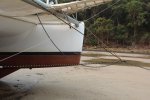
This is our bridle, above, when we have dried out. I have set the anchor off the bow as we retreated stern first toward the shore (as its easier to exit the bay moving forward). I have also kept the stern anchors taut as we dried out. The bow anchor is thus 'similar' to when we might anchor - though in this case the scope is 10:1. However note that the bridle plate is effectively at sea level - offering a better scope ratio than expected, we draw 1m. The reason for the improvement in scope is simple - the upper half of the bridle which is routed to the transom stretches more than the bottom part. I thought at first the problem was the LFRs on the bridle plate but replacing the LFRs with blocks made no difference. The triangles defined by the higher part of the bridle from bow deck to bridle plate and the lower part help manage chop and to increase the elasticity in the lower part, from bridle plate to the water line, bobstay padeyes I have added dog bone things (as I have them) - I have not drawn a conclusion yet.

Jonathan
 
The chain is always there for if the rope of a snubber snaps but I find even quite fine rope is pretty strong. I want the rope to be stretchy and if it is too thick it won’t be very effective as a snubber. In even a slight blow the chain becomes taught and you start to get snatching and grinding of the chain. You need a reasonable length of ‘stretchy’ rope as your snubber and, as I mentioned, I add a rubber ‘dildo’. I feel is has a more gradual stretch and so it works as a snubber to the snubber. I have a quick clip on hook on the chain end and a spliced in loop on the Samson post end. This makes it easy to put on the the extent that I always use it. On the rare occasion I don’t I get punished by the requirement to get out of bed and put it on in the middle of the night because of the chain noise. I think a good snubber with all chain rode gives the best of all worlds. Strength of chain as backup and benefits of rope for stretch and snatch and noise

You need a chain lock or short strop, attached to a strong point (or a very robust windlass) as your back up in the event of a snubber failure. A snubber will fail as a result of cyclical loading (which is how a snubber is used - it is a consumable (like a sheet, halyard or your sails). Snubbers are constantly cycled and rope life is a function of cyclical loading (and abrasion, UV, extremes of elasticity).

Jonathan
 
Thanks Jonathan!

And yes, my comment on 1 metre stretch (at least) needs more qualifications. All my studies have shown that no matter what snubber or rope or even dog bone you use, thin and short, thick and long, at the end of the day all that counts is by how much it stretches at a given wind force. In my work I chose - arbitrarily - a wind strength of 8 Beaufort as a reference force, but any other would do equally well. But my 1 metre comment refers to 8 Beaufort.

Now, why is that so? Since energy / work is force times distance, it is clear that in order to absorb a given amount of shock load energy, you can either chose a large force and a short distance, or a small force and a long distance. The product of the two is the same. But you do not want a large force, as this is the anchor load / bow load. Consequently, if you intend to keep the force as low as possible, you need to increase the distance over which the rope or snubber will have to stretch.

For any normal sized vessel that in this community we usually talk about, it turns out that this distance is 1 - 2 metres at 8 Beaufort. Beyond this, the additonal gain gets very small.

And yes, 30 kn, 40 kn, 50 kn winds are quite different, as the wind load is quadratic in wind speed. To me, the only solution is to have more than one snubber. Have one as a lunch hook, another one for daily / nightly use in ok weather, and yet another one for when it really blows hard. They will come with different elasticities and different maximal working loads. The added benefit is that the heavy duty one will not get worn out by daily use and then be rendered useless when its time comes.

The question how to change from one to another is a tricky one. With sufficient weather forecast, one can do this switch in time before it starts to blow. Otherwise, I think I will simply add my heavy duty bridle and then disconnect my normal bridle, dropping its ends in the water. It is too short to get entangled in the prop, so it should be ok.

Cheers, Mathias
 
Top