
Neeves
Well-Known Member
Thanks Jonathan!
And yes, my comment on 1 metre stretch (at least) needs more qualifications. All my studies have shown that no matter what snubber or rope or even dog bone you use, thin and short, thick and long, at the end of the day all that counts is by how much it stretches at a given wind force. In my work I chose - arbitrarily - a wind strength of 8 Beaufort as a reference force, but any other would do equally well. But my 1 metre comment refers to 8 Beaufort.
Now, why is that so? Since energy / work is force times distance, it is clear that in order to absorb a given amount of shock load energy, you can either chose a large force and a short distance, or a small force and a long distance. The product of the two is the same. But you do not want a large force, as this is the anchor load / bow load. Consequently, if you intend to keep the force as low as possible, you need to increase the distance over which the rope or snubber will have to stretch.
For any normal sized vessel that in this community we usually talk about, it turns out that this distance is 1 - 2 metres at 8 Beaufort. Beyond this, the additonal gain gets very small.
And yes, 30 kn, 40 kn, 50 kn winds are quite different, as the wind load is quadratic in wind speed. To me, the only solution is to have more than one snubber. Have one as a lunch hook, another one for daily / nightly use in ok weather, and yet another one for when it really blows hard. They will come with different elasticities and different maximal working loads. The added benefit is that the heavy duty one will not get worn out by daily use and then be rendered useless when its time comes.
The question how to change from one to another is a tricky one. With sufficient weather forecast, one can do this switch in time before it starts to blow. Otherwise, I think I will simply add my heavy duty bridle and then disconnect my normal bridle, dropping its ends in the water. It is too short to get entangled in the prop, so it should be ok.
Cheers, Mathias
Thanks Mathias.
If I read carefully
 you are not saying 1m elasticity but 1m-2m elasticity? You may find some surprise being expressed (but not from me)
I thought you recommended long snubbers but you are saying that if the squall came through 'unforecast' then you would drop the everyday bridle and attach your storm bridle. I assume you are still looking for the same 1m-2m elasticity (but now at the higher windspeed). what sort of length are you advocating, both for the storm bridle and the everyday bridle?
In this community very few will have any idea of the tension in their rode - how do you suggest they address this omission with any certainty..
I have recently been introduced to Marlow's KERR, vehicle snatch recovery cordage. K.E.R.R. To me it looks too beefy for the size of vessel owned by members here. But there may be other ropes of a similar construction that might be more applicable - and offer the 1m-2m elasticity you recommend. In Oz, as you may know, 4x4 adventures are common place and snatch recovery kits (and land anchors) can be bought off the shelf (I thought they used tape, rather than rope). Any comments?
Take care, stay safe
Jonathan


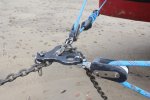
 Although an individual squall may not be forecast, one certainly knows whether squalls are likely or not in a given area. So, when I say 'every day snubber', I mean a snubber that can take the usual in the region one happens to be in, and this will certainly depend on the region. But it is not there to ride a long, serious storm.


