Anchoring accidents

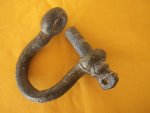
I might have posted this picture before:IMGP2663.jpeg

Its of an unbranded shackle - the sort you might buy in hardware store. Its a 3/8th" shackle and marked 1t WLL. I've tested some of them, they have no indication of origin nor manufacturer. They test 'OK' ish - sometimes UTS of 6t.

This particular shackle was used to secure a new Excel anchor, worth stg500 here in the UK. It was part of the rode of a cat and they had anchored near Brisbane and had rafted up with a friend for the day, and later the night. The wind got up but not enough to cause any concern. In the morning the friend (with his yacht, maybe another cat, departed) and the owner of the shackle tried to retrieve his anchor. The windlass struggled and then it all went pear shaped.

He lost the anchor.

It seems that the shackle might have been side loaded, the shackle pin has simply pulled out of the thread - the mousing wire is intact.

I'm part of a 'lecture circuit' in Oz, he came to one of the day of lectures, in Manly QLD, and gave me the shackle

Once lesson might be - buy a decent shackle. His was an expensive lesson - yours is the time invested in reading this :)

Most shackles, taking 3/8th" as a standard, are UTS of 5t or 6t and a WLL of 1t. If you side load a shackle at 90 degrees (if the shackle locks up in the shank of the anchor) the numbers reduce to 0.5t and 2.5t/3t. If you buy a Crosby G209a shackle it has a 2t WLL and is a UTS of 10t. They are relatively easily available in the UK - don't be complacent.

We only use Crosby shackles, the G209a quality (not quite true as Peerless and Campbell also make to the same quality and we have some of them as well). Yoke in Taiwan make a similar quality and I have some them to test, but Covid has buried testing in the short term. There are 2 Chinese manufacturers of a similar quality , again I have samples waiting to test. But we only have, Peerless, Campbell or Crosby 3/8th" shackles with a WLL of 2t - no chance of picking up the wrong shackle in the dark (because we don't have any gal 'wrong' shackles). Each of our spare anchors has the shackle already attached and we have a shackle, same quality on the spare rode. All belt and braces.


Take care, stay safe - take note.

Jonathan
 
Have you ever seen test data on a shackle loaded across vs. 90 degrees (pin in hole, load at 90 degrees)? I imagine it is even weaker cross loaded, but I don't know how much.

There are other factors:
  • How corroded are the threads? A good reason to retire shackles early.
  • If a bow shackle is cross-loaded, the load is on the wide part, about 1/3 on the threads and 2/3 on the bow. With a d-shackle, the chain could slide up and load right on the threads. In fact, it could jam so that it was pulling downwards, against the pin and threads.
  • A d-shackle (or bow shackle) cannot load right on the threads if it is fitted into a properly sized hole in a shank. Not enough room.
Obviously, it helps if the shackle is large enough that the chain cannot slide over the threaded bosses.

---

"Ground Tackle Failures" would have been a better thread title.

---

The only failures I see in my sailing area are pivoting fluke anchors with shanks bent during recovery. They can really get stuck in the mud, and people charge over them to yank them out.
 
Have you ever seen test data on a shackle loaded across vs. 90 degrees (pin in hole, load at 90 degrees)? I imagine it is even weaker cross loaded, but I don't know how much.


---


I've tested a shackle, 2 shackles actually, one at 45 degrees and one at 90 degrees.

They fail as the, or some, shackle makers warn - an approximate reduction in strength 25% when loaded at 45 degrees and 50% loss when loaded at 90 degrees. But it is very difficult to set up the test. To be realistic for us you really need a bit of HT steel with a slot in it, like the end of a shank. You then need to find a way of securing your mock shank and load the shackle at the angles desired - now you will also point load the shackle which may impact the results, even more negatively.

But the failure I illustrate does underline that test data does not necessarily reflect what actually might happen and testing for every non conforming application needs a fertile imagination and the ability to conduct the tests (testing cost me about US$10 per test + the cost of the test piece (all of which are destroyed). y testing is cheap - I negotiated a rate per hour, the cost of the operator, the 100t test rig is thrown in for free. I don't get a signed certificate, that costs more, I simply take a photo of the screen showing the stress strain curve. But the rig and test is NATA approved.

Its at this point, I'm not going to hesitate mentioning, but I have seen chain under tension with links locked up - I did wonder with the 'C' link thread, especially as the Crosby 'C' links are imperial if there was chance for the link to be 'not straight line' loaded with a resultant loss of advertised strength (no reflection on Crosby - just bad luck).

I have lots of pictures of shackles, like the one above, people sadly do not read these Forum nor the decreasing number of printed magazines. A decent Crosby shackle is cheap - and much cheaper than your anchor and hugely cheaper than your yacht - don't skimp!


Listen to the gifted amateurs - they are doing their best :)

A whinge, I'm not easily upset - but this really annoys me - with the loss of printed media, who do pay some or all testing costs (sometimes) there is also a loss of 'independent' testing - who is willing to test, say 10 shackles at US$10 each and US$10 to test each one - especially when some wise**** says the testing is wrong - he knows because he is an expert - if not a professional. I know that some of my testing is contrived, like loading a shackle at 45 degrees but not actually in an anchor slot - but I'm offering an order of magnitude of data . Our cat has a cross sectional area of a 45 Bav - not good enough you need to do a wind tunnel test to say the windage are the same or not. The results might be different if you used a wind tunnel - get real, join the real world - people know cats are different to 45 'Bavs - but they get an idea...... Yes lets discourage the people who invest time in testing (however poor the test, however ignorant the tester) - don't bother to be positive and offer help and support in designing a test - just deflate - its so much more fun and you look so clever. I'm just glad I'm not a student, nor my offspring, at a University where such attitudes are tolerated.

Jonathan

Edit - yes I got the title wrong - but everyone reads anchor threads - look at the numbers. But the thread 'sort of' developed and you cannot change thread titles. Many of my 'errors', mine and those I see, happen inconveniently without a phone or camera to hand, like the time a whale swam under our cat - panic mode sets in. They are etched in memory - but not in megapixels.

another edits

Commenting on another of Thins points. Ignoring stainless shackles - galvanised alloy shackles, without exception always fail at the pin where the thread is exposed. This logical - the thread has to overlap the hole , slightly, so the pin is thinnest where the thread is exposed. The pins shear at that point. But they shear, if its a decent shackle, within specification. But make sure you tighten the pin home to minimise the amount of thread exposed - do not rely on the mousing wire, thinking it will hold the pin - it will but if the pin is loose you have more thread exposed. You will note that better shackles have long clevis pins and an external bolt - I think this might be because the thread is 'external' to the bow and increases strength - and inconvenience for us.
 
Last edited:
I am highly critical of some of those who commission yachts as the equipment appears to be added at the convenience of the fitter (and maybe the boat builder) - with little regard for the owner or anyone who might be employed to service the unit

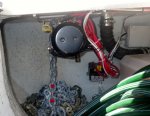
This a picture of not terribly typical windlass installation. But I have seen others similar and some worse.

IMGP5145 2.jpeg


On most modern windlass you can locate the motor at different orientations, sometimes only though 90 degree increments and I think other might be infinitely variable.

This one looks neat and tidy except the chain falls and rubs on the motor casing (sorry but it was difficult enough to take this picture). So every time the chain is deployed or retrieved the chain rubs the casing and when retrieved it rubs the casing with any sand on the chain and sprays the motor with salt water. ALL windlass instruction manuals underline - keep the fall of the chain away from the motor.

To service this motor you will need to release the retaining bolts (or quick release if it is has one), which are 'behind' the motor. I don't know how long the cables are but I guess you might need to unbolt them from the motor as well before taking the windlass itself out of the locker. No wonder windlass are out of sight, out of mind.

But if you check your windlass, have the manual handy and if its not too late and the fall of the chain is near the motor - maybe wonder if you can swing the motor away from the chain (this might be restricted by the amount of cable in your installation).

If you are the lucky owner of a new yacht, or new windlass - consider painting the motor with those paints you use, or used to use, to seal the underside of UK vehicles from the salt put on the roads in winter - (Ziebart ??)

Jonathan

And referring to an earlier post - you can see the while rust on this chain
 
I have learned an Awful Lot from Johnathan, over the years.

Twenty years ago I “Knew How To Anchor”… (CQR, heavy chain, drop the lot on top of the anchor and the boat will sort it out) (and that is still a good way to anchor a gaff cutter in Essex and Suffolk).

Now, I know almost nothing!
Socratic anchoring?
 
Think of it as weary recognition rather than negativity. "Here we go again", basically.

I have been on this forum for some time.
Its fantastic and I feel a personal loyalty to it because it has been so useful and helpful over years.

But we are a bit 'British' and don't always speak up when someone is sounding off unnecessarily. I love this about us Brits but don't want the loudest to define the character of this forum. I'm not I to witch hunts (being British again) but challenging some of the nay sayers might not be a bad thing.

I advocate a culture of openness where any question is welcome no matter how often it has been posted before. This ensures a vibrant growing community and culture of information sharing.
 
Twenty years ago I “Knew How To Anchor”… (CQR, heavy chain, drop the lot on top of the anchor and the boat will sort it out) (and that is still a good way to anchor a gaff cutter in Essex and Suffolk).

Now, I know almost nothing!

The more you know the more you realise you need to learn.

Jonathan
 
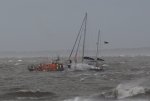
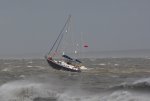
As the thread has run its course I thought I'd finish with a flurry, if not a Whymper, and return to the theme of the thread. One of the images has been much used but it was part of a sequence of, at least 4 images, and the 4 images tell a different story to the picture commonly seen.. Photographs don't lie - they just mask the truth.

The photographs were taken by a local bird watcher who happened to be passing and are courtesy of the RNLI. The location is, your neck of the woods, New Brighton - looking north across the Mersea estuary. The inflatable was from New Brighton - the bigger lifeboat was from the next nearest station (I don't recall the name, Hoylake??).

You, or someone, will know the location far better than me.

I happend to be in the UK not long after this and visited the Lifeboat station for the big boat and shouted them lunch. They showed me all over the station and the lifeboat then I took them, they navigated, to roughly where these photographs were taken to allow me a better idea of the estuary.

Back to the images.

The owner was single handing and the forecast was not great and he sought shelter in the Mersea, I think aiming for a 'locked' marina, but missed the gate and had to anchor outside. The conditions are described as 'strong gale'. There is a sort of breakwater upwind and I recall the water is quite deep -- around 10m

The New Brighton boat was out looking for some missing children (who turned up safe and well) but came across the ketch and it was decided to call out the big boat. The owner initially refused any help.


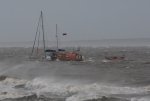
shout to Quo Vadis (strong gale 9) 008.jpeg

A man was put on board, you can see him on the bow, wearing a white helmet.

shout to Quo Vadis (strong gale 9) 009.jpeg

They put a tow rope on the ketch


shout to Quo Vadis (strong gale 9) 010.jpeg
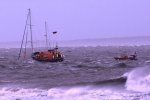
Image 8 to Quo Vadis (strong gale 9) 013.jpeg

In the last picture, which is the one commonly seen, the crew man is on the bow and you can see the rode, the rode is obviously (or hopefully) being retrieved) and its not clear in these images but the lifeboat is trying to take the strain (or reduce the strain) on the rode. However despite the best efforts of the lifeboat the snatch load at short scope at the instant the photograph was take must have been huge - and illustrates why you should use a snubber.

Really the end of the story - what is amazing are the size of the seas - the ketch completely disappears at one point.

The ketch was using a SARCA anchor, that held, despite the conditions - though the lifeboat crew did say it 'looked' bent on retrieval.

Take care, stay safe

Jonathan
 
We were out at the weekend over at East Head at anchor my Kobra2 dug in beautifully on the sand and held us without shifting in 20kts.
Anyway on Sunday morning the gathered throng started to depart, one yacht was struggling, 3 of them on the bow tryinging to get the anchor up, along come 2 very young chaps in the harbour patrol collecting dues so they lent a hand so then there was 5....... so with most of us sat in our cockpits drinking coffee watching the entertainment they got the anchor free an the yacht able to sail off, Harbour patrol then came to collect our dues and we were able to see what had fouled the anchor as it lay in the bottom of the Rib.

So if you have visited Chi Harbour fairly recently and had the misfortune to have an all silver coloured 4 stroke ? outboard fall off the back of your boat the Harbour Master has it if you would like it back ?
 
Here we go again. :unsure:
Edit: Let him have his fun. It's no more harmful than train spotting.

and RichardS

I'm being restrictive of my finger point to those who have exposed themselves on this thread - there are others, on other threads.

I am hoping the bullying by some members, the arrogance, the condescending comments can now be curtailed.

They are simply little people without any self discipline, a total inability to edit their own scope of reading - but a reach enough to discourage people to commence an anchor thread and threads on restoration and the 'project yacht', Shame on you. Get a life or - you have a role to play - support, encourage give your background on the topic - without the point scoring.

We are all here to learn - not be lectured nor mocked.

Yes I'm angry - its should not be part (and is only practised by a few - but they have impact) of YBW.

I sadly know at least 3 people who have simply left YBW, or who have publicly announced they are leaving, because of similar attitudes.

I might be criticised by the Mods (and possibly rightly so) for belabouring the point. But the bullying has been going on continuously for some time - enough is enough. I'll take a ban, curtailment, if it means the thought police, on what they think is right or wrong, get the message - we have Mods for that!

And I only follow two parts of YBW, the PBO section and Scuttlebutt

Rant over

Hopefully - not good bye

Take care, stay safe

Jonathan
 
Not quite an anchoring accident. I also have a Fortress FX23 that I bought on here with a bent shank, advertised as shuch. The shank was only bent by a few degrees and the anchor had never been in the water. It was obvious that it had been braced against a bar, by the mark across the shank, and a force applied to bend it. It was low cost and I sent off to Fortress for a free replacement shank, which they sent to the UK.

I have lost both a CQR and a Danforth. The CQR was at the Ailsa Craig, a volcanic plug where granite curling stones were cut from the rock. It probably got caught in boulders or a ledge, but we could not get it free. The Danforth was on a pebble beach, with lots of beach launched boat equipment running into the sea. It was likely fouled and again we could not get it free. We buoyed it to recover later but someone stole it by the time we returned; it was busy, tourist beach.

I had a Bruce refuse to budge in bay with thick clay seabed. We ended up winding down the bow by about 2 feet trying to break it out, a known clean bay, so risk of fouling was very low. As I sat there pondering what to do next, with the bow still down, I noticed it floating back to normal. The anchor was retrieved with a humongous clay ball hiding the anchor. Of course, clay was exactly the sediments that the Bruce was designed for.
 
Quality item
My 60lb CQR showing the OEM shackle.

51382189601_81f7189c3a_4k.jpg


51382189686_6f1496bc23_4k.jpg


51382189691_fb0e90633c_4k.jpg
 
When I try to load big files to YBW the little man who assess quality (and size) raps me on the knuckles and refuses entry, so I knock them back to 200kb (approx). Now it appears I'm being censored, can I complain?

How do you load a 2 Mb file....? - no - I don't need to know the answer (or when I do I'll ask B.O.B.

:)

Jonathan.
 
Top