Anchor thread

I queried Milady on the merits of acquiring a bigger anchor. She then asked whether that might require the purchase of a bigger boat.
I'm still mulling over the 'domestic politics' of that Socratic question....

:cool:
 
That is a much better idea. More fun discussing what boat to buy. One of the most enjoyable experiences I had was buying the new Bavaria in 2015. Like a kid in a toy shop both enjoying the choosing of the toys and then trying to get the best financial deal.

Much more fun than anchors although I got a great deal on my Epsilon and they carried it out to the car.
 
For example one might like to test the the oft quoted truism " in a blow you never wished you had a smaller anchor" . We can show in simulated tests that many designs of anchors will outperform larger versions of others in terms of ultimate holding power so why should they not do so in real life situations?

If you anchor frequently I wholeheartedly agree on the importance of selecting the best primary anchor design you can.

“In a blow you never wished you had a smaller anchor"

is a phrase that (for me at least) assumes that the anchor design and material is not changed. I don’t want one of those Box anchors no matter how big :). An excellent small anchor can beat a poor large anchor, but an excellent large anchor is better again and this is what most sensible sailors wish for when anchored in adverse conditions.
 
Last edited:
At an individual level we would have difficulty in testing out whether a bigger anchor is really better, for example having dragged with a smaller anchor and then gone back in identical circumstances with a bigger anchor of the same design. No different from any other field of enquiry where there are so many variables that are unknown.

After almost 4,000 nights at anchor (including well over a dozen named storms) using a considerably oversized anchor (Rocna then Mantus), personally I am convinced that a larger anchor (of the same design and material) provides better performance than a smaller model.

There are many advantages to name two: we can use shorter scopes when necessary and the performance of the anchor is much better in difficult substrates such as weed. I often dive on my other boats’ anchors and the difference is clear.
those that have changed newer designs outperform older ones in line with the findings of the simulated tests.

I absolutely agree.

Further than that, as most of us never get into a situation where the anchor drags because of a lack of theoretical holding power rather than (as discussed earlier the nature of the seabed)

I agree that many boats drag in a less than ideal substrate. Sometimes we are forced, or it is simply convenient to anchor in this type of substrate. One of the greatest advantages of larger anchors is that you can often safely make use of more marginal substrates.

A larger anchor of the same design and construction material has higher ultimate holding power than a smaller model and this generally applies in all substrates. In a marginal substrate this is often enough to provide adequate holding. This is particularly true in weed where the larger anchor does much better than the increase in size alone would suggest.

These are rare exceptions such as a rock substrate where a larger anchor often does not help, so this not a universal panacea, but there is a useful and practical increase in the anchorages that can be utilised with a larger anchor, especially in stronger wind where many boats will be forced to only consider anchorages with excellent holding. Safely making use of these more marginal substrates is often more convenient. It can avoid what can sometimes be a long sail in poor conditions to reach the perfect anchorage.

Many boats never anchor in adverse conditions, but if you want to include this capability you will see instances where even anchors of good design that are correctly deployed are simply overwhelmed. Once the wind rises to over a sustained 50 knots, even in good substrates a high percentage of boats in an anchorage will drag and this includes boats with modern anchor designs. This is not surprising given that even the more conservative anchor tables stop at 50 knots.

Not all boats want excellent anchoring capability even if they anchor often. Some owners are willing to accept restrictions in the pursuit of the lightest anchor possible. Some examples of these restrictions include never using less than a 5:1 scope, always deploying two anchors in wind over 25 knots, and frequently swapping between multiple anchor designs depending on the perceived substrate . In my eyes this is restrictive and unnecessary, especially given the small weight savings involved, but for some boats fitting the largest anchor they comfortably manage may still be relatively small.
 
Last edited:
We power set our anchor and often bury it. Maybe that's why it doesn't drag. According to the engine power graph at 1800rpm I am using 60hp?
Is there not a difference in energy developed by the prop when it's in reverse?
 
In adverse conditions - we do not even think about our anchor as we are confident in its ability under adverse conditions. Only a fool has doubts - as adverse conditions should be part of the decision making process. It’s all a bit late when the conditions are adverse.

All the talk of anchor design and size is a bit restrictive. The ability of the anchor to allow you to stay in your chosen bit of seabed is only partially as a result of your choice of anchor. The anchor does work (or not) in isolation - the rode and scope must be chosen with care, the bit of seabed needs to be chosen with care as does the location you choose (the anchorage). It’s not quite as simple as ‘we chose an anchor twice the size recommended - so we are as safe as houses…… ’.

In the article on the storm in the Med - one of the photographs shows an owner looking at his bent chain hook - I bet he wondered why he had not chosen one from the lifting industry - nothing to do with his choice of anchor. His problem was the inability to change from an everyday snubber to a storm snubber - nothing to do with his anchor - and if he had been prescient he would have planned for a storm snubber before he left the shelter of his home port. Hindsight is so useful - of course. But how many here have a snubber that can be used in a storm. How many have the kit to anchor in a storm with a short rode….? How many…..?

rhe information is actually all here, somewhere on YBW (though people complain at the repetition), it is available in the printed media - people do get too engrossed in anchor size and forget, or ignore ……. Cannot see the wood for the trees.

Jonathan
 
Is there not a difference in energy developed by the prop when it's in reverse?
It depends upon propeller type but on average yes.
Also, a correctly sized propeller absorbing 60hp at 1800rpm (fwd or reverse) is implying an engine giving 3-400hp at full throttle say 4000rpm, not sure it's a common occurance among mid size sailing boats.
 
Is there not a difference in energy developed by the prop when it's in reverse?
I made my measurements using the prop in reverse. 10hp = 100kg of tension. I have no reason to measure in forward gear :)

but it’s rough - different props, different results. But it’s not going to be too far out.

The important facet is that the tension you can develop is a very small fraction of the potential hold of your anchor. All setting in reverse tells you is - your anchor has begun to set and it is holding at the very low tension you are able develop with your engine. It does not tell you if there is an oyster shell 10mm ahead of the toe of your anchor that will possibly reduce the hold when the wind rises to 35 knots. The hold developed does not tell you what will happen when a front comes through etc etc

diving on your anchor is a great idea - but is of little value if you are arriving at your anchorage at midnight, if the anchorage has a weed seabed, if the anchorage is mud and you cannot see your anchor because of the murk - you need confidence in your kit when the chips are down - not on a nice sunny day on clean sand.

diving on your anchor demands some appreciation of what a good anchor might look like when set - and it is obvious many have no idea. If you google Practical Sailor and anchor angles - you will find an article describing one facet of anchor design that was overlooked. The article describes a shallow setting anchor - and in a follow up article, by a different investigator, the conclusion was that a shallow setting anchor had a poor hold in a veering wind. It looked well set - appearances are deceptive.

I’d provide the link but I’m working off an iPad - and it’s easier for you to search…… when my laptop comes back from having a new screen installed - I’ll be a bit more useful.

In a veering wind, when the wind is yawing your anchor will be compromised - setting 2 anchors in a fork or ‘V’ addresses the issue - but is a bit difficult if your anchors are oversized.

Jonathan
 
Last edited:
Is there not a difference in energy developed by the prop when it's in reverse?
See post #117 for real world data on thrust in reverse. Thrust is determined largely by the propeller as the table shows and most propellers are designed for forward motion and are less efficient in reverse. Also many installations have gearboxes with different reduction ratios un reverse meaning the pitch is wrong for reverse. This can be overcome with some feathering props like the Featherstream and Maxprop where you can set the pitch differently in forward and reverse. The Yanmar gearbox in the test boat is one of those with different ratios and I expect the Featherstream that achieved second highest thrust in reverse had its reverse pitch set to do just that and why other props that did well in forward were comparatively worse in reverse.
 
It depends upon propeller type but on average yes.
Also, a correctly sized propeller absorbing 60hp at 1800rpm (fwd or reverse) is implying an engine giving 3-400hp at full throttle say 4000rpm, not sure it's a common occurance among mid size sailing boats.
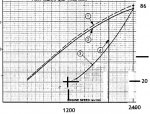
Our maximum engine revs are 2400. Reading off the engine power curve which is quite flat. Maximum torque is at 1200 rpm. 86hp at 2400rpm. We normally run at circa 1200 rpm. 3.3 litres per hour. Its a Perkins M92b 4.4 litre
 
It depends upon propeller type but on average yes.
Also, a correctly sized propeller absorbing 60hp at 1800rpm (fwd or reverse) is implying an engine giving 3-400hp at full throttle say 4000rpm, not sure it's a common occurance among mid size sailing boats.
Deleted. Actual figures (rather than my estimates) provided by geem
 
I made a video of my oversized Mantus setting many years ago. This should settle any concern that a yacht cannot set a large anchor adequately.

This is a 57kg (125 lb) Mantus M1 on a 47 foot yacht with a 53 hp engine and a two blade prop ( my previous yacht).

There was zero wind so the only setting force on this drop was from the engine.

Note how the Mantus sets instantly barely moving back from the drop point. Many anchor models will drag for some distance before the toe manages to engage (and some continue ploughing or slowly furrowing under the surface for many metres).

Also note that the anchor is still diving when the engine is cut. If you really want it set deeper just leave the power on longer, but there is no need. This setting depth is better than 99% of anchors achieve in Mediterranean (the sand tends to be quite hard), despite the relativly short scope, which in this case was only 3:1 in shallow water.

On a large anchor such as this the fluke is a long way below the top of the shank so the imortant part, the fluke, is buried a long way. If exposed to more force such as winds above 25-30 knots, the anchor will bury even deeper. A smaller anchor, especially one without the large roll bar of the Mantus, would need to completely disappear before the fluke was as deep as this large anchor and of course this would have a smaller fluke area .

I have seen many sets of this large anchor (and my previous 55kg Rocna ). This was not cherry picked (this was the one and only take). It is just a typical result.

As the following video illustrates, larger anchors (both Rocna and especially the Mantus M1 ) have performed exceptionally well for our yachts over many thousands of nights at anchor in a wide diversity of substrates including those in Barbados, the Canary Islands, Caribbean, Croatia, Greece, west coast of Ireland, Madeira , Netherlands , Norway, Scotland and more. If you can comfortably manage a larger modern anchor on your vessel you will be rewarded with many practical benefits.

 
Last edited:
Our maximum engine revs are 2400. Reading off the engine power curve which is quite flat. Maximum torque is at 1200 rpm. 86hp at 2400rpm. We normally run at circa 1200 rpm. 3.3 litres per hour. Its a Perkins M92b 4.4 litre
Sorry I could not look at the proper curve, this is a typical one for engine/propeller absorbed power, I think it gives an idea about the difference between engine power and propeller absorbed power.
86hp at 2400 as you say.
You run it at 1200rpm, if your propeller is correctly dimensioned (max absorbed power at max power), at 1200 rpm it would absorb 20hp, give or take a few hp.
With similar, typical propeller/engine power curves, to absorb 60hp at 1200rpm the engine should deliver 250ish hp at full rpm.


Add: for a simple two blade fixed propeller, the absorbed power in reverse gear would most likely be a small percentage of the forward (graph) one.
rpm.jpg
 
Last edited:
I made a video of my oversized Mantus setting a few years ago. This should settle any concern that a yacht cannot set a large anchor.

This is a 55kg Mantus on a 47 foot yacht.

Note how it sets instantly barely moving back from the drop point. Many anchor models will drag for some distance before the toe manages to engage (and some continue ploughing or slowly furrowing under the surface for many metres).

Also note that the anchor is still diving deeper when the engine is cut. If you really want it set deeper just leave the power on longer, but there is no need. This setting depth is better than 99% of anchors in Mediterranean anchorages (the sand is quite hard) despite the relativly short scope of only 3:1 in shallow water.

On a large anchor such as this the fluke is a long way below the top of the shank So it is buried a long way although it will of course dive deeper when exposed to more force such as a wind above 25-30 knots.


interesting.

47’ yacht, about 14.3m

Rocna recommendation for a 14m yacht of 13t is a 25kg anchor and for 23t yacht a 33kg anchor. Your anchor weighs 55 kg.

Having tested a 15kg Mantus vs a 15kg Delta, 15kg Spade and 15kg Excel the Mantus has a hold similar to a Delta and about 50% of that of a Rocna, Spade and Excel. Your choice is about spot on. Your 55kg Mantus has roughly the same hold as the anchor recommended by Rocna 25/33kg. If you had opted for a Viking the 10kg version is roughly the same hold as the 15kg Rocna/Spade/Excel Or the 8kg aluminium versions of the Spade and Excel.]

I’m sorry but I simply cannot test a 55kg model, 2t is the limit of my load cell and winch Making 15kg anchors the max I can safely handle. On the basis that all the anchors are scaled approximately correctly then a comparison of the 15kg models should be ‘similar, to 25kg, 33kg or 55kg models.

other than hold the big difference between modern anchors, Rocna et al, and the previous generation is their more reliable and consistent ability to engage with the seabed.

Jonathan
 
Having just bought an oversized anchor for my boat, I'm firmly in the 'bigger is better' camp. I want to maximize the chances that the anchor will hold when I'm caught out in an anchorage in less than ideal circumstances, be it a poor bottom or a limitation on how much scope I can have out.

Despite struggling with this in my head for months, I fail to see how a bigger anchor can be worse than a smaller one.

One of the arguments is that I can't "set" the anchor as deeply. I don't understand this argument -- anchors aren't sized based on the power of your engine. If I redline my poor 35-year old 16hp 2GM20F in reverse, I'll at best simulate a 30 knot pull. Will it hold at 50 knots? I'll only find out when it blows that much. My hope is that it will dig deeper and hold. My "massive" anchor is not as deeply buried at my simulated 30 knots pull compared to a "normal sized" anchor -- so what? It doesn't need to dig as deep to match the maximum tension I can exert on it.

Is there any scenario were a smaller anchor would hold my boat better? I sincerely doubt it, please explain to me how this would work.

Did I unnecessarily spend money on a larger anchor? Perhaps.. Bit If my anchor drags in the middle of the night I can at least rest assured that it wasn't because I was trying to save £80 when purchasing it.

My windlass is beefy enough to lift it, and it will fit on the bow roller. So why not, why would I go for a smaller one? Makes no sense to me.
 
Having just bought an oversized anchor for my boat, I'm firmly in the 'bigger is better' camp. I want to maximize the chances that the anchor will hold when I'm caught out in an anchorage in less than ideal circumstances, be it a poor bottom or a limitation on how much scope I can have out.

Despite struggling with this in my head for months, I fail to see how a bigger anchor can be worse than a smaller one.

One of the arguments is that I can't "set" the anchor as deeply. I don't understand this argument -- anchors aren't sized based on the power of your engine. If I redline my poor 35-year old 16hp 2GM20F in reverse, I'll at best simulate a 30 knot pull. Will it hold at 50 knots? I'll only find out when it blows that much. My hope is that it will dig deeper and hold. My "massive" anchor is not as deeply buried at my simulated 30 knots pull compared to a "normal sized" anchor -- so what? It doesn't need to dig as deep to match the maximum tension I can exert on it.

Is there any scenario were a smaller anchor would hold my boat better? I sincerely doubt it, please explain to me how this would work.

Did I unnecessarily spend money on a larger anchor? Perhaps.. Bit If my anchor drags in the middle of the night I can at least rest assured that it wasn't because I was trying to save £80 when purchasing it.

My windlass is beefy enough to lift it, and it will fit on the bow roller. So why not, why would I go for a smaller one? Makes no sense to me.

I think the argument given in the Practical Sailor article quoted by Jonathan goes as follows: A deeper dug anchor seems to be less susceptible to yawing than a more shallow-set anchor. And if yawing gets excessive, then over some 20 min or so the shallow-set anchor will wiggle free and start its walk about, whilst the deeper-set anchor does not. But they also do note that once the deeper-set anchor does wiggle free, it will never dig in as deep again and so will not set properly, whilst the anchor that was set more shallow can manage to reset. It seems like a choice between 'everything is completely fine until it fails ungracefully' and 'it will start to drag earlier, but it will not fail ungracefully'. They also say that when you can keep yawing under control (less than 30 degrees according to them), then all this is not a problem to begin with.

So, I believe that article says that if you have excessive yawing, then shallow is bad, but if this is not an issue, there is no difference.

Whether this is all true, I really do not know. But this is the essence of what I read out of that article. But interestingly, in that article they did not warn of oversized anchors. It was more a comparison between anchors that by nature bury deep versus those that stay more shallow. I am not sure one can extrapolate those results to two anchors of the same type, with one being much larger than the other, and hence not as deeply set.

My Spade is according to that in the category of 'more shallow' independent of it being oversized or not. I can confirm that it has handled all wind shifts very well and never caused me trouble because of that. This is very valuable to me. The maximum we had to sustain yet was 50+ kn in a brief spell. 40+kn we have seen regularly. Using my 'storm' bridle for that.

The few times I ever dragged (slightly), even with more than enough chain and a very good bridle, was in extremely poor mud, and it was only noticeable over a 24h period. Once I was in poor mud in the middle of a small harbour in Mexico and I knew I had not enough chain out should the wind be much stronger than predicted. And it did get much stronger, resulting in a serious drag in the middle of the night... And once I was anchoring at a steep bank, were the anchor just fell off the cliff, so to speak. That place was labeled as for day anchorage only, for good reason. When it was crowded and you had to anchor in the 2nd row, you were simply at the edge of the cliff.
 
Having just bought an oversized anchor for my boat, I'm firmly in the 'bigger is better' camp. I want to maximize the chances that the anchor will hold when I'm caught out in an anchorage in less than ideal circumstances, be it a poor bottom or a limitation on how much scope I can have out.

Despite struggling with this in my head for months, I fail to see how a bigger anchor can be worse than a smaller one.


Is there any scenario were a smaller anchor would hold my boat better? I sincerely doubt it, please explain to me how this would work.


My windlass is beefy enough to lift it, and it will fit on the bow roller. So why not, why would I go for a smaller one? Makes no sense to me.

Being objective - why do you think the big one will be better. Quote the data that convinced you to shell out more cash (the numbers must be there to justify the cash)

Much of the argument revolves round - I had a 20kg CQR/Delta/Bruce and it dragged. I dumped it and bought a 25kg Rocna,, Spade, Excel etc and I have not dragged since (Or not that I’ll admit) QED - a bigger anchor is better.

we looked at the data - we had a 17kg Manson plough (CQR Clone) it deagged, we replaced it with a 15kg Steel Excel, we reduced chain size from 8mm to 6mm and added a decent bridle and changed the 15kg steel Excel anchor for the 8kg aluminium version. We needed a spare anchor and have a 8kg aluminium Spade and a FX 16. Our cross section of anchors covers all eventualities, loss of anchor included. if you feel the need for an oversized anchor and you are prudent then your fall back anchor should be the same weight as the one on your bow roller. Don’t carry a spare - the caution expressed in going oversized seems to contradict the absence of a spare.

And if you have a spare - why not use it, to quell a oscilating/veering wind. There is no honour lost in making your night at anchor comfortable. Setting the spare is child’s play - if you find deploying a second anchor onerous - maybe you should take up bowls. putting third reef in is more difficult than deploying a second anchor - don’t you bother with reefs either….;? Too much trouble….

a smaller anchor will not hold your yacht better, if both hold they are doing exactly the same task you cannot get better than your anchor holds Maybe that’s not quite true - and is not retrieved full of mud :)

Part of the equation is a simple philosophy - keep unnecessary weight out of your yacht and especially in the ends. your sailing
will be more comfortable with less weight in the ends. I have mixed views over sailing more quickly - we do what we do to go sailing - so reducing the time actually sailing seems to be contradictory :)

‘However I do like sailing and averaging 10 knots over 100nm In fact we derive a lot of pleasure from doing so. There is something quite surreal in having breakfast, fresh toast, home made marmalade, fresh coffee , sailing flat - and averaging 10knots. But each to their own. But it is more difficult,to achieve if you take the bigger is better route, anchor chain, steel (not aluminium) oversized anchor, dinghy on the foredeck, etc etc our anchors have a hold in clean sand of 2,000kg - if the hold in one of these questionable seabeds is half that - we still have a large, enormous, safety margin. Only idiots anchor in thick weeed (and weed is well documented)

But define the data that confinced you to buy the bigger anchor.

Jonathan
 
Sorry I could not look at the proper curve . . .
Here's the Perkins data sheet for the M92B, but the Euro specs with power in kW. But you're right, with a prop pitched to allow the engine to reach its maximum RPM (2400), the propeller only delivers about 15-20hp at 1200 rpm.

Anyone interested in propellors and engines, Dave Gerr is your source. His propellor handbook if you're a nerd or this article for a resume. ( https://www.gerrmarine.com/Articles/EnginePowerCurves.pdf )


Perkins M92B.jpg
 
Last edited:
Top