
geem
Well-Known Member
Oh come on, is that the best you can do? 1 out of 10. Must try harder?You can write as much verbage as you like, but I can assure you that no anchor known to mankind knows anything about the boat to which it is attached. ?

Oh come on, is that the best you can do? 1 out of 10. Must try harder?You can write as much verbage as you like, but I can assure you that no anchor known to mankind knows anything about the boat to which it is attached. ?


Indeed. I’m happy with my oversized Rocna. A truly negligible extra weight burden (chain is not oversized). The extra surface area means better holding in weak ground and that’s when you need it most usually. It also means better ultimate holding in extremis. I’ve not needed that insurance policy so far, but when I do it could be a boat saver. For what practical downside? That it may not bury fully in hard ground perhaps. Not a problem as far as I can see as it still holds perfectly partly buried and will always dig deeper when the wind gets up.The advantage of a larger anchor is not to have more maximal holding power than I ever need.
As said before, if the maximal holding power is more than what I need, I can use some of that to shorten my chain and thus anchor where it is crowded. And yes, severe yawing may wiggle out the anchor if the chain is pulling at an angle, so I have to take some precautions to make sure yawing is less than 30 degrees, which the folks in Jonathan's link claim means there is no harm done to the anchor.
Also, you may be anchoring in a very muddy place where the maximal holding power is greatly reduced. I had to do this for 9 months during Covid, when we were not allowed to move, and I learned to love my somewhat oversized Spade anchor then. Yes, above 26 kn of wind it would drag a little, regardless of how much chain and snubber I would put out, but not by much and as the wind came from different directions, it was a kind of random walk...Every two weeks or so I would weigh the anchor and go back to where we were originally. In all that time it never broke free, it always stayed buried.
And finally, when the substrate is a layer of sand over rock, then there is a natural limit as to how deep a smaller anchor can be buried. The best anchor here is one that just fits into this layer of sand to make optimal use of it.
Thus, to me, it all depends on the circumstances whether a larger anchor makes sense or not. I am currently also in the Caribbean and I have never regretted my choice of anchor.
Cheers, Mathias
Sorry you seem unable to understand a simple proposition and are resistant to anything concrete that challenges your unsupported one liners. The anchor reacts differently depending on the boat to which it is attached. You were claiming that it will soon "dig in" when the wind gets up when clearly the boat it is attached to will determine how well it digs in. Nobody said that a big anchor would not hold a small boat. The question is whether it will hold better than an appropriately sized (smaller) anchor. The data suggests not.You can write as much verbage as you like, but I can assure you that no anchor known to mankind knows anything about the boat to which it is attached. ?


I definitely take the point about not spending more money than necessary, and safe handling is an issue too.
But intuitively at least I would have thought that a heavier anchor would be more likely to set, all things being equal, given that it would put more weight on the tip and thus be more likely to penetrate into the sea bottom.
I think I'll maintain my policy of generous but not ridiculous anchor sizing, long rodes with nylon rope as well as chain, and at least two full sets of ground tackle on board.
It's interesting stuff though, and great to read other people's experiences, which are much broader than my own - my sailing has mostly been East Coast and Bristol Channel, with a lot more time spent thinking about tides, depths and rode length than about holding power and setting.
I think the mechanics of anchor holding is extremely complicated and my earlier post was written wondering if a shallow buried big anchor is better than a deeply buried smaller anchor. Clearly anecdotal evidence here suggests it is.
In my elemental understanding of soil mechanics, the deeper the burial, the higher the shear force the soil can withstand before failure. In other words, the deeper you bury the tighter the hold the soil has on the anchor. I think it’s fair to say for a given anchor, the deeper it is buried, the better it holds. What then matters is the relationship between the rode force and the depth of burial and the depth of burial verses the holding capacity. Are the relationships simple and linear or more complicated? Perhaps (and I don’t know this) an oversized anchor will bury so far where it’s holding capacity is say 2000kg but a smaller anchor can bury deeper with the same ride load and thereby make use of stronger soil and give a capacity of say 2500kg. Or big anchor in weak soil not as good as small anchor in strong soil? I don’t know enough about soil mechanics and would be interested if someone on here had that knowledge.
From a practical point of view, as Neeves points out, it’s probably academic anyway since we never get close to theoretical holding capacities anyway - the 3D dynamic reality of riding to anchor makes the 2d static pull presumably used in most anchor tests rather simplistic.
I like NormanS’ thoughts about reassurance, which is the fundamental need we have of our anchors - will our anchor let us sleep well. It is only time and experience of our own boats that provides that and I wonder if the OP is any the wiser for this discussion.
Ps I have an over sized anchor because it’s the smallest they make.

I believe he uses one of those totally treacherous and unreliable Rocnas now.No comprehensive survey of wild weather anchoring techniques, gear and opinion would be complete without those of Skip Novak. He knows rather a lot about such, and some of it can be seen here:
Skip Novak’s Storm Sailing Techniques Part 10: Anchoring
I wouldn't dream of agreeing, or disagreeing, with any of it. Should I find myself facing 'hooking up' in such heavy air, I hope I remember it all .
BTW, this is what he used when the films were made....
Someone will be along very soon to tell me he swopped that monster CQR - which no-one could lug around the deck - for something else.
There are those who advocate the use of smaller or standard sized anchors in strong winds, and then there are anchor manufacturers who advise going up one size or even two sizes, if anchoring in storm conditions.
My own hard won personal experience of decades of anchoring, often in challenging conditions, leads me to support the latter.
Sorry you seem unable to understand a simple proposition and are resistant to anything concrete that challenges your unsupported one liners. The anchor reacts differently depending on the boat to which it is attached. You were claiming that it will soon "dig in" when the wind gets up when clearly the boat it is attached to will determine how well it digs in. Nobody said that a big anchor would not hold a small boat. The question is whether it will hold better than an appropriately sized (smaller) anchor. The data suggests not.
No comprehensive survey of wild weather anchoring techniques, gear and opinion would be complete without those of Skip Novak. He knows rather a lot about such, and some of it can be seen here:
Skip Novak’s Storm Sailing Techniques Part 10: Anchoring
I wouldn't dream of agreeing, or disagreeing, with any of it. Should I find myself facing 'hooking up' in such heavy air, I hope I remember it all .
BTW, this is what he used when the films were made....
Someone will be along very soon to tell me he swopped that monster CQR - which no-one could lug around the deck - for something else.
Don't use use an old generation anchor?There are those who advocate the use of smaller or standard sized anchors in strong winds, and then there are anchor manufacturers who advise going up one size or even two sizes, if anchoring in storm conditions.
My own hard won personal experience of decades of anchoring, often in challenging conditions, leads me to support the latter.
I'm not a dedicated follower of fashion, but even if I was, if Knox and Fortress say to go up a size or two, for heavy weather anchoring, who am I to argue. But anyway, we'll all do our own thing, and for those lucky people who don't anchor in more than 30 knots of wind, it doesn't matter at all. Unlike some others, I'm not advocating what others should do, - merely saying what works for me where I sail.................
Don't use use an old generation anchor?
and for those lucky people who don't anchor in more than 30 knots of wind, it doesn't matter at all.

No wonder you need to go up a few sizesI'm not a dedicated follower of fashion, but even if I was, if Knox and Fortress say to go up a size or two, for heavy weather anchoring, who am I to argue. But anyway, we'll all do our own thing, and for those lucky people who don't anchor in more than 30 knots of wind, it doesn't matter at all. Unlike some others, I'm not advocating what others should do, - merely saying what works for me where I sail.
????Must have missed that - can you point me to exactly who said that?

I believe he uses one of those totally treacherous and unreliable Rocnas now.

If you are that gullible then you deserve to drag?Manufacturers love to overrate their products and make exaggerated performance claims.. The gullible are the people that always believe these claims.
Unfortunately, in an effort to out do each other and convince the buyer that their design is superior it has reached the stage where manufacturers are claiming a mainstream steel anchor under 13kg is sufficient for a 50 foot boat.
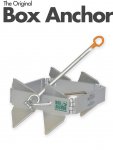
If you really want to trust manufacturers claims, you can always purchase the anchor pictured below. It is a “state of the art offshore boating anchor that brings anchoring to a new level of sophistication”. It needs no chain and only a 2:1 scope.
Rather than simply trusting manufacturer’s claims, sensible people will make their own assessment.
View attachment 149117
Part of that (not the box anchor which I can't seem to delete) is reviewing the "scientific" evidence to understand the forces involved plus the tests that have been carried out and relate those to your own situation. What makes it difficult is that controlled real time tests are virtually impossible to construct. For example one might like to test the the oft quoted truism " in a blow you never wished you had a smaller anchor" . We can show in simulated tests that many designs of anchors will outperform larger versions of others in terms of ultimate holding power so why should they not do so in real life situations? At an individual level we would have difficulty in testing out whether a bigger anchor is really better, for example having dragged with a smaller anchor and then gone back in identical circumstances with a bigger anchor of the same design. No different from any other field of enquiry where there are so many variables that are unknown.Rather than simply trusting manufacturer’s claims, sensible people will make their own assessment.
View attachment 149117
