Anchor thread

To those who insist that a larger/heavier anchor will not "set" properly, and then will apparently be a disaster when the wind increases. Please explain how the same anchor used on a bigger boat will be alright, when there's initially not enough wind to "set" it, but apparently it will be alright when the wind gets up.

That is very simple because when the wind gets up the bigger and heavier boat will apply more load to the anchor. You clearly have not read the articles I directed you to, preferring to term them "verbiage"

BTW don't think anybody has said "will not" nor that it will be a "disaster" in this context, but just that a smaller, lighter lower windage boat may not be able to apply sufficient load to dig the anchor in properly and so access the greater potential holding power. The question is whether it is of any benefit to have an oversize anchor compared with the recommended size (with all the reservations about recommendations)
 
Last edited:
That is very simple because when the wind gets up the bigger and heavier boat will apply more load to the anchor. You clearly have not read the articles I directed you to, preferring to term them "verbiage"

BTW don't think anybody has said "will not" nor that it will be a "disaster" in this context, but just that a smaller, lighter lower windage boat may not be able to apply sufficient load to dig the anchor in properly and so access the greater potential holding power. The question is whether it is of any benefit to have an oversize anchor compared with the recommended size (with all the reservations about recommendations)
You are quite correct. I haven't read the articles that you instanced. I much prefer going by my own practical experience, rather than relying on the opinions of others.
 
You are quite correct. I haven't read the articles that you instanced. I much prefer going by my own practical experience, rather than relying on the opinions of others.

Norman - I have to wonder - why are you here, why do you waste time reading these threads. Your experience is very restricted if it is only based on what you have and do. Your experience is of value but how do you compare what you do with anything else - unless you have shed full of anchors you can only comment on what you use - and with no disrespect - you have no idea what you might be missing.

a CQR, Bruce, Delta are all adequate anchors but there is simply too much evidence (that you ignore as you have not used them personally) to confirm that there are better anchors.

if you want to step outside your comfort zone how would you choose other equipment?

Jonathan
 
1673661113462.jpeg

I think this is part of the question.

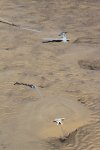
I have set a FX16 and an FX 23 off the transom of our cat. As near as I can make it they are in the same, or essentially similar seabed. I set both anchors under water and the left Josepheline to dry out. I used the same or similar rode, setting the FX16 first and then transferring the rode to the FX23. I set the 2 anchors to the same tension, so they have the same hold (as hold and tension are the same). as you might expect the FX16 is ‘almost’ fully buried and the FX 23 still has some of the mud palms fully exposed, and the stock.

I also have pictures of other anchors that are slightly canted over - so if you query the list it happens with any and all anchors - but the list here is important.

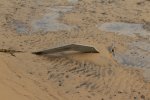
this is an Excel set in the same seabed, at a different time. Same scope, same methodology.

1673662052655.jpeg


Now if you increase the tension (underwater) in the same direction as the set direction then both anchors, Fortress, will simply set more deeply and you will never, ever, achieve maximin tension/hold of the anchors for the yacht for which these anchors are specified.

Now when you come to lift these anchors the FX16 is actually more difficult to retrieve than the FX23 - because the shank of the FX23 is longer and you have more leverage - noting they are set to equal hold - so the lever arm is working agains or for the same hold.

if there is a change of tide and the chain is pulled along the seabed then the chain might get under the stock, of the more shallow set anchor. In the case of the Excel the chain might get under the uplift wing at the heel - and if the anchor had been bigger - this would been a real danger (for both the big Fortress anda bigger Excel.)

If the wind, or yacht, is veering through 15 degrees either side of the tension direction, with no or only minimal increase in tension both Fortress anchors will be reliable - as the shank/crown hinge allows for a variation of 30 degrees (the advantgae of a loose hinge)

the Excel is different - it it had been set more deeply the shank would have been more buried, or completely buried and then it would act like a vertical fluke resisting maybe is only a small,way - but resisting a lateral tension. The bigger less deeply buried Excel would be more prone to capsizing than a more deeply set anchor - again longer lever arm, same hold but in the Excel case the buried shank offers resistance to hold in lateral directions.

I have specially chosen an Excel, so not to show favour - but I have similar pictures of other anchors for which the same description would be applicable. I don’t have slightly smaller Excel to show the same comparison as I have tried to achieve with the Fortress.

there is another facet worth noting. The fluke angle of thenFortress, both of them is 30 degrees. The shank is lying on the seabed horizontally and as the flukes are set at 30 degrees to the shank then the flukes have buried at 30 degrees. If you make a crude analysis of the Excel and make a guess where the fluke ‘angle’ might be (difficult it’s a complex fluke unlike the flat p=late of the Fortress - then the Excel is also at 30 degrees. I have tried to simulate the attitude of the anchor in the seabed using a white batten to indicate the horizontal.

Unsurprisingly all anchors follow this rough similarity - the fluke addresses the seabed at 30 degrees.

If, basically, you set any anchor they all set and bury with the same orientation - that 30 degrees. I only know 2 exceptions - Gortress allow alteration to 45 degrees in mud and there is another anchor, poorly designed, that sets at 16mdegrees.

1673664019695.jpeg

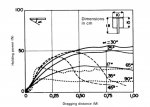
So if you are choosing an anchor - check the fluke angle, as I have done - there are plenty of images of anchors under water and think of this graph

1673664422859.jpeg

Dan forth and Ogg knew this it’s the same angle for a CQR, for a Rocna, for a Bugel, for a Spade. You can see the reduction in hold if the fluke angle is 17 degrees and why 30 degrees has been chosen as the optimum. This graph was I copied from a book, the US Ana y have research papers showing the same conclusion.

note that a big, beefy, rode will modify the setting angle - as it will resist penetration. In really Hard seabeds you need a lower enable - it’s not set in concrete :)

Don’t be blinded by the hype. Do your homework. And wonder why you read all this here and it was jnot discussed earlier……

Jonathan
 
All anchors set the same way, big or small

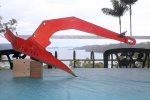
i’ve mocked this one up but you deploy your anchor and strats off a bit like this, lying on its side.

1673666112128.jpeg

So at the outset your anchor is asymmetrical to the seabed, it is canted over. As you apply tension the toe engages and the toe and shackle bury, roughly together (pulling the shackle and chain with them. As the anchor dives the list slowly disappears.

Here the anchor is nearly symmetrical, with only a slight list.


1673666409079.jpeg

the anchor may not become fully symmetrical but it does not matter for a small anchor as it is easy bury completely. Larger anchors if not deepset can, or will, show as symmetrical tendencies and result in part of the fluke, the heel, protruding.

a tidal or wind change can allow the chain to get under the heel and trip the anchor
Most anchors have some form of protuberance, like the stock of a Fortress or the stabilisers of the Excel, some of the protrude ranges are ‘worse’ than others.

this Bugel type is quite ‘smooth’

1673667133153.jpeg

This inverted Spade fluke has stabilisers, like, Rocna and Excel etc, and the Mantus has a ‘sort of’ stock (a bit like a Fortress) and supporting the roll bar but a the extra impediment of the nut and bolt.

1673668188004.jpeg

You cannot set your anchor deep enough, because it’s too big - enjoy a wind or tide change - opportunity to trip.

Now tell me again the reason for the bigger anchor,

it has a higher potential hold, that you cannot access (bacause your yacht is too small.

It costs more

If not deeply set is has a risk of being tripped by its own rode.

In yawing conditions the shank is not fully buried and you lose the advantage of the vertical fluke

the longer lever arm of the shank will make self tripping, slightly, more likely.

if you dive on your anchor when all the chain is off the seabed, so, say, above 20 knots and touch the anchor, any part, gently -y our will find it twitches. The constant movement of the yacht and chain is transmitted to the anchor and it moves, pereceptibly. If your anchor is small and we’ll buried - touch the anchor with a screw driver - you will feel the twitching. A moving mass, a twitching mass (lets call it an anchor) in the seabed will reduce the shear strength of the seabed in which the mass, sorry - anchor is buried. A shallow set anchor with a long lever arm (longer than recommended) will trip more easily and have a greater propensity to reduce the shear strength of the seabed in which it is embedded. Hold is a function of the shear strength of the seabed in which your anchor is embedded. Now this is also true of a smaller anchor - except shorter shank, deeper burial And if you use a snubber/bridle the twitching is reduced.

you are following other people without any reason

One of the proponents of the bigger anchor never mentioned that his anchor had a fluke seabed angle of 16 degrees, contrary to every other anchor currently available. This results in his anchor having a hold half that of other similarly weighed modern anchors. You have to wonder about a guru who omits to mention a key characteristic - the unique characteristic But you blindly follow.

Lambs to the slaughter.

but hey Ho - don’t feel bad - you are contributing to a pension fund, for an anchor maker. Altruism is alive and kicking.

Jonathan
 
Last edited:
Norman - I have to wonder - why are you here, why do you waste time reading these threads. Your experience is very restricted if it is only based on what you have and do. Your experience is of value but how do you compare what you do with anything else - unless you have shed full of anchors you can only comment on what you use - and with no disrespect - you have no idea what you might be missing.

a CQR, Bruce, Delta are all adequate anchors but there is simply too much evidence (that you ignore as you have not used them personally) to confirm that there are better anchors.

if you want to step outside your comfort zone how would you choose other equipment?

Jonathan
Sorry, but I take it as a sign of a shaky argument when someone derides the person who doesn't agree with him. You say, "Why are you here?".
You say, concerning other anchors, without any proof or knowledge, that I have never used them.
You have a particular type of lightweight boat, where any extra weight aboard is anathema, so in your own particular and limited circumstances, a smaller and lighter anchor and rode is of benefit to you. You have explained all this ad nauseam, writing screeds and screeds. Well done, but you must be aware that your boat is at an extreme end of the spectrum. You have also said that you don't normally anchor in more than 30 knots of wind.
Can you not accept that for the vast majority of boats, a wee bit of extra weight, is neither here nor there, and if it gives some extra reassurance, when anchored in a blow, surely well worthwhile.
 
You are quite correct. I haven't read the articles that you instanced. I much prefer going by my own practical experience, rather than relying on the opinions of others.

I’m happy that you have clarifiedyour answer.

Actually Norman I think you will find that most people owning yachts actually own fairly light and weight sensitive yachts built by Benny, Jenny and Bav. There are some who have others but the most common yachts are from the major yards - because there are a decent number released, every year, there are a decent choice in the second hand market and they are of a decent quality. we are not the exception, except we have 2 hulls, believe it or not other people here also with 2 hulls and some with 3.

I’m interested - how did you find using a Spads, Excel, Kobra, Epsilon, Supreme, SARCA. BJe as brief as you like. I for one would value your comment. And as you are apparently defending your answer, above - how did you find sailing a Benny, Jenny and Bav and did you notice when you altered the weight distribution and actual amount of weight -your practical experience would be of value to owners here.

Jonathan
 
Norman

And on anchoring why would we choose to normaly anchor in a location with winds over 30 knots. it’s not a competition. After a 100nm passage we like to relax and we choose anchorages with security and as little wind as possible - that is our normal choice. it would perverse to choose anchorages subject a 30 knot wind. That does not mean we do not experience 30 knot + winds - but we are prepared - and sit them out - but it’s not our choice. Our choice is a steady 10 knot breeze - but as with a lottery ticket what one hopes for and what one gets are different.

Your are strange individual if you choose anchorages subject to 30 knots. we are all different. Remind me what we are the Outer Isles to check your location and we will anchor somehiwere else - though I’d miss the thrust and parry - a good laugh and a conVivial malt.[
 
I choose my anchorages very carefully, taking all sorts of things into consideration. Unfortunately, I have no control over the weather. ?️?️⚡?❄️?️
 
Top