Anchor shackles

I’ve always wondered what the long term (a few days of rough weather) effect a lifting rode (ie one that comes off the sea bed right to the anchor shackle) has on the screw pin shackle at the anchor. Depending on which way round you install the shackle, there will be a tendency for the (small) rotating effect of friction as the shackle lifts and drop to either tighten or slacken the pin. I suppose if it was a significant concern, yachts would lose their anchors more frequently.
Bolt types are certainly much easier to install in my experience. The means of securing the nut is the down side. But at least the pin is allowed to rotate and the load on the nut relatively small but there may be a (smaller) tendency for it to be unscrewed by long term use. IIRC they are slightly stronger and better at dealing with asymmetric loading (which could well happen at an anchor).
I think I would prefer to leave the split pin hole in place and find a user friendly means of securing the nut that doesn’t catch on anything (I think it might be as simple as galvanised nail or fence wire bent into a circular shape - not very yachty but I’m more agricultural in my solutions!). But the over riding factor is the clearance at the bow roller and how comfortable skippers feel about how small 3/4 and 1te shackles are - they simply don’t look big enough so the natural tendency is to unnecessarily up size.

Having said all this, most boats seem to do very nicely with a screw pin D shackle, moused or otherwise.
 
Some 316 bow shackles have an Alan key securement - but I tested 316 shackles and they are prone to deformation, which means the shackle pin would lock, irretrievably. You would need to cut the shackle off - not easy at 2am in the rain.

The shackles bent easily but took some time to subsequently break, they simply yield.

For this reason I would not use a 316 stainless shackle to secure an anchor, convenient with the lack of obstruction - but I'd opt for safety not conveninece

Each to their own.


I do recall that a French chain maker made an Alan keyed galvanised shackle - but could not find it with a google search. I thought marketed by Jimmy Green, but that also drew a blank.

I was interested in a specification of these Alan keyed shackles, galvanised. If anyone can post a link, or uses same, I'd be grateful, for the link, and any comment on usage.

The advantage of Crosby, Peerless, Yoke, Campbell., G80, Grade B, bow shackles - they are almost indestructible, inconvenient to source and may foul your bow roller. They tend not to be cheap :(. I'd vote for safety and live with the inconvenience.

Each to their own.

I will source some nut shackles and see what modifications might be possible to make them more convenient to use. One obvious idea is to assemble the shackle and then drill through the securement nut and shaft - and use the split pin in the new hole (and cut the excess shank off).


Noelex posted earlier a modification that he finds works for the inconvenience of a shackle fouling the bow roller. An alternative to Noelex' suggestion is to cut the. ear off, completely (but leaving the shoulder - or the shackle pin will simply pull through) and cut a slot for a big, flat screw driver. Secure with blue Loctite.

Anchor shackles, or bow shackles (the same tihing) are the recommended design, NOT "D" shackles. D shackles will simply increase the length of the shank increasing any lever effect. Bow shackles have opportunity to slide round in the slot of the anchor shank.

I know that CQRs used D shackle - they were designed that way, not so our current choice of modern design of anchor.

Jonathan
 
Last edited:
.
I do recall that a French chain maker made an Alan keyed galvanised shackle - but could not find it with a google search. I thought marketed by Jimmy Green, but that also drew a blank.

I was interested in a specification of these Alan keyed shackles, galvanised. If anyone can post a link, or uses same, I'd be grateful, for the link, and any comment on usage.

1000000502.jpg

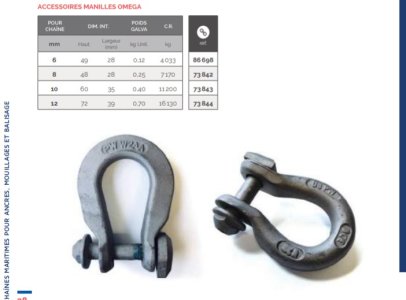
This is the only specific G70 shackle made in France, by Chaineries Limousines (Pewag group), they made it to suit g70 chain. One sometimes sees them on boats, maybe 1 in 100. From French internet forum, people use them with particularly narrow bow rollers, no complaints though there is a specific anchor model where it does not fit properly (can't remember which)

Random first seller from google with some more images
Manille Oméga Force7 HR Grade 70 - Ø10 - rupture 11 200kg

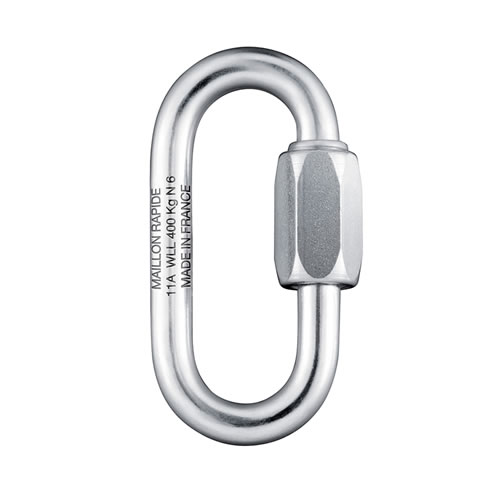
Another type is the "maillon rapide", in France more common than the above from CL
maillon-rapide-normal-zoom.jpg


Maillon rapide Normal - Peguet
 
I’ve always wondered what the long term (a few days of rough weather) effect a lifting rode (ie one that comes off the sea bed right to the anchor shackle) has on the screw pin shackle at the anchor. Depending on which way round you install the shackle, there will be a tendency for the (small) rotating effect of friction as the shackle lifts and drop to either tighten or slacken the pin. I suppose if it was a significant concern, yachts would lose their anchors more frequently.
Bolt types are certainly much easier to install in my experience. The means of securing the nut is the down side. But at least the pin is allowed to rotate and the load on the nut relatively small but there may be a (smaller) tendency for it to be unscrewed by long term use. IIRC they are slightly stronger and better at dealing with asymmetric loading (which could well happen at an anchor).
I think I would prefer to leave the split pin hole in place and find a user friendly means of securing the nut that doesn’t catch on anything (I think it might be as simple as galvanised nail or fence wire bent into a circular shape - not very yachty but I’m more agricultural in my solutions!). But the over riding factor is the clearance at the bow roller and how comfortable skippers feel about how small 3/4 and 1te shackles are - they simply don’t look big enough so the natural tendency is to unnecessarily up size.

Having said all this, most boats seem to do very nicely with a screw pin D shackle, moused or otherwise.
 
The 4 part shackle is just a faff on an anchor, dicking about with pins, nuts and split pins. A simple screw pin with mousing or the flush countersunk socket cap head screw secured with a lock tight glue is fine. The bits of a 4 part are just stuff to snag and foul.
 
As for chaineries limousines, a few (15?) years ago there have been several cases of chain of unknown origin bought through regular chandlers whose links split open (seems a bad weld?), people venturing a little beyond the horizon got in touch with CL and asked for tested chain, **really** bench tested to I can't remember what % of breaking strain. CL jumped in and filled the void, meanwhile developing other components like the above shackles, again, a specific demand from customers. There are of course additionaI costs, but there seens to be some demand.
View attachment 206618

Most chain, or all chain, is tested "Proof Tested" to 2 times WLL. WLL is commonly derived from a 5:1 safety factor. Chain batches are checked for UTS by simply cutting off a few links and testing to destruction. Proof Testing is usually conducted as the chain is made, its part of the chain making equipment. Proof testing would show up a poor weld.

Chain failure 20 or 30 years ago was quite common - Forum threads on failed chain were not unusual. Those days are now history, chain failure is like hens teeth. Both Vyv Cox and I tested chain and we both found that chain strength is not an issue (Vyv's test is part of his website., my tests are on Practical Sailor). Most anchor chain is now made in China the quality is perfectly acceptable. But there are thousands of chain makers in China, some cowboy might pick up a bargain - buy your chain from a reputable chandler or 'retailer' (for example windlass makes sell chain).

CL had a chain failure about 20. or 30 years ago, It was a poor weld. Amazingly the poor weld was retrieved from the seabed. They, CL, quietly replaced the chain. It was part of a. thread on YBW. Since then CL has been bought by Pewag, one of. the top lifting chain and components manufacturers.

Rode failure is now focussed at the shackle (failure of which might be human, not mousing, poor choice of shackle). I have never heard of a Crosby, Campbell, Yoke, Peerless shackle failure. People who buy branded shackles, the ones I list, are careful and will probably be the people who religiously mouse their shackles (both because the shackles are expensive and because these people are careful). Sadly most people still use unbranded shackles, use stainless shackles, use a mix of different shackles.

I'm involved with owners who want to down size chain. The replacement chain, G100, is certificated by the supplier, Proof Tested by the maufacturer tested in Australia with a 0.5 length of chain from each end of the rode, usually 100m. The chain is then galvanised and tested again, 0.5m metre length from each end. The galvanised coating thickness, which determines life, is defined.

Chain life, or galvanising life, is long, 3-4 years for liveaboards - which for non liveaboards means much longer than their ownership of the yacht.

A big killer of galvanising is soupy mud, the sort of mud that smells. The mud is acidic and attacks both the gal and the steel. Anchoring overnight and your rode will turn black - its superficial. Leave your yacht at anchor for months - you can lose all the gal.

Jonathan
 
Last edited:
Link to Jimmy Green website Chaineries Limousines anchor shackle. The 8mm (similar to 3/8th") device has a UTS of just over 7t.

Force 7 Grade 70 Anchor Chain Shackle Link

They are not cheap, approx Stg70

If I've got it right (I was directed to Tacni's Chinese website ? :) ) the relevant Crosby shackle costs Stg16 (I was brought up under strict Scots presbyterian parsimony - I'd live with the inconvenience of the Crosby/Yoke/Peerless/Campbell shackles. However our bow roller was 120mm wide and I have noted that the bow rollers on production yachts has become more and more narrow.

Each to their own

Jonathan
 
Top