Anchor Tripline

Nessy

Active Member
Joined
13 Feb 2024
Messages
65
Visit site
Dear Skippers!

First of all, sorry for my bad English! I‘m to lazy to use AI and hope discussing with you will help to improve my English a little.

We are retired German motorboaters. During winter the boat, Beneteau Antares 9.80, is lying in Barneville-Carteret/Normandy.
Since 2019 we made several trips to Southern Brittany until La Rochelle, Bilbao Guggenheim.Museum, Isles of Scilly and Southcoast to Isle of Wight, last year Normandy, Seine, Paris.

This year, first we planned to travel to Dublin for a Guinness, but my wife and multifunction crew Regine is afraid of storm, rain, coldness and long distances in rough weather.

Therefore we will go once again to La Rochelle, slow to and slow back, with 6 months time.

Until now with the „new“ boat we never had anchored anywhere.

Due to this we were completly unexpierienced with overnighting at anchor in the rocky region of the Brittany coast.

With our former boat we often spent the weekend at anchor, but on the river Rhine on sandy grounds.

Now I read about using a trip line to rescue the anchor if it hooks in between some stones on the ground.

Therefore I would like to ask you politely for some advice regarding an anchor trip line:

  • recommended length?
  • line diameter?
  • best attachment point on the anchor?
  • should it be a heavy sinking line or a floating line?
  • with a buoy or without?
What are the risks or dangers?

Who has experience with a hooked anchor? Does it happen often?

Many thanks in advance for your help and Happy Easter!

Stefan + Regine

MY Nautic, WYC Wiesbaden Yacht Club

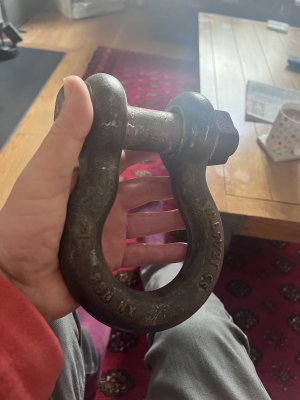
IMG_0525.jpeg
 
Thats a good question.

There will be many answers!

I often use a tripping line with buoy, less because of rocky bottoms, more because of the risk of discarded or active moorings. I adjust the length so it is just more than the water depth at HW by taking a hank of the slack just under the buoy.

I use an 8mm line that sinks. Some use a floating line which makes sense as there is a risk of a sinking line getting tied around the anchor or chain in calm conditions. And I will probably replace with a 10mm line for my 20kg anchor.

The anchor should have a hole or eye at the front to attach a line. I use a bowline
so the regular retying avoids chafe in one place.

I anchor often and am used to setting and recovering the line, taking care to make sure the line and buoy are not tangled in the chain. The buoy and line are left rigged as in the photo, and I normally anchor in about 6-7m HW so the line is rarely adjusted.Screenshot_20260403_154110_Gallery.jpgScreenshot_20260403_154032_Gallery.jpg

I have not yet used the line to recover my anchor from the bottom, but I have been caught on a large discarded rope and an old chain. Both times I could lift the anchor (with the winch) and then use the tripping line to free it.
 
I detest having to rig a tripping line, because of the potential risk of fouling it on rudder or propeller. There are times when I do use one, particularly if I know that there is liable to be old discarded gear on the seabed. I avoid anchoring on rocky ground. On balance, I would favour method "E" in Roberto's post (2), but admit to using "A" for simplicity. Best avoided by anchoring on clean ground, ideally by seeing through the water, and if not, by using a fish finder.
 
I've anchored all over the world, many thousands of times, and I've never needed a tripping line. On a voyage on the west coast of France and the east of Ireland I don't think it's called for. Better is to get confident at anchoring - which is much easier without a tripping line.

It's a simple risk/reward calculation: probability of tangling: perhaps 1 in 2000. Cost of the anchor and rode if you have to abandon it: €1000? So for 50 euro-cents you'll make your life vastly more complicated? Really? Just go and have fun on the way there and back!
 
Dear Skippers!

First of all, sorry for my bad English! I‘m to lazy to use AI and hope discussing with you will help to improve my English a little.

We are retired German motorboaters. During winter the boat, Beneteau Antares 9.80, is lying in Barneville-Carteret/Normandy.
Since 2019 we made several trips to Southern Brittany until La Rochelle, Bilbao Guggenheim.Museum, Isles of Scilly and Southcoast to Isle of Wight, last year Normandy, Seine, Paris.

This year, first we planned to travel to Dublin for a Guinness, but my wife and multifunction crew Regine is afraid of storm, rain, coldness and long distances in rough weather.

Therefore we will go once again to La Rochelle, slow to and slow back, with 6 months time.

Until now with the „new“ boat we never had anchored anywhere.

Due to this we were completly unexpierienced with overnighting at anchor in the rocky region of the Brittany coast.

With our former boat we often spent the weekend at anchor, but on the river Rhine on sandy grounds.

Now I read about using a trip line to rescue the anchor if it hooks in between some stones on the ground.

Therefore I would like to ask you politely for some advice regarding an anchor trip line:

  • recommended length?
  • line diameter?
  • best attachment point on the anchor?
  • should it be a heavy sinking line or a floating line?
  • with a buoy or without?
What are the risks or dangers?

Who has experience with a hooked anchor? Does it happen often?

Many thanks in advance for your help and Happy Easter!

Stefan + Regine

MY Nautic, WYC Wiesbaden Yacht Club

View attachment 208737
In 40 years I have never had the need to use a trip line to retrieve an anchor although in most of those years I had not set one. In the times I have used a trip line there were too many occasions when the trip line caused a problem so I gave up. Never again! If it ever happens in the future I will buoy it and cut it free.
 
We have anchored many many times, but like some others above, very rarely bothered with a trip line.
The “trip line” is often just as likely to cause problems as to give solutions - complicates the anchor lifting, can get tangled around prop or rudder, and very occasionally somebody thinks it is a mooring and tries to lift buoy to moor to it!

Where have used the trip line we use System B in the diagrams posted above. Light non floating rope attached to anchor, up through medium sized shackle on the buoy, and back down where we have tied an unused heavy anchor swivel to the end to act as a weight. We adjust the length of rope to a few metres more than HW depth to avoid the weight hitting the bottom. Seems to work OK, and the weight helps keep the buoy roughly over the anchor and no floating line.

NB Anchor swivel removed as anchor comes up the right way around more often without the swivel.
 
Last edited:
The only time I used a trip line my boat was swinging around and the trip line twisted with the anchor line. Only once in 50 years a trip line would have been handy and that was in Studland when my anchor found a old national trust mooring weight.
 
I was thinking, a bouy that could retrieve its own line internally staying on top of the anchor would be the answer but someone would probably still run over it and pick up my hook. So I don't bother. Im going to use some sort of snap link over rough ground....Cable ties...nylon...
 
Top