Advice on size

Whilst Jeanneau make some nice boats, and you can get a lot of LOA for not much money on the older boats …… there are countless other brands of boats which could also be considered to get a better fit to needs if necessary. Limiting to one brand is, well, limiting!
We focus on Jeanneau because they're the ones we've found that we like. It's not brand loyalty, just that for us they make better boats than the competition.
 
Re the maintenance costs, Some specifics to think about vs theories:

Engine - they both take oil, impellers, filters etc, probably not much difference between them, so not much of a consideration, but fuel consumption may be highly relevant if the HP of the engine is significantly different. Do they both have the same shaft diameter? Relevant to prop replacements etc.

Rigging, are they both the same size of standing rigging, or is the '49 a step up in diameter? Or rod vs 7x19 etc. Are they both double spreader / triple? I have seen rigger prices based on the number of spreaders (for tuning and adjustments etc)

Running rigging - both the same diameter or a step up? Obviously, bigger boat probably means more string, but is the cost per string the next price point because its 14mm not 12mm?

Both of the above, if they are the same diameters etc, its a toss up, if they are a step up - that's the next bracket in costs of replacement terms.

Marinas - others have commented.

Moorings - in addition to the 12m limit, they often have a weight limit - 10t or 12t. Are one or both under/over that common cut off?

Sail plan - what's the difference in area? Most sail valet costs I've found are weight based - more sail = more cost.

Boat lift - typically weight limited, but can be length limited. longer boat might restrict where you can get a lift out.


"too much boat if I buy the 49" - reefing - manual , single line , furling main etc? Power winches? bow thruster? Hard to compare, a push button 49 might be easier to short hand than a manual 40.

my 2p (but what a situation to be making a decision on!)

M
Very good comments. Worth more than 2p in my opinion.

17 years ago I was in the market for a new to me yacht after some decades sailing on my father 38' Pearson in America.

I had been chartering 45' boats in the Aegean and Adriatic and thought that would be a good size for me, maybe just a bit larger. I tried to buy a 49'-er which however failed the survey.

I ended up with a Moody 54 which I thought was too big, but was such a great boat in so many ways that I held my nose and decided I would live with that somehow.

I very quickly forgot that I ever thought she was too big, and now 17 years later I still have her. If I were in the market to buy a different boat, in fact, I would go a little bigger still -- maybe 60'.

What concerns costs, the above is a very good analysis. Systems and their maintenance, repair and replacement will be very similar regardless of the size of the boat.

Biggest difference is the cost of SAILS. This cost goes up way out of proportion to size, in fact even out of proportion to sail area, because the cloth has to be heavier, the longer the spans in the sail. If you've ever talked to the crew of a professionally crewed superyacht you will probably know that the owners forbid the crew from using the sails when the owners are not on board -- because the cost per mile far exceeds the cost of motoring.

Fuel cost will go up as a linear function of displacement.

Berthing is usually by the metre, but some Euro countries charge by area (length x beam).

A boat as big as 49' will be too big for many moorings, but will be accommodated in 95% of all marinas.

Other advantages to a little more size -- carry a larger anchor and heavier chain, anchor in deeper water. Better motion. Faster passage times (waterline length). Less sensitive to loading. More storage space. More tankage.
 
Totally agree with @Dockhead .

I set out to find a Nicholson 43; all the boats in my price range were “very tired” but a plain and simple but basically good 55 was not.

Running her on a tight budget forces a ruthless approach to buying the boat the sort of “little presents” that make a mess of the calculations. I am forced to Keep It Simple.

“ Watermaker”? “What for? - We carry a ton!”

Sails are a ghastly expense, but she is never too big at sea.
 
No one in the middle of the North Sea in November ever thought to himself -- I wish I had a smaller boat.
Not sure that the OP (like all sensible people) will ever find himself in the middle of the North Sea in November.

If he wanted a boat for that he would have asked the question directly, but he did not.
 
Not sure that the OP (like all sensible people) will ever find himself in the middle of the North Sea in November.

If he wanted a boat for that he would have asked the question directly, but he did not.
He did start this thread by saying he planned to do some 'extended sailing'. I think that implies a good chance of getting caught out in slightly nasty weather.
 
He did start this thread by saying he planned to do some 'extended sailing'. I think that implies a good chance of getting caught out in slightly nasty weather.
Plenty of people manage just fine in a 42' which was the smaller boat of the two he was considering.. He war going up from a Moody 37 which is a well regarded boat for offshore sailing (as are the 2 Jeanneaus)
 
We focus on Jeanneau because they're the ones we've found that we like. It's not brand loyalty, just that for us they make better boats than the competition.
Jeanneaus up to the early 2000's were the only inexpensive mass produced boat which was still being stick-built. Those were very nice and a lot of boat from the money. Good sailing, too. Besides being stick-built, these boats did not have the aggressive value-engineering of the rigs and deck gear which you see on later boats. I believe that reflects the values of Groupe Beneteau which acquired Jeanneau in the late 90's. It took Beneteau a few years to redesign the Jeanneaus.

Sadly the early 2000's is already a long time ago, in this 2026 year so these boats are pretty old by now.

The biggest issue with modern mass produced boats, not stick built, is the hull liners. Besides the aggressive value engineering.
 
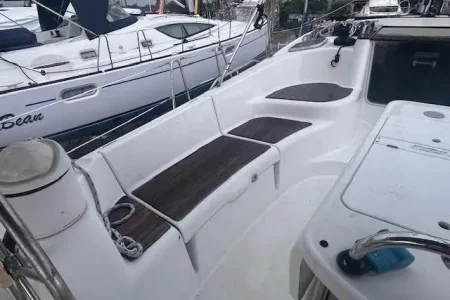
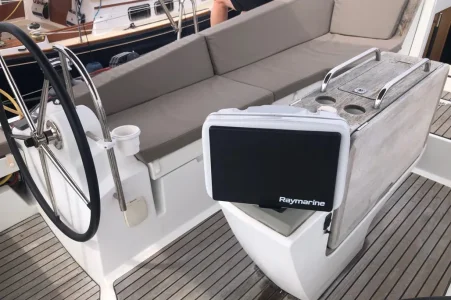
We had the 41/42DS in the frame when we were looking but the thing that put us off the older 42DS was the step in the cockpit seating that made it awkward to lay out flat whilst underway.

The later 41DS had a flat area. Daft I know, but it was important to us. We ended up buying a virtually unused Benny O38 with a linear galley and an original owner who was VAT rated 0% so he added every single option from the list except a generator and airconditioning!

The Ancasta rep who had the 41DS we were interested was so arrogant and cocky on the phone and by email, we cancelled our viewing and swore never to do business with them. If only the owner knew.

The 42DS and 41DS ..

2007-jeanneau-sun-odyssey-42-ds-sail-10114634-20260319084408693-2.webp

2017-jeanneau-sun-odyssey-41-ds-sail-10136433-20260402141048131-4.webp
 
Jeanneaus up to the early 2000's were the only inexpensive mass produced boat which was still being stick-built. Those were very nice and a lot of boat from the money. Good sailing, too. Besides being stick-built, these boats did not have the aggressive value-engineering of the rigs and deck gear which you see on later boats. I believe that reflects the values of Groupe Beneteau which acquired Jeanneau in the late 90's. It took Beneteau a few years to redesign the Jeanneaus.

Sadly the early 2000's is already a long time ago, in this 2026 year so these boats are pretty old by now.

The biggest issue with modern mass produced boats, not stick built, is the hull liners. Besides the aggressive value engineering.
What do.you mean by stick built?
Built with sticks?
Stick it together with glue?

Was stick built a good thing or not in your opinion?
 
Top