Advice for a Merlin Rocket underside repair. (Complete amateur)

Joined
16 Feb 2025
Messages
4
Visit site
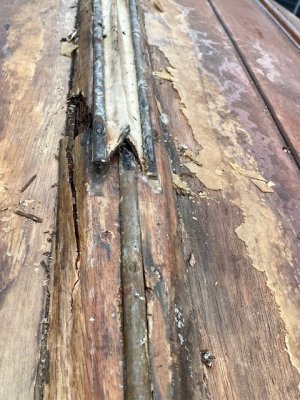
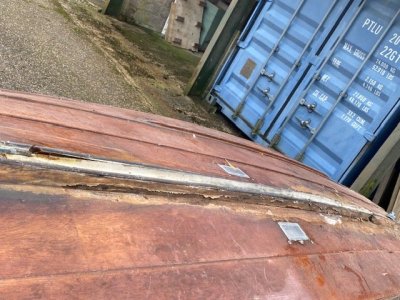
Complete newbie here who has inherited a 1965 Merlin Rocket boat. The boat is beautiful - or no doubt will be once fully varnished up. It looks in pretty good shape from the inside - but there is rot on the wooden strip along the bottom. It needs to be replaced. I've attached a pic. I wanted to understand a bunch of probably very basic things and am hoping some of you experts can start me along the right path!

1) Is this is a part that can be easily replaced?
2) Is it a critical part of the boat or does it just form protection?
3) Does it need to be replaced with wood or are there other easier options?
4) the bit after the dagger board is still very firm and structurally sound. Would I be able to add a replacement wooden strip up until that point ans epoxy it together or is that just someone who knows nothing looking at too many YouTube clips trying to find an answer?!

While I would love to fully and faithfully restore it I don't have woodworking skills so am looking for options that I may be able to take on to fix this. Any thought or suggestions would be very gratefully accepted!

Thanks so much for any help,

Chris
 

Attachments

  • IMG_1125.jpg
    IMG_1125.jpg
    153.4 KB · Views: 53
  • IMG_1117.jpg
    IMG_1117.jpg
    93.8 KB · Views: 53
  • IMG_1114.jpg
    IMG_1114.jpg
    105.3 KB · Views: 54
Complete newbie here who has inherited a 1965 Merlin Rocket boat. The boat is beautiful - or no doubt will be once fully varnished up. It looks in pretty good shape from the inside - but there is rot on the wooden strip along the bottom. It needs to be replaced. I've attached a pic. I wanted to understand a bunch of probably very basic things and am hoping some of you experts can start me along the right
Thanks so much for any help,

Chris
You might get good advice here, there are lots of ex dinghy sailors.

You would also obtain more info from a Facebook group Classic and Vintage Dinghy Racing Assoc (CVRDA). Also the Merlin Rocket Revival Fleet on Facebook. And the Merlin Rocket Owners Assoc,

That’s quite a task you have there, but it’s possible.

What name and number is the boat?
 
You don’t say your location but there was once active Merlin Rocket sailing /racing on Thames at Surbiton located club(they have Thames raters as well) so if you are near London such a club might be source of advice plus even maybe someone who has made repairs mentioned. It’s also a very friendly club(I’m not a member) so worth a visit if feasible.
 
Merlin Rocket website says 1685 - Too Scared - Phil Tyler - Name is a continuation of a theme - says Phil had previously owned 162 - 'Scare' - so some history - is this a relative so has been in family a long time? Do you have any trophies?

If the rest of the boat is OK and you have all the 'bits' - centreboard, rudder, mast, boom, sails, fittings and they are OK - there is just a labour of love to get it sailing again and sail in a vintage Merlin Rocket Regatta - there are probably not many of that age left but there are plenty of events to enter.

If there is not too much rotten wood - poke planks gently with a bradawl and see if still firm and plank joints/fixings still good - particularly around the centreboard case, Is the deck and interior / centreboard case still good? Is the 1960's glue still good?- Tap gently all over with knuckle to see if it still feels hard. Is it still strong enough to take the rough and tumble including the launching trolley and standing in it? From photos of others the rotten piece does appear to be structural and you stand directly on the hull planking - no framing or floorboards -so it needs general hull strength - Ideally need someone with knowledge to give it a good look over and give advice,

If you decide to restore for sailing, the boat should be braced/restrained to hold/restore shape - set high enough that you can get inside and out for fixings - then the rotten piece(s) of wood cut out well beyond visible rot and new pieces of similar hardwood timber, cut to shape, scarfed and bonded and fixed in place, possibly together with strengthening pieces - Shouldn't be too onerous - an interesting project .

There are veteran dinghy groups all over the country - try the Merlin Rocket Class and Classic and Veteran Dinghy Racing Association for their 2025 programme and Classic Boat Magazine. Log something on their forums.. Go to a classics meet with some photos. There might be someone close to you who can help,- where are you roughly?
 
Last edited:
Merlin Rocket website says 1685 - Too Scared - Phil Tyler - Name is a continuation of a theme - says Phil had previously owned 162 - 'Scare' - so some history - is this a relative so has been in family a long time? Do you have any trophies?

If the rest of the boat is OK and you have all the 'bits' - centreboard, rudder, mast, boom, sails, fittings and they are OK - there is just a labour of love to get it sailing again and sail in a vintage Merlin Rocket Regatta - there are probably not many of that age left but there are plenty of events to enter.

If there is not too much rotten wood - poke planks gently with a bradawl and see if still firm and plank joints/fixings still good - particularly around the centreboard case, Is the deck and interior / centreboard case still good? Is the 1960's glue still good?- Tap gently all over with knuckle to see if it still feels hard. Is it still strong enough to take the rough and tumble including the launching trolley and standing in it? From photos of others the rotten piece does appear to be structural and you stand directly on the hull planking - no framing or floorboards -so it needs general hull strength - Ideally need someone with knowledge to give it a good look over and give advice,

If you decide to restore for sailing, the boat should be braced/restrained to hold/restore shape - set high enough that you can get inside and out for fixings - then the rotten piece(s) of wood cut out well beyond visible rot and new pieces of similar hardwood timber, cut to shape, scarfed and bonded and fixed in place, possibly together with strengthening pieces - Shouldn't be too onerous - an interesting project .

There are veteran dinghy groups all over the country - try the Merlin Rocket Class and Classic and Veteran Dinghy Racing Association for their 2025 programme and Classic Boat Magazine. Log something on their forums.. Go to a classics meet with some photos. There might be someone close to you who can help,- where are you roughly?
Thanks for the advice here. The boat wasn't from a family member and I don't know any of the history unfortunately. I will do some digging and try to find out for sure.
The interior looks pretty good and Ive risked walking up and down - no sense I'm going through it which is a start! If I can source a piece of correct sized and shaped timber I'm very happy to give this a good go. I'm down in Lyme Regis next week so I may pop into the boat building academy there and ask if they have any suggestions for this too.
As with everyone else who is kindly offering ideas - thanks for yours here!
 
Looking at the photos it is obvious that the keel itself is rotten. This renders the boat uneconomic to repair. Difficult but not impossible.
But it looks like a glued clinker boat, What is the rest of the planking like? If its delaminating all over the place it isnt practical to repair.
Epoxy is just a sticking plaster.
You really need to get a good boatbuilder to cast his eye over it.
 
I agree with Keith 66 if its the keel its a major job, and requires a fair bit of woodworking skill to make a good repair. You need a good boat builder to assess just how bad it is. It will be a labour of life, as it is certainly beyond economic repair. But they are beautiful boats both in appearance and handling, and if you have the time and can learn the skills you will end up with a cracker of a boat!

An elderly boat builder once said that the biggest mistake people make tackling a job like that is not cutting the timber back far enough. You need to to be at least 150mms back from where you think it is sound.
 
Following from Post #6 - From the photos it shouldn't really be that difficult to remove part of the keel and repair - scarfing and bonding in a new piece - (this is PBO) - if the OP wants to have a go, and he must otherwise he wouldn't have contacted the forum - why not.

Learn as much as he can, consider advice, including for fixings and glues/resins,

Check for delamination of planks - for leaks at plank joints, put a couple of bucketfuls of water in it - sluice it around a bit - see if there are any leaks which will need resin - or blow with hair drier and see if you feel hot air coming through - or a torch in the dark.

If the rest of the boat is reasonably OK - not delaminating too much - or even if it needs some repairs -if it has sentimental value, or just nice to keep - useful to have someone knowledgeable to check it over' - Then dry it out and repair.
.
Probably also double the keel sideways for the length of the centreboard case plus a bit more for strength- and scarf in some areas of rotted planking - maybe a wooden strip along the inside at the keel to take fixings if none there and maybe a knee between keel and transom if none there to stiffen, and restrain the 'spring' of the new keel timber - maybe fit some floor boarding to distribute foot loading


- Better than destroying it now - give it another life even if only for a few years. Someone has saved it for 60 years and passed it to you and the original owner had one of the very early Merlin Rockets so it has some history. A professional boat builder to do the work would probably be uneconomic, but it is worth asking.

Are there some photos of the inside?

They are quite nice boats, hence still sailed in vintage events and some fully restored ones hold a very high price. Sail first on a pond or sheltered river with a rescue boat nearby until confident - and if something breaks or falls apart - just need to make it a bit stronger - which is how it used to be before computer design.

I did some repairs to planking on a Walker 10 when I was 12 - and as far as I am aware it is still sailing 50 years later - saw it not so long ago. There are ordinary people in the yard I frequent that do quite major repairs on old wooden boats, so it is possible,
 
Last edited:
Hi, just to reinforce the last post. Although the job may look a bit daunting you will be surprised what you can do. Looking at the photos you want to get the hull under cover to dry everything out. Remove the brass keel band then remove as much of the rotten timber keel as you can. It looks like it may have delaminated all the way back to the stern and it will be much easier to remove and replace this whole section. If you measure the cross section you should be able to find a timber merchant who can supply the timber machined to size and should be able to plane/route a chamfer. If not it is fairly straightforward to plane the chamfer with an old stanley plane or buy a cheap router with a 45 degree chamfer bit. A hard wood like sapele would work and is reasonably priced and stable. You would need to scarf(1:8) this to the sound existing timber. Bond with epoxy and screw, ideally with bronze screws. Epoxy can give a very good permanent repair but the surrounding timber must be very very dry, if the wood has a high moisture content you will trap in the water and cause more rot. West Systems have very good advice on their website.

Could be a nice little project and you will learn a lot doing it.

Good luck
 
Just had another look, the chamfer is too wide for a router bit but could be cut with a table saw/bandsaw.

Where abouts are you?
 
Complete newbie here who has inherited a 1965 Merlin Rocket boat. The boat is beautiful - or no doubt will be once fully varnished up. It looks in pretty good shape from the inside - but there is rot on the wooden strip along the bottom. It needs to be replaced. I've attached a pic. I wanted to understand a bunch of probably very basic things and am hoping some of you experts can start me along the right path!

1) Is this is a part that can be easily replaced?
2) Is it a critical part of the boat or does it just form protection?
3) Does it need to be replaced with wood or are there other easier options?
4) the bit after the dagger board is still very firm and structurally sound. Would I be able to add a replacement wooden strip up until that point ans epoxy it together or is that just someone who knows nothing looking at too many YouTube clips trying to find an answer?!

While I would love to fully and faithfully restore it I don't have woodworking skills so am looking for options that I may be able to take on to fix this. Any thought or suggestions would be very gratefully accepted!

Thanks so much for any help,

Chris
Chris, your Merlin Rocket sounds like a fantastic project! The wooden strip along the bottom is likely the keel band or hog, and while it’s replaceable, the approach depends on its structural role. If it’s just for protection, a well-fitted wooden replacement or even a fiberglass/epoxy reinforcement could work. A partial replacement might be possible if the remaining wood is solid, but ensuring a strong bond is key. Since you're new to this, take your time, remove the rot carefully, and test materials before committing. A local boatbuilder could offer great advice if needed—best of luck with the restoration!
 
Hi, just to reinforce the last post. Although the job may look a bit daunting you will be surprised what you can do. Looking at the photos you want to get the hull under cover to dry everything out. Remove the brass keel band then remove as much of the rotten timber keel as you can. It looks like it may have delaminated all the way back to the stern and it will be much easier to remove and replace this whole section. If you measure the cross section you should be able to find a timber merchant who can supply the timber machined to size and should be able to plane/route a chamfer. If not it is fairly straightforward to plane the chamfer with an old stanley plane or buy a cheap router with a 45 degree chamfer bit. A hard wood like sapele would work and is reasonably priced and stable. You would need to scarf(1:8) this to the sound existing timber. Bond with epoxy and screw, ideally with bronze screws. Epoxy can give a very good permanent repair but the surrounding timber must be very very dry, if the wood has a high moisture content you will trap in the water and cause more rot. West Systems have very good advice on their website.

Could be a nice little project and you will learn a lot doing it.

Good luck
That’s excellent advice! Drying the hull thoroughly before any epoxy work is crucial to prevent future rot issues. Replacing the entire delaminated section rather than patching small parts will ensure a stronger, longer-lasting repair. Using sapele and properly scarfing the joint will help maintain structural integrity, and epoxy bonding with bronze screws will add durability. Taking the time to source pre-machined timber or learning to chamfer it yourself will make the process much smoother. It may seem like a big job, but with patience, you’ll gain valuable skills and end up with a well-restored boat. Good luck!
 
Top