240v inverter earth

Very different to a marina supply which is the typical PME setup wit the extra issue as a disconnectable boat supply connection that could do go faulty

The same set also applied to a onboard generator
Booger , Paul is right ,can ask are you familiar with BS 7671 amendment 2,
Regulation 709.411.4
 
Marina earth is usually via a large earth rod or a earth plate in the water , the ESQCR apply to marinas but only on floating pontoons and fixed but not marina buildings , which can be supplied via TNCS SYSTEM commonly called pme .
Shoreside isn't really my field, but it's my understanding the the incoming supply is PME, then the PE is separated for the pontoon supplies, which have Earth rods/plates (as you say), but the Earth and Neutral are bonded again before the connectors for the boats.

Fixed inverters and generators are required to have the PE and neutral bonded.

Roger likes to argue that there is no need for the onboard PE to be grounded to the water or for inverters/generators to have this connection. All major inverter manufacturers and current regs state differently.
 
Last edited:
Booger , Paul is right ,can ask are you familiar with BS 7671 amendment 2,
Regulation 709.411.4

I have put Paul an Ignore as he has insulted me several times and I have no interest in any more of his insults

Paul has an issue with me as I have disagrees with his knowledge and all he knows is the standards and not the basis theory of electrical current flows

The Fact that the BS and ISO standards hac change over the years raised a question. having been involved with the design and manufacture of all types of industrial mechanical and electrical equipment and the design of all types of electrical and electronics equipment

Where I live has a more reirus standards and regulations than you do in the UK.

An example of this is that 40 years ago my home in the UK did not require a RCD where in South Africa all residences must have a RCD and it it does not the house cannot be sold.

Any one who dies domestic or industrial wiring needs a wireman's licence from the department of labour. I can do al the design work but I must get someone with a wiremens to do the installation.

I built my own boat and wired it up myself as I am allowed to. This includes both 12V DC and 240 VAC with inverter, mains generator and shore power that can be selected as required.

I have mains compressor and well as a HP dive cylinder fill compressor, microwave battery charger and mains calorifier and all inspected and approved by the state safety authority.

Paul has a better knowledge of current boat equipment but as an issue with anyone who differs from him

You are free to take advice from who you chose but I don't run any business and have nothing to gain for giving anyone wrong or dangerous advice
 
I would go with the manufacturers requirements.
a: I believe they are correct and given the various compromises, safest.
b: If something goes wrong and someone gets a bad shock and the installation does not comply with the manufacturers guidelines you are liable.
 
Shoreside isn't really my field, but it's my understanding the the incoming supply is PME, then the PE is separated for the pontoon supplies, which have Earth rods/plates (as you say), but the Earth and Neutral are bonded again before the connectors for the boats.

Fixed inverters and generators are required to have the PE and neutral bonded.

Roger like to argue that there is no need for the onboard PE to be grounded to the water or for inverters/generators to have this connection. All major inverter manufacturers and current regs state differently.
No they are not bonded , I am a little puzzled by how after an inverter an RCD can trip as it measures the load balance between L&N ie leakage to earth , but if they are bonded how can this work.
 
No they are not bonded , I am a little puzzled by how after an inverter an RCD can trip as it measures the load balance between L&N ie leakage to earth , but if they are bonded how can this work.
An RCD measures the current in the live and neutral only. If they are different it trips out. The RCD doesn't know where the electrical leakage is, just that there is an alternative circuit. The separate earth wire is there to provide an alternative path back to the power source if the neutral is compromised or the live touches the earthed parts of the machine. Ultimately if you go back far enough all Neutrals are connected to earth at the transformer/substation/pontoon/generator.
 
... that will conduct electricity unlike a plastic bucket or boat
I know what your saying, but real world it just isnt. Wearing rubber welly boots i should be insulated from the ground but electric fence finds a way. Regardless of whether they are new, old, dry or wet, i havent owned a shoe or welly in 30 years that can stop the fencer .

On the boat that grimey film of condensation that coats your hull and makes everything damp to touch will conduct regardless of the material

I dont know much about all this stuff which is why im asking questions but i do have experience of being frequently electrocuted by 8000v & its very very hard to isolate yourself & if its damp conditions you might as well forget it.
 
I would go with the manufacturers requirements.
a: I believe they are correct and given the various compromises, safest.
b: If something goes wrong and someone gets a bad shock and the installation does not comply with the manufacturers guidelines you are liable.
If you have the choice to follow the manufacturers fitting instructions, which agree with every standard there is, or some random bloke on an internet forum, who do you go with ?

B (above) is good enough for me, as an industry professional.
 
An RCD measures the current in the live and neutral only. If they are different it trips out. The RCD doesn't know where the electrical leakage is, just that there is an alternative circuit. The separate earth wire is there to provide an alternative path back to the power source if the neutral is compromised or the live touches the earthed parts of the machine. Ultimately if you go back far enough all Neutrals are connected to earth at the transformer/substation/pontoon/generator.
Not on marinas pontoon.
 
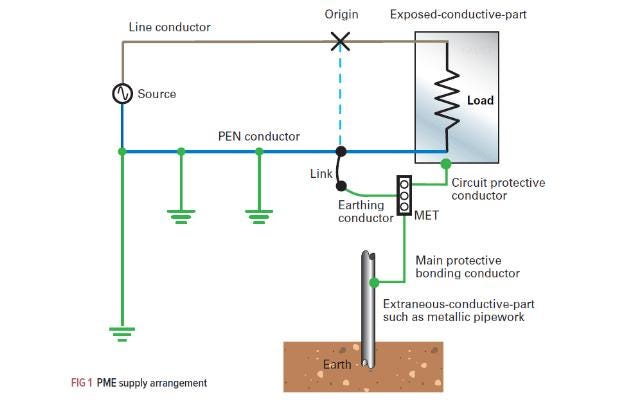
Protective multi earth is normal where you have a protective earth from the neutral out to the powered equipment


0*A92qwtLUwMiY7OED.jpg


In this case the neutral and the earth line becomes the same as the is a duplicate protective as it can be seen that there is a ground point at both the supply Source and at the main protective bonding conductor

On a GRP boat with an inverter on the boat and water earth connector at the source and th load will be at the same point unlike in the above setup and your shed connector where the earthing points are separated connected by the ground that will conduct electricity unlike a plastic bucket or boat
This not for marinas.
 
An RCD measures the current in the live and neutral only. If they are different it trips out. The RCD doesn't know where the electrical leakage is, just that there is an alternative circuit. The separate earth wire is there to provide an alternative path back to the power source if the neutral is compromised or the live touches the earthed parts of the machine. Ultimately if you go back far enough all Neutrals are connected to earth at the transformer/substation/pontoon/generator.
This not for marinas.
Kash if the neutral and the earth are joined on a pontoon then that makes the earth a neutral so if a fault occurred the current would be the same n the live and neutral so no rcd trip . Show me a diagram and I will send you a drink.
 
Some interesting stuff written in this thread, one of the problems is that people asking questions/for help are usually limited with knowledge or confidence and seek assurance.
Well what I read is understandable, but not all accurate, and not really helpful to those of limited knowledge and ability with electric stuff.
I personally would not connect the ground/earth wire to the engine or make any connection with anything that has a DC negative connection for fear of a spike entering the DC circuits. I would buy an anode and connect the ground/earth to it and hang it over the side, fit a dedicated anode next time lifted out. However that is just my way, but connection/bonding to the engine/gearbox giving direct contact with the water is not wrong, it's ok as Paul says.
RCD's are normally 30ma trip also incorporating a time response, so although 30ma will make you stutter a bit, incite foul language and uncontrollable gesticulating, the response time will cut the power so quick you should be ok.
 
Last edited:
What's the difference? Do you mean the type of ground/earth regulations?
Yes the earth to pontoons have to be a completely separate earth , say the earth was connected to the neutral at the pontoon earth and the cable feeding the pontoon the neutral breaks , now the live voltage comes down the live and should return down the neutral , which is not there so it uses the earth which then makes everything metal live , you could die . Hence the separate earth.
 
Quote Seastoke "Kash if the neutral and the earth are joined on a pontoon then that makes the earth a neutral so if a fault occurred the current would be the same n the live and neutral so no rcd trip . Show me a diagram and I will send you a drink."

What is the purpose of an "earth" to ground or a large body of water?

Forget the regulations and specifications, why are they used?
 
Quote Seastoke "Kash if the neutral and the earth are joined on a pontoon then that makes the earth a neutral so if a fault occurred the current would be the same n the live and neutral so no rcd trip . Show me a diagram and I will send you a drink."

What is the purpose of an "earth" to ground or a large body of water?

Forget the regulations and specifications, why are they used?
If fault occurs to earth the rcd will trip as there will be an imbalance of current.
 
Top