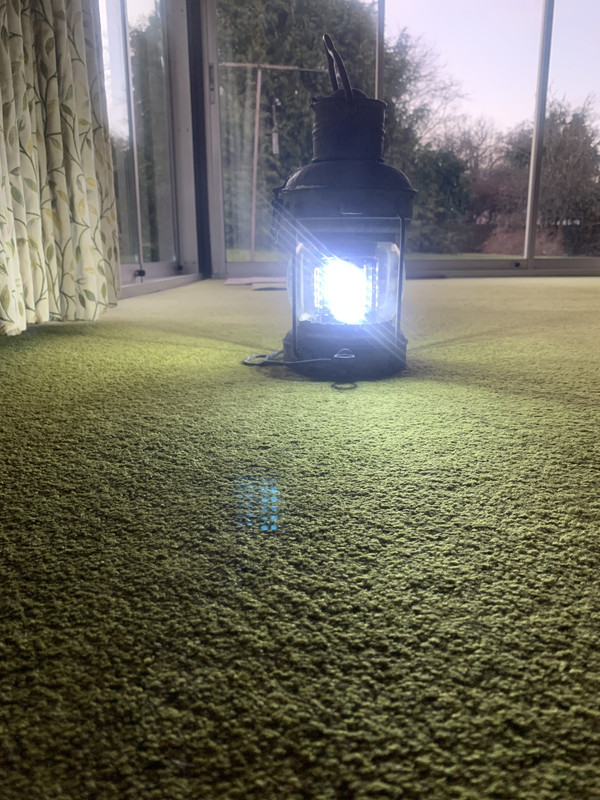
“Where it can best be seen...”

...............
Which is why at night I illuminate the deck to enable other vessels to both spot the anchored vessel and to judge perspective which can be tricky at night. I also illuminate an all-round masthead for belt-and-braces and compliance purposes.

But that's a directional flood light with a reflector. How is that going to be seen from all around?

Poss not clear, but post #36 hopefully resolves IRPCS conflict.
 
"I guess my point is that compliance with the anchor ball rule is unfortunately now so low that one barely bothers looking out for one."

Perhaps in UK waters. If you anchor in German waters without flying the requisite black ball in the fore rigging, and the Wassershutzpolizei come along, they will stop and fine you.

If you don't abide by the regulations, and something goes wrong, then who do you think is going to be at fault?
 
This thread has got me poking around Ebay/Amazon for something to suit lighting the cockpit on a forthcoming warm climes bare boat. If you don't need the traditional lantern look, this one looks really good with reviews to match. It's IP65 and dimmable which is a bonus for Caribbean cocktail swigging ;-)

Lanktoo 2 in 1 Rechargeable Camping Lantern & Power Bank for Hiking Fishing Emergencies - Super Bright, Lightweight, Water Resistant.

We've been down the battery light route and found the light output of many is a bit dim and got fed up with having to charge or swap batteries every few days when we found it had packed up. Why not spend a little more and buy something which meets the brightness regs such as this? https://boatlamps.co.uk/products/dusk-to-dawn-anchor-utility-led-light?variant=21259016775
 
It looks good, but there didn't seem to be any information about the power consumption or how long it would last. Amazon really winds me up sometimes by not giving information I would have thought pretty basic and necessary to decide if something's suitable for my needs.
 
We've been down the battery light route and found the light output of many is a bit dim and got fed up with having to charge or swap batteries every few days when we found it had packed up. Why not spend a little more and buy something which meets the brightness regs such as this? https://boatlamps.co.uk/products/dusk-to-dawn-anchor-utility-led-light?variant=21259016775

We used one for some years, only replaced it when a newer version came out with LED bulb. Also used a brass 'hurricane' lamp hung over cockpit from boom, protected from wind by sprayhood. lit after area of boat and very obvious to anyone arriving from astern as most would if we lay to wind. Nowadays on our mobo have a similar lantern kitted out with adjustable brightness LEDs and hang this in the aft conservatory doubling as cockpit lighting, ideal for pre dinner aperitifs or post dinner coffee and liqueurs.
 
It looks good, but there didn't seem to be any information about the power consumption or how long it would last. Amazon really winds me up sometimes by not giving information I would have thought pretty basic and necessary to decide if something's suitable for my needs.

Good point. Nevertheless in this case if you scroll down the answer appears in first customer review.
 
We've been down the battery light route and found the light output of many is a bit dim and got fed up with having to charge or swap batteries every few days when we found it had packed up. Why not spend a little more and buy something which meets the brightness regs such as this? https://boatlamps.co.uk/products/dusk-to-dawn-anchor-utility-led-light?variant=21259016775

The brightness regs say all round visible from 2nm. The distance to horizon calcs mean it needs to be about a metre (three foot in old money) above sea level to be seen two miles away (and that assumes the viewer is at sea level, if their eyes are say 4 metres above sea, then your light could be bobbing in the sea and still be seen 4 miles away).

Most yachts I've been on have a freeboard of at least a metre so even deck level will suffice (provided no obstructions in a 360 degree arc). From other interweb sources, a light needs to be 4.3 candelas to be visible from 2 miles in average conditions, so around 54 lumens. I wouldn't believe Chinese quoted lumen outputs but 54 is pretty small compared to a lot of these lamps are going to be in the hundreds of lumens so, in my view would meet the regs, especially if strung a couple of metres up forward of the mast.

Interesting post from 11 years ago on this very forum - Masthead anchor light colreg is meaningless foryachts.


Yes! Thanks for the thought, which I had missed.

Thats a seriously bright light !

Just a couple of points. You were clearly on the Norfolk Broads at the time and missed a tack and ran up someone's garden and the tide fell. Don't feel too bad about it. Also,
through long trial and error, most navigation lights work better outside the boat. Nice extension. :)
 
Except his eye level constant, all-around white light is not a violation!

Or or did I miss something about strobes?

Not strobes, which are a pet hate of mine, but "masthead, eye level at foredeck" does not seem to accord with:

(a) A vessel at anchor shall exhibit where it can best be seen;
(i) in the fore part, an all-round white light or one ball
(II) at or near the stern and at a lower level than the light prescribed in sub-paragraph (I), an all around white light
[My bold]
 
Not strobes, which are a pet hate of mine, but "masthead, eye level at foredeck" does not seem to accord with:

(a) A vessel at anchor shall exhibit where it can best be seen;
(i) in the fore part, an all-round white light or one ball
(II) at or near the stern and at a lower level than the light prescribed in sub-paragraph (I), an all around white light
[My bold]

Not much use in quoting that unless you also include part (b).
 
Top