
Yawing at anchor

I think we may be talking about two completely different phenomenon: Yawing caused by windage/lateral plain imbalance, like the fluttering of a flag. And yawing caused by abrupt changes in wind direction, typically when anchored near headlands. Very different.

I maintain that true slack in the first case is probably near impossible, or at least very rare. The physics don't suport it. It is also the case I have tested. The second case is open ended, and I would would almost certainly have two anchors down, which will prevent snatching. Since the mid-Atlantic coast has very few areas with headlands subject to abrupt wind changes (only thunderstorms), I have little expereince with this case and was not talking about it.

We really need to define two cases of yawing, and talk about them one at a time, since the causes and solutions are very different. As Neeves, a riding sail helps one but could make the other worse. But a drogue at the bow, for example, should help in both cases.
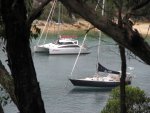
 
We would agree with Thinwater that often anchoring in a 'V' reduces veering. But there is no one size fits all.

Tasmania On route 08 118.jpeg

This is Refuge Cove, Wilsons Promintory on the northern edge of Bass Strait. its a favourite location for a crossing to or from Tasmania waiting for a weather window. We had crossed from Tasmania before a forecast Storm and we and Blaze, a UK vessel half way round a circumnavigation, sheltered here. It looks placid but the williwaws were savage and we were enjoying bullets 180 degrees apart. The wind was actually blowing from the SW roughly directed at our transoms but the bullets were random. We deployed 2 anchors and a stern line to a tree, we have a bridle for this that fits on the sheet winches in the cockpit, Blaze deployed their bower, a CQR, and 2 stern lines. The anchorage is very narrow and there is really not much room. Reliance on anchors would have had us yawing uncontrollably and though we might never have touched - that risk was too high - better to simply immobilise the 2 yachts. Had someone else entered the anchorage there would have been room.

One message is - 'anchoring - think outside the box'

Jonathan
 
I'm glad to hear I'm not alone. Have you any idea why it happens?
I've observed same. It's the same underlying reason as the yawing. An AWB is slippery - by design, it's low-drag and very efficient at sailing..

The boat sails either side of the anchor. The main protection is a snubber but it still happens. Next steps in more serious conditions are riding sails (which can be improvised); offsetting the anchor to one side; two anchors in a V.

When anchored or moored, brisk wind-against-tide, the current is sufficient to turn the transom into the wind. As soon as it's there, the wind is strong enough to sail the boat against the current. The wind "wins" untill the tension comes on the bows and pulls the boat at a slight angle, so the tide catches the keel and rudder sideways. Equilibrium is with the boat sitting somewhere atop the anchor/mooring. The stronger the wind, the more we override the mooring.
I am not sure of a solution to this.
 
Wind vs. current is tough. I vividly remenber one dinner in the salon (360 view in a cat) watching the harbor rotate 15 times in 40 minutes. It was like being in a revolving restaurant. It was a good bottom and the wind and current were both benign, so it was just entertainment. If I have any concerns I set two anchors at about 120 degrees; at that angle, the force does not multiply at any angle and I don't swing over the anchors (fouling--setting them both well also helps). I'm good for any motion or wind direction. I do not favor a tight Bahamian moor, in case the wind comes from the side. This is more of a "loose" Bahamian moor.
 
A yacht will respond to both wind and tide.
Tide: Underwater Area balance will decide. Typical long keeler has underwater "CG" well aft, so strong tendency to align with tide.
Wind: Similar story. Area balance. More windage aft will make her align with the wind. Hence the riding sail, or a "wedgy" at the stern helps.

These two factors will compete, and the winner will be decided by the prevailing circumstances.

Modern underwater shapes do not have much directional stability, and the topside areas can be well forward, so sailing on the mooring is more likely.
 
Rival 41C: Deep forefoot, encapsulated longer fin keel, skeg rudder, deep aft sections from fin to skeg. Hull has a shear from low at stern, dipping slightly at beam and rising more steeply to bow. Single mast, single spreaders, mast stored twin poles on one boat, deck stored on the other boat (bellow a 4" gunwale). I have sailed two versions of this boat: with and without roller furling sails, with decks clear of stuff except spray hoods and liferaft stored on deck, midships. Coach roof extends fairly uniformly from aft of bow to stern with the centre cockpit coamings interrupting the line, but not by much.

Boat shears in steady wind, bow will will blow off, presents more beam to wind, then boat straightens up. Motion is not rapid in any wind strengths, even violent gusts. In strong winds you do see the catenary relaxing as the bow swings back after the rode has arrested the shear. The flare of the bow is definitely the culprit. Great for sailing into big seas, zero slap, but less stable at anchor.

With no sails up, at sea, the boat lies a hull, slightly bow into wind i.e. I assume the hull and rigging aft of the bow is the dominant area that the wind acts on.

Response is the same with or without a genoa furling system fitted. The motion is gentle and it appears that the boat starts to pivot around her centre of lateral resistance before the stern starts to move in line with the bow. A sort of shimmying motion. In the past I have taken the anchor rode and secured it to the stern and the boat then sits dead straight to the wind, unsurprisingly.

Not my boat, same model Rival 41C - Red Ensign
 
My experience is similar to OldBoots and others.

Our old boat was a heavy bilge keeler ketch with considerable top hamper, and now a small long keeler with wheelhouse.

Both boats could run forward over the anchor if wind and tide conflicted as they often did in Bristol Channel for the Bilge Keeler or Scilly for the long keeler. Neither yawed markedly though shifting of chain on the roller made even small changes sound alarming if one was sleeping. Snubber reduced the grinding effect but as placement was from fairlead not bow roller it increased the angle to the wind.

Both boats prefer to lie at about 20 or 30 degrees to the wind, though high bows mean that waves can smack them round a bit. It is sufficiently stable on latest boat that we have had better luck lying ahull while cooking in rough seas rather than trying to do conventional hove too. This stability is probably what keeps yawing minimal at anchor

I have only used twin anchors once in a steady F6 blow as normally the change of tide would just twist it all up every time it changed, and then again next change. Maybe OK for sheltered bays with minimal tides but not the SW Britain
 
Its not just the tide but the tidal difference. Down the west coast of Tasmania the tide is an unreal 30cm. In Bass Strait the tide is around 3.0m so twice a day a huge volume water rushes into and out of Bass Strait and 'tidal flows' of 8 knots are not unusual. getting the tides right is critical and commonly people would anchor waiting for both a tide and weather window - and that can be fun. In Sydney tides a re typically 2m and have little impact on 'sailing' (unless you are in shallow water and or want to dry out) further north tidal range can be 12m.

Jonathan
 
Very occasionally, my boat lies at anchor the wrong way round, so the chain goes over the bow roller and heads back under the boat to the anchor somewhere astern. She's perfectly stable and comfortable like that, but I have never been able to work out what combination of wind and tide does it. It seems odd whatever force is strong enough to move her in one direction isn't strong enough to swing her round as well.
We have had the same - on 2 different boats - and have had the rode get caught behind the keel and above the "torpedo" shape at the bottom of the keel on two occasions. It is as simple as tide against wind, both times it was in a river. So if I fear this happening now I deploy an angel so that unless very windy the rode drops vertically from the bow and will clear the keel if we do swing round.
 
We have had the same - on 2 different boats - and have had the rode get caught behind the keel and above the "torpedo" shape at the bottom of the keel on two occasions. It is as simple as tide against wind, both times it was in a river. So if I fear this happening now I deploy an angel so that unless very windy the rode drops vertically from the bow and will clear the keel if we do swing round.
Having now a long keeler it is not really an issue but I have had to discard the anchor and chain in that caught situation earlier when I had a bulb keel.

What weight of angel do you use compared to your anchor weight etc?
 
Having now a long keeler it is not really an issue but I have had to discard the anchor and chain in that caught situation earlier when I had a bulb keel.

What weight of angel do you use compared to your anchor weight etc?

I've found about 1/3 does the job. However, leaning around and clipping on a weight is a drag, so I use a looped bunch of chain; this will feed over the roller and won't knock a hole in the topsides if you drop it. Sort of like a soft, flexible kellet.

(Correct me if I am wrong. Angel, Buddy, and Sentinel are brand names. Kellet is generic.)
 
No idea what the angel weight is (sure there must be a joke there about angels on a pin head) but it is just an exercise weight with a handle all encased in nice soft plastic so doesn't damage the hull or break things rolling about on the cockpit locker. For this use - wind against tide- I don't think it needs a lot of weight as the boat is nearly balanced by the opposing forces.
 
Rival 32 - almost exactly the same as Blowing Old Boots. And she faces backwards sometimes too.

A few weeks ago, up the Dart, we had 40kt gusts. For these she would turn 90 degrees to wind and sit there until the gust eased the chain would pull her back to the wind. Forty metres of 8mm chain in 5 m depth. The furled genny is significant and we had a dinghy tethered from transom.

In lighter winds she will wander about 30 degrees off the wind line, each way.
 
Rival 32 - almost exactly the same as Blowing Old Boots. And she faces backwards sometimes too.

A few weeks ago, up the Dart, we had 40kt gusts. For these she would turn 90 degrees to wind and sit there until the gust eased the chain would pull her back to the wind. Forty metres of 8mm chain in 5 m depth. The furled genny is significant and we had a dinghy tethered from transom.

In lighter winds she will wander about 30 degrees off the wind line, each way.
90 degs seems alot.. ?
 
90 degs seems a lot.. ?

Maybe, maybe not.

When you are yawing through 90 degrees in 40 knots you have questions without answers. If the wind was veering through 60 degrees the yawing is not unexpected. But when you are veering through 90 degrees in a river - you don't have too many options that offer any improvement. No mention of how stable was the wind, no mention of use of a snubber - not being critical - you have other priorities than measure wind variation to satisfy the forum's voracious appetite for data :) .

In hind sight, if room, we would have deployed a second anchor, our primary would have had a bridle (2 decent snubbers) and our second rode has 40m of 12mm 3ply - but hindsight is so useful (sitting in my armchair :)).

When I was testing - I had larger yaws than 90 degrees at 35 knots (I can check but from memory 120 degrees), primarily due to an 'unstable' wind - but I was testing - I simply stopped testing, not so easy when you are at anchor miles from 'home' and the wind is so strong a dinghy trip a health risk.

Jonathan
 
Sorry, forgot to mention
Maybe, maybe not.

When you are yawing through 90 degrees in 40 knots you have questions without answers. If the wind was veering through 60 degrees the yawing is not unexpected. But when you are veering through 90 degrees in a river - you don't have too many options that offer any improvement. No mention of how stable was the wind, no mention of use of a snubber - not being critical - you have other priorities than measure wind variation to satisfy the forum's voracious appetite for data :) .

In hind sight, if room, we would have deployed a second anchor, our primary would have had a bridle (2 decent snubbers) and our second rode has 40m of 12mm 3ply - but hindsight is so useful (sitting in my armchair :)).

When I was testing - I had larger yaws than 90 degrees at 35 knots (I can check but from memory 120 degrees), primarily due to an 'unstable' wind - but I was testing - I simply stopped testing, not so easy when you are at anchor miles from 'home' and the wind is so strong a dinghy trip a health risk.

Jonathan
Sorry forgot to mention the tide helping the yaw. We only had a short snubber as no waves to speak of. The main swing was the wind going around or over the substantial wood that almost sheltered us.
 
Sorry, forgot to mention
Sorry forgot to mention the tide helping the yaw. We only had a short snubber as no waves to speak of. The main swing was the wind going around or over the substantial wood that almost sheltered us.
I generally anchor for bad weather with two in tanden.my main anchor is a cqr( im happy with mine )and a danforth at least twice the depth of water from it (makes recovery easy ) have sat out 65kts ..being solo most of the time this method suits me and has not let me down while others have dragged by ..thou i would like to try to riding sail method some time .
 
Sorry, forgot to mention
Sorry forgot to mention the tide helping the yaw. We only had a short snubber as no waves to speak of. The main swing was the wind going around or over the substantial wood that almost sheltered us.

The snubber will reduce the snatch from the gusts.

Trees can offer a false sense of security - they do offer shelter but when the wind gets up it finds gaps in the trees you had not seen, comes round the back - and when its blowing 40 knots and its dark - difficult to find somewhere better.

Jonathan
 
Top