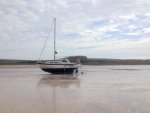
Yacht legs / beaching legs

Yet to use mine in anger, came with the boat which was Bristol based so well used down there. Stuck one out when I dried out to fix the stern gland to make sure she sat right and they are down just now while it's in the cradle as we just had the hurricane hit us so piece of mind!
 
Sorry to hijack the thread slightly...

New to me boat (LM 27) came with a pair of pukka beaching legs from when it lived down South. They are adjustable for length and have padded lower hull supports. Is there any special technique for deploying these? Boat lives on the Clyde estuary and it would be nice to be able to dry out on a suitable sandy area to give her bum a scrub!

Well well, I have some wooden legs in my yard and was going to take them with me when I dry out my new LM27 along side the staging on 12th July to see if they could be made to fit (in the winter). Big wooden props with padded curve and 20mm coach bolt.

a/ Did you use them sucessfully?

b/ Where is attachment point, is it below the midpoint cleat? I'm not worried about drilling holes, but I am worried about fibreglass tearing and dont know how big a pad is appropriate.
 
I fitted mine recently and the advice from the Yacht Leg Company, who were most helpful, was fit the fitting mid length along the keel, as high as possible allowing for the need to insert a pin. Large hardwood or similar backing plate c.300mmx200mmx20mm (from memory). Fitting was easy on my boat because I had good access.

Remember that the boat rests on the keel not the legs. The legs are used to prevent tilting only. Mine are adjustable so my technique is to wind them up about 8 inches. Let the boat settle on the keel, wind the down to counter act any slight tilt as the tide falls. Seems to work on the two occasions I have used them. Although I fussed about adjusting them I think that in reality in soft mud I could have just left them alone ant the boat would have settled without input. I added a lanyard with a snap carbineer which I clip onto the guard rail to prevent dropping them overboard whilst fitting.

Great bit of kit. Bilge keel flexibility with fin keel performance. My keel is a shallow fin about 1.5 meters long with 1.5m draft so that helps I think. The boat feels 100% solid even with my not insignificant weight standing on the bow.

PM me if anyone wants a copy of the Yacht Leg Company fitting instructions.
 
Last edited:
Well well, I have some wooden legs in my yard and was going to take them with me when I dry out my new LM27 along side the staging on 12th July to see if they could be made to fit (in the winter). Big wooden props with padded curve and 20mm coach bolt.

a/ Did you use them sucessfully?

b/ Where is attachment point, is it below the midpoint cleat? I'm not worried about drilling holes, but I am worried about fibreglass tearing and dont know how big a pad is appropriate.

Yes, I put her up on a nice beach a couple of months ago, and cleaned the bottom, checked anodes etc. I found that using the existing marks where they had been used previously, the legs were a tad too long according to all the advice given about only wanting to balance the boat on one of the legs, so I have noted in the log book to adjust them slightly shorter next time. My boat is based in an area where drying out isn't really a big thing, but it originally was sailed out of the east coast of England.

In terms of the fitment, the sockets that the legs 'plug' into are bolted on just under the rubbing strake in the galley area (the bolts come through in the top locker behind the sink) and another beside the helm seat. There is a backing pad of about 200mm x 75mm x 20mm thickness.

The keel design is such that she will sit nice and flat quite happily. I will admit to being rather nervous about the procedure the first time, but would be far more confident next time.

Click on attachment below for pic:

IMG_4272.jpg
 
Last edited:
I have just looked up the installation instructions from the Yacht Leg Company. The backing plate recommendation was:
“ reinforcing plates should be 300 mm x 150mm or larger.The material can be good quality marine ply or hardwood with a 20 mm or more depth ~ if possible the plates should be bonded to the Inner core”.

That is how I fixed mine using an oak backing plate. For the sake of a couple of pounds I would not recommend 200mm x 75mm backing plate.
 
Last edited:
Top