Wooden Mast Repair

jamie N

Well-Known Member
Joined
20 Dec 2012
Messages
6,494
Location
Fortrose
Visit site
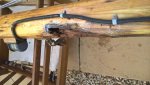
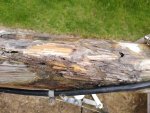
I took the hounds off of the mast, and found that the wood was totally rotten beneath. It's tricky to get a 'good' perspective of this, but at it's deepest point, it went into the wood to about 70mm. The whole length being the size of the hounds, say 200 in length. This is all bad news as I certainly don't have the skills to scarf a repair.
WP_20161012_11_14_30_Pro (1).jpg
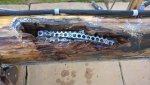
The thought came to me that given the skills shortage, what do I want to achieve here; and that's to replace the rotten wood with good wood. I fitted some perforated stainless that I'd liberated years ago from a diving ship, and screwed that into the excavated hole. The hole had been taken back to good wood, and treated with anti-rot stuff in preparation. The area was left 'rough' to give better adhesion to the glues. The stainless stuff was fitted to give the repair a spine to be built around.
WP_20161012_12_36_20_Pro.jpg
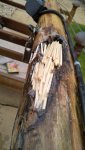
The replacement wood were carefully selected from a box of 'long matches' (heads removed) which were smeared with the glue, Araldite IIRC, and fitted/shoved into the crevice of the hole, getting as much overlap and fill for the wooden bits. Araldite was regularly poured in to ensure no empty voids free of adhesive.
WP_20161016_12_32_39_Pro (1).jpg
From there, it was a question a waiting for the glue to go off, then using a belt sander to profile it back to shape. Once in shape it was liberal coated with varnish, and the hounds refitted.
IMG_20200624_140317094.jpg
OK, it doesn't look award winning, but it has lasted 3 years, and been around Scotland via Orkney, Fair Isle, Shetland & the Western Isles in all of the weather that you'd ever want it to see! Apart from looking tired, it seems still to be very firm, with no cracking or delamination anywhere.
Cowboy or innovative?
 
My first thought was that the lack of tapering at the left side in the pictures meant that it wasn't nearly as strong as it could have been.
Then I realised the square hole was at that part of the damage.
As it worked, it's good enough!

But I think a poor attempt at a scarf would have been, neater, stronger, used less epoxy and been more satisfying.
 
How kind, all responses! As for the aesthetics Wnasworth, the saving grace is that it's hidden under the hounds.
"In the true spirit of PBO" really can mean anything to anyone! Cheers :giggle:
 
Sorry but a damper. I have a thing about bodges. I can understand bodging something if you have to. Out at sea, can’t get the spares, don’t want to ruin a weekend - holiday, have to get home, whatever. What I don’t get is not doing the job properly once the immediate priority is over. Jeez, three years sailing in some pretty dodgy areas with a dodgy mast?
My brother is a serious bodger just like you and I would want him on board for any serious passage for that ability. But I remember entering the Deben in his boat and engine cutting out just on the bar, just as the ebb started running. I got the anchor down, CQR, for those interested ? and he proceeded to fix the fault with, and I kid you not, a paper clip and a blob of chewing gum. Next time aboard several months later and the paper clip and chewing gum were still in use ?. Maybe I’m anal but we are playing about in a dangerous environment so why risk it?
 
Sorry but a damper. I have a thing about bodges. I can understand bodging something if you have to. Out at sea, can’t get the spares, don’t want to ruin a weekend - holiday, have to get home, whatever. What I don’t get is not doing the job properly once the immediate priority is over. Jeez, three years sailing in some pretty dodgy areas with a dodgy mast?
My brother is a serious bodger just like you and I would want him on board for any serious passage for that ability. But I remember entering the Deben in his boat and engine cutting out just on the bar, just as the ebb started running. I got the anchor down, CQR, for those interested ? and he proceeded to fix the fault with, and I kid you not, a paper clip and a blob of chewing gum. Next time aboard several months later and the paper clip and chewing gum were still in use ?. Maybe I’m anal but we are playing about in a dangerous environment so why risk it?
Good points made; but the original post was one stating "Cowboy or Innovator", with good reason and to invite discussion, so thanks for your considered response.
My logic for this was that araldite has enormous strength and resilience. The matches are wood, as is the mast. The matches are tightly packed together, and overlapping wherever possible, with the spaces joining them filled by araldite. I did think long and hard about this and about whether a traditional scarf joint would be stronger, and I'm still not sure that it would, without any figures to support that of course. The S/S stuff screwed in allowed the glue and 'some' matches beneath & around them giving continuity, and as said earlier the adhesion between the repair and the mast won't be worse than a scarf I believe.
A small consideration perhaps, but with the repair made, and having been proven, I believe that I'd have caused further damage to the mast removing this repair and then going into the 'unknown' area of a traditional repair.
Your brother is perhaps a kindred spirit, but as a non-mast maker, I'd really like to see how it's structurally worse than a 'proper'/ traditional repair.
A 2nd thing that interested me are that the hounds on the Folkboat mast have the diamond spreader attached, as well as the upper shrouds; I've not a convenient photo, but I've looked at this often enough and am not sure whether it's the area of most stress, or least stress by only having compression.
Good to see that you use a CQR of course; if it's of any comfort I've one also!
 
Sorry to be a party pooper but all you've done is fill the hole and added almost nothing in strength. The hounds take a major load in a mast and yours is largely supported by some matchsticks glued together.

Good luck.
 
Good points made; but the original post was one stating "Cowboy or Innovator", with good reason and to invite discussion, so thanks for your considered response.
My logic for this was that araldite has enormous strength and resilience. The matches are wood, as is the mast. The matches are tightly packed together, and overlapping wherever possible, with the spaces joining them filled by araldite. I did think long and hard about this and about whether a traditional scarf joint would be stronger, and I'm still not sure that it would, without any figures to support that of course. The S/S stuff screwed in allowed the glue and 'some' matches beneath & around them giving continuity, and as said earlier the adhesion between the repair and the mast won't be worse than a scarf I believe.
A small consideration perhaps, but with the repair made, and having been proven, I believe that I'd have caused further damage to the mast removing this repair and then going into the 'unknown' area of a traditional repair.
Your brother is perhaps a kindred spirit, but as a non-mast maker, I'd really like to see how it's structurally worse than a 'proper'/ traditional repair.
A 2nd thing that interested me are that the hounds on the Folkboat mast have the diamond spreader attached, as well as the upper shrouds; I've not a convenient photo, but I've looked at this often enough and am not sure whether it's the area of most stress, or least stress by only having compression.
Good to see that you use a CQR of course; if it's of any comfort I've one also!
Araldite doesn't have "enormous strength and resilience", it just dries hard and sticks things together well. The whole essence of GRP is that the strength lies in the overlapping weave of the matting whereas the resin just sticks it together. Your "matting" is some softwood sticks, most of which don't overlap, which will snap like firewood when even a small load comes on them. Don't trust your life to this bodge.
 
Catalina 36; interesting that you say those things, then say that the araldite "dries hard & sticks things together well". That's what I wanted it to do. The matches do actually overlap, perhaps the photo's don't illustrate that well enough, and they overlap vertically, not horizontally, as that is how I envisaged the strength requirement to be; following the grain so to speak.
I don't agree that they'll "snap like firewood when even a small load comes on them" as they "stuck together well" to make a larger mass of wood, with a larger area of adhesion to the original mast than they would've had if I'd have had a scarf joint put in. That was the 'philosophy' behind it. I appreciate your warning, but having had 2 years of sailing out of it, and now seeing no deterioration in it, I'm not too concerned about it and did put this post up for it to be 'commented on'. :)
 
I have been known to use epoxy mixed with sawdust on a bed of bits of chipped wood block flooring with a few holes drilled into the rotten bit filled with old stainless screws also drizzled in. See Masterchef.

My concern was not so much the strength of the filler piece more that it stays in the right place. With yours I would be tempted to wrap it in matt also...but if you have a luff groove that becomes problematic.

If you know what you have done and don't forget that you have done it then I see no problem. One day you will find another mast, maybe.
 
It's hard to tell looking at your pics but how sound is the wood you've glued to?
I would guess the point of failure would be where you glue joints the original wood as the edges look to be "weathered" wood.
I can't see the stainless doing anything other than reducing the overall glueable area.
Well done for being brave enough to share your repair.?
 
The only point I might make is that the mast is definitely not as strong as it should be & has to be at risk of coming down sooner or later. The problem then is that if & when it does, if it causes damage to the vessel (not sure what type of boat you have) if you were hoping that insurance would cover your damage & any any other peripheral damage the insurers would definitely not cover any of the costs if they considered the damage a result of preventable intelligence. I do know of one timber vessel that suffered damage through mast failure running into several thousands of pounds but the insurers declined any responsibility for any of the damage due to this exact phrase . At this time the mast might be repairable but will that still be the case if it finally breaks. The best advice I can suggest is treat the repair as a temporary get you back repair & do it properly as soon as. Presumably your boat is a reasonable size given it is fitted with a steaming light
 
I have been known to use epoxy mixed with sawdust on a bed of bits of chipped wood block flooring with a few holes drilled into the rotten bit filled with old stainless screws also drizzled in. See Masterchef.

My concern was not so much the strength of the filler piece more that it stays in the right place. With yours I would be tempted to wrap it in matt also...but if you have a luff groove that becomes problematic.

If you know what you have done and don't forget that you have done it then I see no problem. One day you will find another mast, maybe.
I feel that the s/s pices there add to its ability to remain in place, as it (perhaps) gives a 'rebar' effect.

It's hard to tell looking at your pics but how sound is the wood you've glued to?
I would guess the point of failure would be where you glue joints the original wood as the edges look to be "weathered" wood.
I can't see the stainless doing anything other than reducing the overall glueable area.
Well done for being brave enough to share your repair.?
Cheers, the rotten wood was assiduously removed, and I did feel that all the remaining wood is 'clean'. There is space beneath the s/s stuff where there are matches and glue; the s/s pieces are encapsulated if you like.

A better bodge would to have used longer lengths of wood?
You're right, in hindsight I'd have layered the wood pieces with longer bits further out, though the '1st layer' does have even shorter bits of wood to fit into the specific areas there.
johnlilley: I appreciate your input & expert knowledge here indeed, but am not sure if it can be said that the mast isn't as strong as it should be? Having a 'proper' repair would've been a scarf joint.
Edit: I've just remeasured the repair size and reckon that I've overstated the original depth somewhat, and would say that I've between 70mm & 90mm of 'good wood' remaining. The mast is on a Folkboat.
A few posts ago, I asked whether the hounds are at the point of maximum stress, or are the most supported area of the mast? The upper shrouds attach there, as do the spreaders for the fwd facing diamonds which go to the masthead where the fwd aspect of them counters the force from the backstay. The diamonds are supporting the sideways force on the mast at the hounds as well. To me, the repaired area is in compression, but doesn't have other forces acting on it, as the diamonds and backstay are triangulating against the other loads.
030007cf.jpg
 
You have created an effective filler, but not actually replaced the structure that has been lost. You need something with tensile strength that bridges to the good section of the mast. Wrapping the whole lot in fibreglass would be the best way to do it, though if there is now moisture in the filler (it looks from the image like there are voids) then you might be creating future problems.

If there is ever any tension across this region, e.g. due to mast bend or pumping then the adhesive will eventually fail and the whole lump will fall out.
 
Sorry to be a party pooper but all you've done is fill the hole and added almost nothing in strength. The hounds take a major load in a mast and yours is largely supported by some matchsticks glued together.

Good luck.
I would not like to be below this mast in any sort of weather. I am all for repair and improvisation but that repair looks to be pretty unsatisfactory and probably dangerous under sail. I apologise for appearing to be critical but I think Catalina is absolutely correct and this is not good enough.
 
Top