jamie N
Well-Known Member
I took the hounds off of the mast, and found that the wood was totally rotten beneath. It's tricky to get a 'good' perspective of this, but at it's deepest point, it went into the wood to about 70mm. The whole length being the size of the hounds, say 200 in length. This is all bad news as I certainly don't have the skills to scarf a repair.
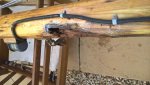
The thought came to me that given the skills shortage, what do I want to achieve here; and that's to replace the rotten wood with good wood. I fitted some perforated stainless that I'd liberated years ago from a diving ship, and screwed that into the excavated hole. The hole had been taken back to good wood, and treated with anti-rot stuff in preparation. The area was left 'rough' to give better adhesion to the glues. The stainless stuff was fitted to give the repair a spine to be built around.
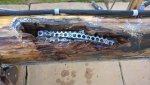
The replacement wood were carefully selected from a box of 'long matches' (heads removed) which were smeared with the glue, Araldite IIRC, and fitted/shoved into the crevice of the hole, getting as much overlap and fill for the wooden bits. Araldite was regularly poured in to ensure no empty voids free of adhesive.
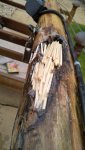
From there, it was a question a waiting for the glue to go off, then using a belt sander to profile it back to shape. Once in shape it was liberal coated with varnish, and the hounds refitted.
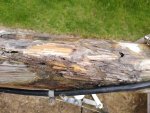
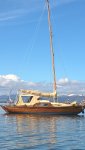
OK, it doesn't look award winning, but it has lasted 3 years, and been around Scotland via Orkney, Fair Isle, Shetland & the Western Isles in all of the weather that you'd ever want it to see! Apart from looking tired, it seems still to be very firm, with no cracking or delamination anywhere.
Cowboy or innovative?
The thought came to me that given the skills shortage, what do I want to achieve here; and that's to replace the rotten wood with good wood. I fitted some perforated stainless that I'd liberated years ago from a diving ship, and screwed that into the excavated hole. The hole had been taken back to good wood, and treated with anti-rot stuff in preparation. The area was left 'rough' to give better adhesion to the glues. The stainless stuff was fitted to give the repair a spine to be built around.
The replacement wood were carefully selected from a box of 'long matches' (heads removed) which were smeared with the glue, Araldite IIRC, and fitted/shoved into the crevice of the hole, getting as much overlap and fill for the wooden bits. Araldite was regularly poured in to ensure no empty voids free of adhesive.
From there, it was a question a waiting for the glue to go off, then using a belt sander to profile it back to shape. Once in shape it was liberal coated with varnish, and the hounds refitted.
OK, it doesn't look award winning, but it has lasted 3 years, and been around Scotland via Orkney, Fair Isle, Shetland & the Western Isles in all of the weather that you'd ever want it to see! Apart from looking tired, it seems still to be very firm, with no cracking or delamination anywhere.
Cowboy or innovative?