Windlass servicing

Thanks guys, this old thread was the best information I've found for servicing my Lofrans windlass (better than the manual, which devotes half the space to this as it does to limitations on the warranty). As my windlass gets a regular dousing, I've used heavy marine grease rather than lithium.
 
Last edited:
Of course you should, and regularly.

It's shocking how many people don't know about their windlass clutch, or use it wrongly. The clutch is a wonderful and important thing. Always makes me facepalm when I see people using the windlass motor to slowly lower their anchor and chain whilst drifting about the anchorage, then having no clue if the anchor has touched ground yet or not.

You use the clutch to let the anchor down at a controllable speed of your choosing (that's why Lofrans gives you a lever that fits on the prongs of the clutch nut - vertical ones often have a winch handle socket for this). When the anchor reaches bottom, it's weight is removed from the equation, so you'll immediately notice this in a slower chain payout speed. You can then wait for the boat to fall back a bit so you don't drop a pile of chain on top of the anchor and foul it. A correctly greased clutch will also protect the windlass from high loads, including the sudden stop when the fully retrieved anchor halts at the bow roller.

It's a quick and simple job to service your clutch cone - on a Lofrans you take off the stopper o-ring, unscrew the pronged nut and the two bolts holding the chain stripper arm. Then you can take off the gypsy and outer clutch cone (the inner can stay on its keyed shaft). Clean the clutch surfaces on both sides (use a scotchbrite if there are any rough spots or corrosion from previous neglect), apply waterproof grease and put it all back together. Takes 10 minutes and your clutch will work properly again. If you don't do this, you'll damage the thing - on mine the key and slot for the inner clutch cone were severely twisted from shock loads (the clutch cone was dry and corroded) and it took hours to get the damn thing off and repair the damage. This does the gearbox no favours either.

Like many, my windlass was also severely neglected when I got the boat, and judging by the SVB sticker on it had already been replaced at least once, probably at great cost and shipping fees. Part of the problem is a widely known issue with the rubber "moat" Lofrans designed that keeps a puddle around the base, leading to severe corrosion until the thing just snaps off. The simple solution is to cut the moat down and make a sealant bevel, so water runs out. I had to rebuild the base first, and painted the thing where the anodizing was gone to prevent further corrosion. Also of course the oil change was well overdue, and the seal protecting the rear housing with the motor had failed. Surprisingly the gearbox and oil seals were okay, given the abuse it had suffered.

All fixed now, and I feel much happier anchoring in the knowledge that this important bit of kit won't randomly fail, or suddenly hop off the boat while breaking out the anchor.

Picking up on part of this old thread. I have the Lofrans Kobra. The 'pronged' nut undoes, but the gypsy will not come off the shaft. I can't see how I could get a puller into the space. Is it wise to use a lever, or failing that heat?
 
As to the question of how often we service them. Not often enough I’m sure. I knew I had not done it for years. Disaster. A total gear box replacement was needed for the sake of an oil seal had I been lucky to catch it in time. I also pulled apart the box and found a damaged main gear, so that’s another thing to check and to remove the chain annually and move it and rotate the gearbox so the main gear gets loaded on different teeth each year. The biggest load probably being imparted on pulling the anchor up to its limit, which of course we shouldn’t do, but often actually do.

And don’t forget to pull the motor off, strip, change brushes, maybe bearings, clean contacts, de-corrode and paint.
 
Probably twisted key resulting from unserviced clutch. Might be worth unbolting the windlass to get a puller on. If it had the "moat" installed, it's worth inspecting the base anyways. Snatching it in reverse might losen it if you don't want to unbolt.
 
Probably twisted key resulting from unserviced clutch. Might be worth unbolting the windlass to get a puller on. If it had the "moat" installed, it's worth inspecting the base anyways. Snatching it in reverse might losen it if you don't want to unbolt.
Windlass appear to be installed by individuals with the dexterity of a monkey. Often when you come to service the only solution is to unbolt the whole thing - and then service at leisure and comfort. Unbolting should be easy (but sometimes is not because of seized bolts) and is best programmed for a warm sunny day.

Just remember to have the Tufgel or whatever to coat the stainless bolts when you reassemble.

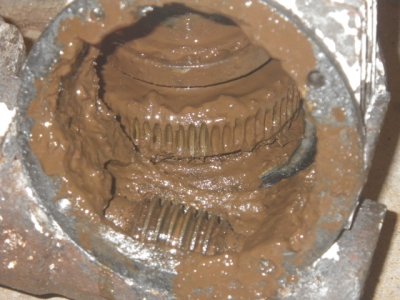
This what the interior looks like of an unserviced windlass. It actually worked well considering and apparently lubricated with salt water, mud and the products of corrosion. Unfortunately to get it to this level of dis-assembly needed the support of an angle grinder to remove the corroded stainless nuts and the windlass was condemned.

A credit to windlass makers - they do seem to work surprisingly well (until they don't) despite the lack of attention.

IMGP4771.jpeg

Its worth dis-assembling your windlass just to coat the stainless with Duralac, etc - and then servicing is much easier.


Jonathan
 
We grease our cone on the Lofrans Falkon. No issue of controlling the speed of the anchor drop. Mine came greased when I replaced it 10 years ago so I keep it greased.
We have a sight glass for the oil that looks very clean after 10 years. No intentions of changing it. My cars differential works a lot harder, and doesn't get new oil for ever. We do have a cover for the windlass that gets fitted before upwind sails. It helps keep the salt off and stops some water going down the hawse pipe. We never load the windlass when power setting. We fit the snubber first, then power set.
 
Picking up on part of this old thread. I have the Lofrans Kobra. The 'pronged' nut undoes, but the gypsy will not come off the shaft. I can't see how I could get a puller into the space. Is it wise to use a lever, or failing that heat?
Same with mine. The key is a tight fit. I got my gypsy off with a lever and a bit of sloshing, but a puller would have been more sensible. The inner cone was even harder to remove (for access to the gasket). I've now ground the key down slightly.
 
  • Like
Reactions: Aja
Don’t know if there’s a difference here, hidden in what we mean by the ‘cone’?

Here’s the manual of the windlass in question. Quick Spa, leader internazionale nella produzione di accessori nautici. Page 17 says:

Clean all the parts removed to avoid corrosion, and grease the shaft thread (13 or 15) and the gypsy (6) where the clutch cones rest (4 and 7) (use grease suitable for marine environment).​

If you also grease the diagonal surface of the cone you are lubricating the very thing that stops your anchor chain slipping. Greasing it would be like greasing the brake pads on your car.

I suspect we’re all actually meaning the same thing, that yes, you should grease the flat surfaces between gypsy and cones so when you open the clutch and the anchor’s falling you don’t have metal abrading on metal, but that you should NOT grease the cone’s conical section which is the very thing that’s providing friction when you close the clutch. Right?

mmmmm ever serviced a 'wet clutch' ? One that sits in oil bath ?

Many motorcycles and other machinery have oil bath wet clutches ..... they seem to hold / release fully without problem ...

What about the cones in some mariner gearboxes ?
 
Just replaced one of my engine gearbox clutches which suffers from lack of oil. I didn't realise that the cones run in oil all the time.
 
Top