Why mild steel fuel tanks?

I think it's the sulphur that reacts with the zinc.Probably with the help of water sloshing under the diesel.

I wonder if that's why I've not had a problem? I use very little fuel so I've always used "white" road diesel - which will be ultra-low sulphur these days. Either that, I guess, or maybe the tank is only galvanised on the outside. (I've never seen inside it).
 
Not sure what the problem is but it applies to gasoline also. When cars were fitted with steel petrol tanks it was lead coated, known as Terne Plate. The sheet metal plant at Shotton had a terne plate line.

I worked for a small car manufacturer who used to make petrol tanks out of a product called "Zintec"

http://www.themetalstore.co.uk/products/zintec-sheet

but I think electroplated zinc behaves differently to hot dip galvanised?
 
Drain the water from the tanks on a regular basis and remove numerous problems. My mild steel tanks are over 30 years old. Mind you I made them with proper 18 inch access hatches making cleaning easy. Not something a 'professional' builder would worry about.
 
Drain the water from the tanks on a regular basis and remove numerous problems. My mild steel tanks are over 30 years old. Mind you I made them with proper 18 inch access hatches making cleaning easy. Not something a 'professional' builder would worry about.
You can say that again!
 
I may have got this all wrong, and surely vyv-cox will correct me, but isn't crevice corrosion an issue with stainless, such that a small amount of water isolated from air at the bottom of the tank could cause corrosion in a tiny crevice? Also, doesn't it have worse fatigue characteristics than mild steel (an issue where there are large unsupported panels ending at right angled edges)? I replaced a mild steel tank that had rusted through with a mild steel like-for-like replacement, and expect it to see me out, as the previous tank had lasted about 25 years!
 
Well mine are almost 40 years old and still well painted on outside and I assume clean on the inside as they are full of diesel.
 
I may have got this all wrong, and surely vyv-cox will correct me, but isn't crevice corrosion an issue with stainless, such that a small amount of water isolated from air at the bottom of the tank could cause corrosion in a tiny crevice? Also, doesn't it have worse fatigue characteristics than mild steel (an issue where there are large unsupported panels ending at right angled edges)? I replaced a mild steel tank that had rusted through with a mild steel like-for-like replacement, and expect it to see me out, as the previous tank had lasted about 25 years!

Crevice corrosion is certainly an issue with stainless steel but by definition there needs to be a crevice for it to occur. A corner of a welded tank is insufficient, there needs to be a situation that promotes different levels of aeration within the same electrolyte, e.g a bolted joint underwater. Examples and a whole page on my website.

The fatigue characteristics of mild steel and 300 series stainless steel are almost identical. The yield point of 304/316 is only 50% of the UTS whereas for mild steel it is considerably higher but I see no reason why this should be important. The overwhelming reason for using mild steel in preference is cost, far more of an issue 20-40 years ago than it is today.

As has been suggested, and as ever with corrosion, keep the water out and all will be well. A regularly drained mild steel tank will last indefinitely. I know of steel storage tanks for a whole variety of hydrocarbons that are over 50 years old, some a lot more. They are inspected and drained regularly.
 
Westery& Moody boats were fitted with painted steel fuel tanks and most are still serviceable even after 30 years if looked after. If i had to replace mine I would still go with painted steel as it would certainly outlive my ownership so cannot see any reason to spend considerable more on S/S or plastic.
My Moody had a leaking steel tank when I got it 10 yrs ago - in the past had had some 'epoxy?' poured in to fix it. I had to cut up the tank into 3 pieces to remove it and replaced with a plastic 19gall tank, approximately half the original capacity but perfectly adequate. Apparently the only way to remove tha tank in one piece was remove the engine and lift out through the engine hatch.....!
 
I removed mine from my Westerly Storm the year after I bought it.
It was easy to get out, so I took it home. The outside had a few rust spots on it, but there was no way of knowing what the interior was like, so I decided to cut a hole in it.
Initially it was going to be a six inch square in the middle, then bang!..... my jigsaw hit the baffler that braces the centre.
This meant I had to have a hole either side of the baffler in order to be able to see, and get in, to clean the tank. The inside was totally devoid of any rust or pitting, so just a good clean with swarfega and boiling water.
An inspection cover was made out of mild steel, and the tank put back, four years on and all seems okay.
 
When I worked at the shipyard we were making new "state of the art" modern trawlers diesel tanks=mild steel
fresh water tanks=mild steel with [special paint coating inside]
diesel is light oil so shouldn't rust...so I would paint them very well on the outside before fitting.
Ours are built into the steel hull using the outside plating as the outside of the tank.
 
Having a steel hull boat I don't see to much of a problem providing proper design and maintenance. I do have mild steel diesel tanks integral with the hull with proper drain taps at the lowest point to the tank.

I also have the fillers in a raised position in the cockpit protected from any rain or spray, as are the vents.
I also have capacitive fuel depth gauge/sender. This will show an over full reading if any water contacts the ends of the capacitive sender. I also have a water testing paste that can be applied to the end of my dip stick to show if there is any water in the bottom of the tank.

The water testing paste as used by most petrol stations in SA IMHO should be used by all boaters.
http://www.amazon.co.uk/Water-Finding-Detects-harmful-Heating/dp/B00NU6C036

One of the other problems with corrosion of mild steel tanks is the way the base is supported which allows pools of water or dampness on the bottom plate or the welded joints around the bottom plate. The same can also apply to the bottom of stainless steel tanks allowing water/dampness to contact the steel thus promoting corrosion.

Lets not forget nearly all commercial shipping use steel in their construction where in some cases proper maintenance can be questionable.

And for the guy who said mild steel should never be used on any boat have a look at this and how would a GRP boat look.

18059d1199668116-steel-yacht-construction-steelhull.jpg


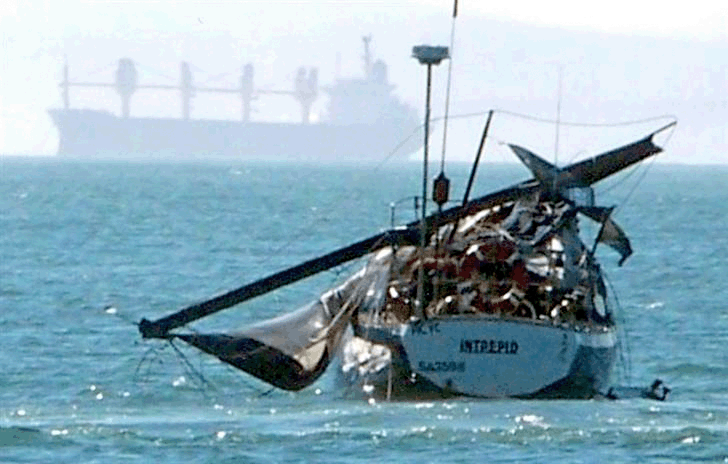
And the steel boat that survived after a whale breach onto it just off Cape Town.

intrepid_smashed.gif
 
Last edited by a moderator:
Westerly had them.Mine is still in place but I'm preparing myself for the worst.It can be taken out more or less easily but it's a task I'm not looking forward to.

Each tank material has its own good and bad points (cost, maintenance, weight, etc) but there is one material not mentioned so far and that is Aluminium. Obviously is has to be of the correct grade to avoid corrosion. The aluminium tank on my Beneteau is 15 years old, no coatings, maintenance free and in perfect condition.

Colin. Www.solocoastalsailing.co.uk
 
Westerly had them.Mine is still in place but I'm preparing myself for the worst.It can be taken out more or less easily but it's a task I'm not looking forward to.

Read post #29.
I removed mine from my Storm and was pleasantly surprised by how good the interior was.
 
Mine is 40 years old. When I bought the boat in 1992 I looked at the rust and thought: 'I'll need to be replacing that'. I got the original spec from the builders, 5mm steel, 1000 litres. However there is a drain off under the sump, a pipe bend with bung, nicely located down amongst the bilge water which may not be so robust. I suppose it depends on t.he quality of the welding. I carry spare fuel in cans which I can jury rig, but I imagine if it leaks it will start slowly, and I have lined up Tek tank replacements, about £600 for 2 x 500litres. I could get it out and have it shot blasted and painted, 2x primer and two pot epoxy finish, but the cost would be about the same.

Edit: I should have included zinc spray. Best for fuel tanks, unlike hot dip galvo. £64 a sq metre two years ago.
 
Last edited:
Crevice corrosion is certainly an issue with stainless steel but by definition there needs to be a crevice for it to occur. A corner of a welded tank is insufficient, there needs to be a situation that promotes different levels of aeration within the same electrolyte, e.g a bolted joint underwater. Examples and a whole page on my website.

The fatigue characteristics of mild steel and 300 series stainless steel are almost identical. The yield point of 304/316 is only 50% of the UTS whereas for mild steel it is considerably higher but I see no reason why this should be important. The overwhelming reason for using mild steel in preference is cost, far more of an issue 20-40 years ago than it is today.

As has been suggested, and as ever with corrosion, keep the water out and all will be well. A regularly drained mild steel tank will last indefinitely. I know of steel storage tanks for a whole variety of hydrocarbons that are over 50 years old, some a lot more. They are inspected and drained regularly.

Vyv, you remember my tank - Mild steel 20 years old. Corrosion thinned the bottom so much that it seeped out all over the bottom. Westerly provided a tin can shaped sump, but cleverly provided no tap! I suspect if it had, and I had drained down regularly, it would still be perfect.

The new tank is great, but I would not want any old stainless welder to make it - it is essential that the welding is top quality.

So if you have a mild steel tank, and you have no easy means to draw aff from the sump, then you may well face the worst at some point. Luckily the Oceanlord tank came out in one piece - just....
 
errrmmm, we were talking about fuel tanks...but anyway, I agree that a mild steel fuel tank would withstand a whale or ship impact better than, say a plastic one.

Yes I know we are talking about fuel tanks but it was your comment " Mild steel anything on a boat is stupid! " is what I was referring too.

Correctly designed and protected mild steel fuel tanks will last a very long time. IMHO the main problem is the outside of the bottom of the tank sitting on damp/wet supports and stopping water entering the tank and testing for water inside the tank.
 

Other threads that may be of interest

Top